
Trolley anti-slip deck Hong Kong — An anti-slip deck may reduce sliding when the deck and load surfaces remain compatible and clean. Bumpers address contact at exposed edges rather than load stability, so buyers should assess likely collision points and verify product-specific materials and care instructions.
Trolley anti-slip deck Hong Kong — Identify when deck friction can help limit load movement
Buyers should start by deciding whether added friction genuinely reduces foreseeable load movement along your routes. If you are evaluating a trolley anti-slip deck Hong Kong, consider that friction works best when the load has a broad, rigid, relatively clean base (such as plastic crates, bakery trays or flight cases) and when the deck provides a compatible contact surface. Observe typical accelerations and decelerations during manual handling, the speed at which staff take corners, and where abrupt stops occur. Note any ramps, threshold strips, lift entrances, changes in flooring and outdoor-to-indoor transitions that may bring moisture or grit onto wheels and decks.
Build a short evidence file before specifying upgrades. Photograph recurring load shifts, mark the trolley deck where items start to slide, and record the base materials in use. Request a small sample of the proposed deck surface to trial against your common load bases on-site. Compare friction improvements with alternative controls such as side rails, containerised loads, strapping, or revised handling practices. Where loads are top-heavy, fragile, on soft packaging, or partially supported, prioritise positive restraint over surface grip. Include route constraints (doorway and goods-lift clear openings, turning space, kerb cuts) in your enquiry so suppliers can confirm whether a friction deck alone is appropriate or must be combined with other retention features in the formal quotation.
Trolley anti-slip deck Hong Kong — Check deck material, contamination and cleaning effects
Deck grip depends on the surface material, how it is bonded or fixed, and how real-world contamination changes its behaviour. Ask suppliers to identify the exact deck material (for example, textured plywood, bonded rubber, resin-laminate or GRP) and provide the manufacturer’s guidance on wet performance, resistance to oils and detergents, and recommended cleaning methods. In Hong Kong’s humid conditions, residues from mopping, disinfectants or floor polish can create a film that reduces friction. Likewise, fine dust from nearby renovation works and car-park grit can undermine grip until properly removed.
Build cleaning and inspection into procurement. Request a bilingual care sheet that names approved cleaners, dilution ranges and drying steps; confirm how the surface should be restored after spills of cooking oil, solvents or cutting fluids relevant to your site. Ask for an offcut or swatch to test under your typical loads and footwear. Clarify how the deck is edge-sealed to limit moisture ingress, and whether fasteners are recessed or flush to avoid snag points. Where grip tape or overlays are proposed, seek the re-application method, minimum cure time between coats (as an example starting point only), and any substrate preparation required; the model specification and written quotation should prevail.
What should buyers compare for trolley anti-slip deck Hong Kong?
| Criterion | Straightforward requirement | More complex requirement | Evidence to provide |
|---|---|---|---|
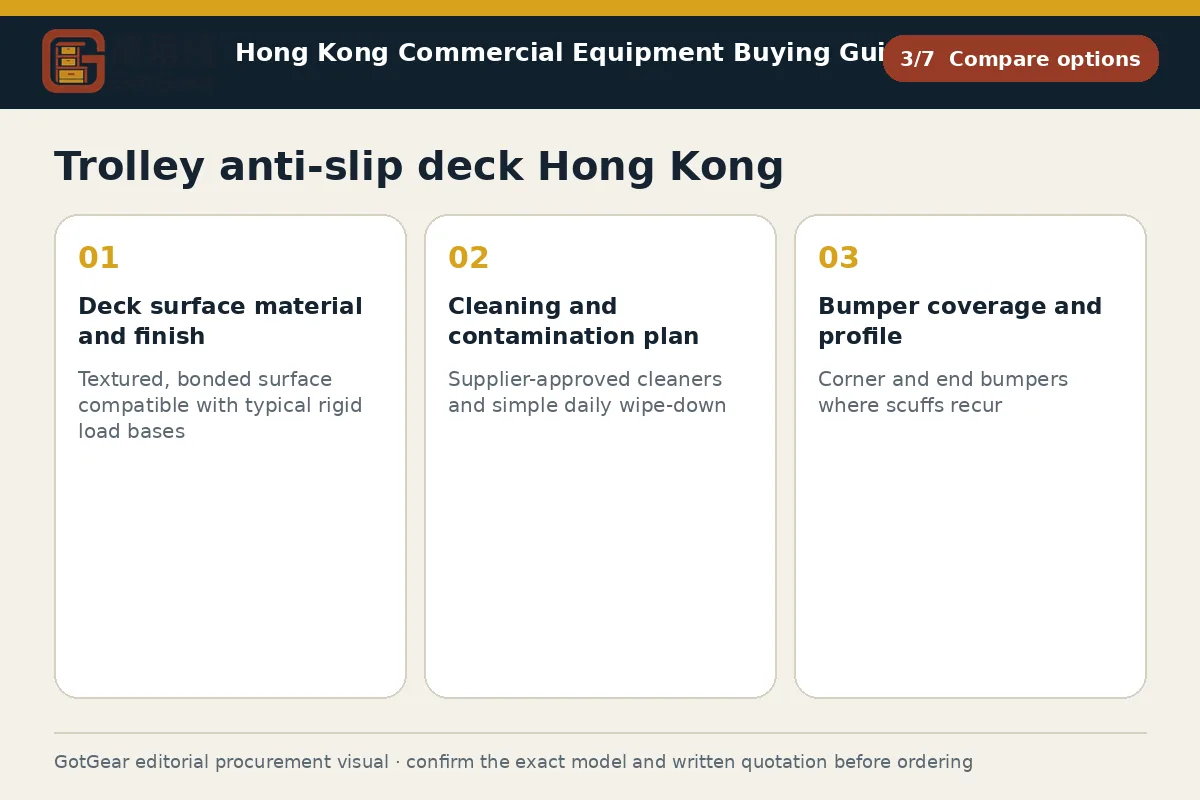
| Deck surface material and finish | Textured, bonded surface compatible with typical rigid load bases | Specified compound with documented wet/oily performance and edge sealing | Material datasheet, sample swatch, note of base materials to be carried |
| Cleaning and contamination plan | Supplier-approved cleaners and simple daily wipe-down | Site-specific method covering spills (oils, solvents), humidity and drying steps | Bilingual care sheet, list of in-use chemicals, cleaning frequency in operations note |
| Bumper coverage and profile | Corner and end bumpers where scuffs recur | Route-mapped coverage with low-profile sides and non-marking compound | Annotated route photos, drawing with installed overall width and heights |
| Route clearance and lift fit | No increase beyond current width and height limits | Turn-envelope verification in tight lifts, door frames and racking aisles | Measured openings, turning sketches, confirmation email from building manager |
| Verification and aftercare | Basic visual inspection on receipt | Documented torque/adhesive checks, spare-parts and replacement method | Delivery inspection record, signed drawing, parts list and warranty statement from supplier |
This framework helps buyers create comparable written enquiries. Final model specifications, availability, delivery and commercial terms must be confirmed in a formal quotation.
Trolley anti-slip deck Hong Kong — Trolley bumper protection Hong Kong: Distinguish load retention from impact protection
Grip reduces sliding; bumpers address contact. Treat them as distinct controls. When comparing options for trolley bumper protection Hong Kong, identify the surfaces you most frequently touch: lift jambs, doorway frames, rack uprights, pallet corners and vehicle thresholds. Bumpers help protect both the trolley and the structure at those edges, but they do not stop a top-heavy or loosely stacked load from shifting. For true retention, review side containment, straps, bins, or lids alongside guidance on trolley load securing Hong Kong.
Procure bumpers by mapping collision points on your actual routes. Specify bumper material (e.g., rubber, TPU or UHMW-PE), coverage (corners, sides, end panels), profile depth, replacement method and whether colour-contrast is required for visibility in public venues. Ask for a dimensioned drawing showing overall width and turning envelopes with bumpers installed, and confirm that profiles will not interfere with lift door sensors or narrow aisles typical of local industrial buildings. For fragile items, such as those moved on a glass trolley Hong Kong, buyers often request soft, non-marking interfaces and separate edge guards. Check that bumper fixings do not introduce snag hazards for garments, film wrap or cables, and request a spare-parts list for ongoing maintenance.
Trolley anti-slip deck Hong Kong — Position bumpers for likely contact without hiding clearance risks
Positioning matters: bumpers should meet the likely contact first, yet never obscure clearance risks. Walk the full route with a sample trolley or cardboard mock-up to observe scuff marks on walls, frames and fixtures, then mark bumper zones at the true impact height. Keep sightlines to wheel edges and toe space visible so staff can still judge gaps at lifts, thresholds and racking legs. Avoid covering inspection labels or safety signage, and ensure bumpers do not mask damage developing in structural members.
Translate observations into specifications. Provide annotated photos of collision points and note door and lift openings, turning radii and slope changes. State whether adhesives, concealed fasteners or through-bolts are acceptable, and where building-management approvals or quiet-hours works are needed. Request drawings that show bumper stand-off from the deck and confirmation that lower edges clear floor irregularities referenced in your material handling floor condition checklist Hong Kong. On delivery, check mounting security, compression set and uniform finish using the trolley inspection checklist Hong Kong. Document any deviations from the signed drawing; the model specification and formal quotation should prevail when resolving differences.
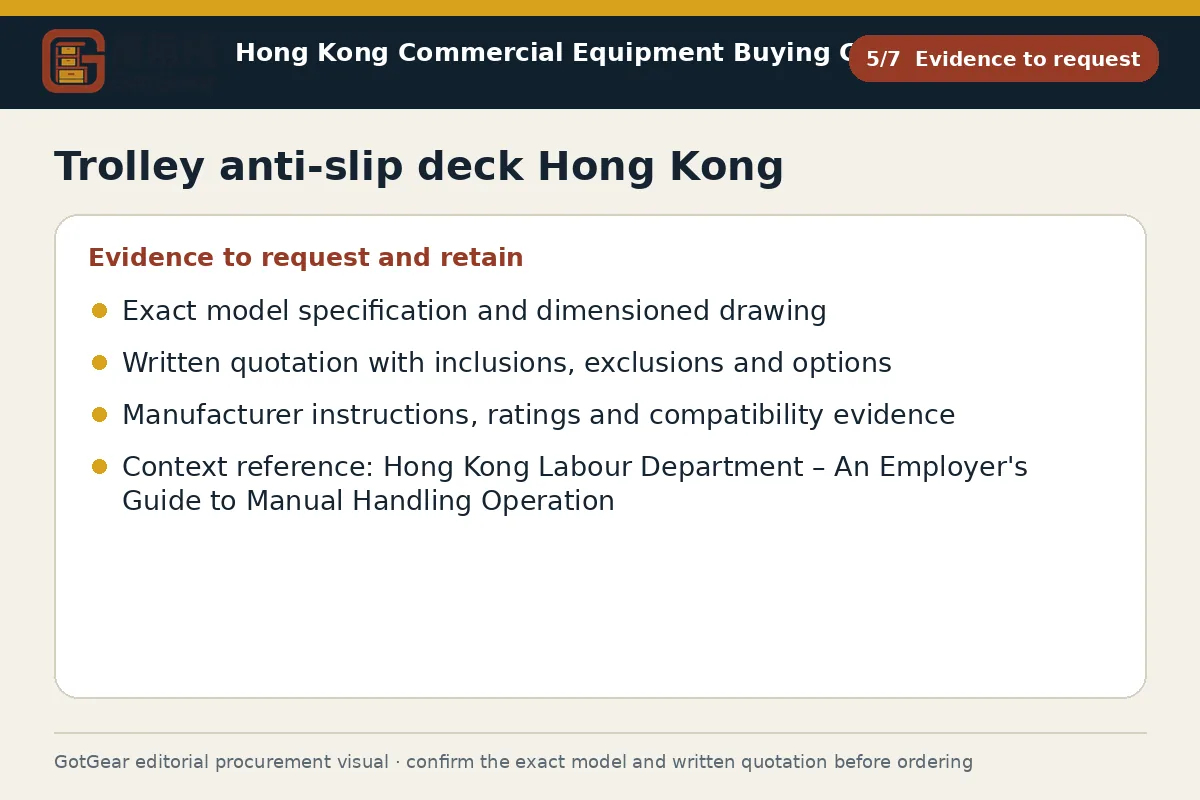
Trolley anti-slip deck Hong Kong decision checklist
Confirm your typical loads have firm, compatible bases and document where movement occurs along real routes. Measure clear openings and turning spaces, record ramps and thresholds, and capture annotated photos of scuff-prone areas. Ask for material datasheets, bilingual cleaning instructions, and a small deck sample for site testing. Specify bumper materials, coverage and profiles based on mapped collision points, and request a signed drawing that includes overall width with bumpers. Compare quotations on deck material, fixing method, bumper design, cleaning guidance and spare-parts support. On receipt, inspect deck flatness, bond integrity, sealed edges, flush fasteners, bumper security and finish; file product codes and care sheets. Where building-management approval or public-venue controls apply, arrange written confirmation before deployment; the model specification and formal quotation prevail.
- Operating use, quantity and expected frequency
- Dimensions, capacity, material and accessory requirements
- Delivery address, floor, goods lift and loading window
- Required documents, acceptance checks and after-sales arrangements
Key points for trolley anti-slip deck Hong Kong, trolley bumper protection Hong Kong
In Hong Kong, the most frequent constraint is tight access: goods-lift cars, corridor pinch points and door frames often leave minimal clearance, so deck surfaces and bumpers must be selected and placed without widening the trolley beyond workable limits. Humidity, frequent mopping and disinfectant use can alter grip in real service, so cleaning compatibility and drying steps should be confirmed with the supplier. Many buildings require management-office approval for modifications and scheduled deliveries within loading windows; obtain bilingual documentation where frontline teams and supervisors differ in language preference. This guidance is practical, not legal advice—verify venue-specific requirements with your building manager, insurer, manufacturer or competent adviser.
Questions about trolley anti-slip deck Hong Kong
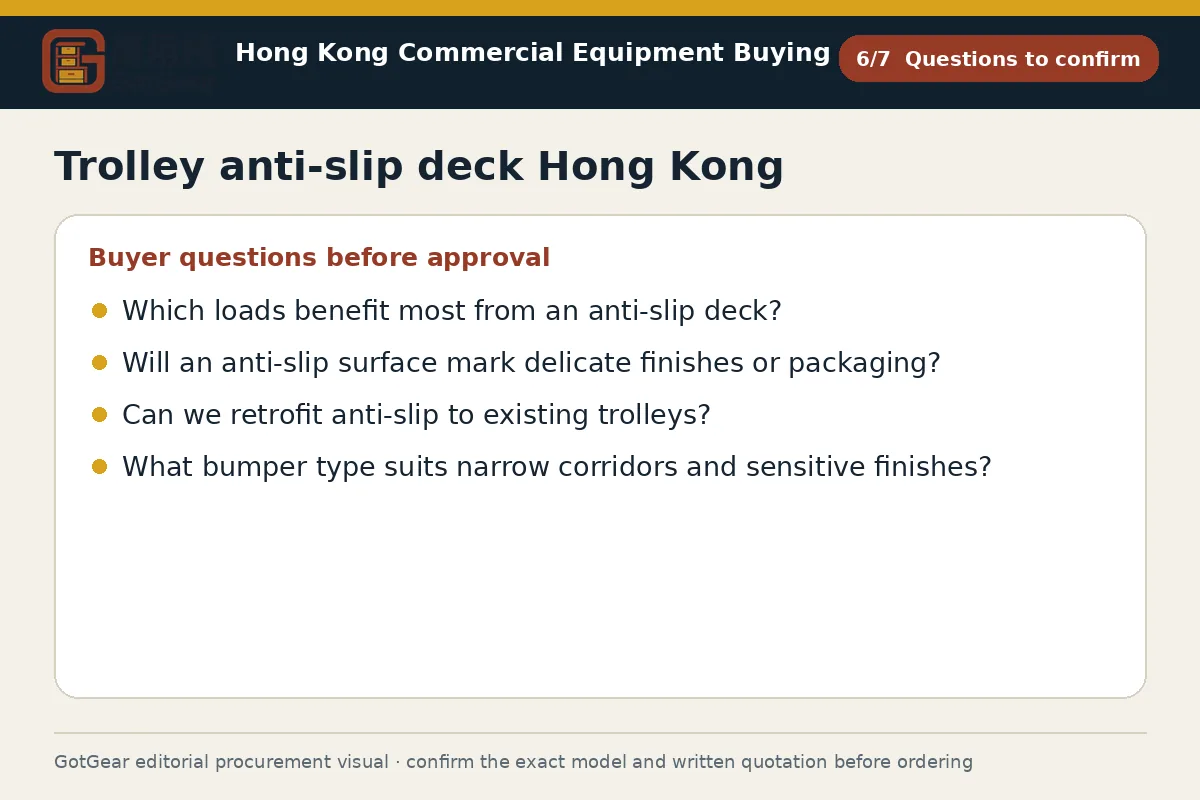
Which loads benefit most from an anti-slip deck?
Rigid, flat-bottomed items such as crates, totes, instrument cases or catering trays typically gain the most from added deck friction. Soft, uneven or highly compressible bases are less predictable and may still shift. If the centre of gravity is high or the route includes abrupt stops, combine grip with positive restraint. Always confirm suitability with the supplier and through on-site trials.
Will an anti-slip surface mark delicate finishes or packaging?
It can, depending on the deck compound and the load material or printing inks. Request the deck material datasheet and a small sample, then perform a clean, dry contact test with your packaging. If any transfer or dulling appears, consider a non-marking surface or a sacrificial liner. Confirm cleaning agents used on-site do not react with either surface before rollout.
Can we retrofit anti-slip to existing trolleys?
Often yes, using bonded overlays, bolted panels or drop-in mats sized to your deck. Check deck condition, allowable fasteners, weight impact and clearance in lifts and doorways. Where hygiene or flame-retardant properties may be required, seek model-specific documentation. Ask for installation guidance, curing or settling times as example starting points, and verify on-site with management approval.
What bumper type suits narrow corridors and sensitive finishes?
Low-profile, energy-absorbing bumpers placed at true impact heights reduce scuffs while keeping width in check. Non-marking compounds help in hospitals, schools and retail. Request a dimensioned drawing with turning envelopes, and confirm compatibility with lift sensors and skirting profiles. Always verify choices with building management and the written quotation; final model specifications govern supply.
Continue with closely related procurement topics
These pages share equipment, operating or decision-stage signals with this guide.
Trolley inspection checklist Hong Kong
GotGear’s trolley inspection checklist Hong Kong and trolley preventive maintenance Hong Kong explain how to inspect wheels and brakes, log defects and schedule servicing under maker guidance.
Read the guide
Trolley load securing Hong Kong
GotGear provides guidance on trolley load securing Hong Kong, explaining how to check the centre of gravity, identify restraint points and compare straps, rails and clamps. It also covers trolley load stability Hong Kong.
Read the guide
Trolley traffic management Hong Kong
GotGear explains trolley traffic management Hong Kong, trolley route assessment Hong Kong and trolley parking safety Hong Kong for mapped pedestrian, vehicle and parking controls.
Read the guide
Trolley turning radius Hong Kong
For trolley turning radius Hong Kong, check the wheelbase and load overhang, and measure the swept path with GotGear. This applies to narrow aisle material handling Hong Kong and small warehouse material handling Hong Kong.
Read the guideRelated topic indexOpen more English procurement pages1 topics
Browse additional equipment families, applications and procurement questions relevant to a wider buying brief.