
For temporary event canopy emergency exit layout Hong Kong, mark the venue-approved exits and connecting paths, keep them continuously clear and provide signs or communications where the venue requires them. Verify manufacturer instructions, actual site conditions and applicable Hong Kong requirements, and escalate any conflict or proposed route change to the venue or event safety lead before proceeding.
Venue-approved routes in temporary event canopy emergency exit layout Hong Kong
Begin with what is already authorised. Obtain the venue’s written evacuation plan, the approved event overlay and any route notes from the event safety lead. When planning a temporary event canopy emergency exit layout Hong Kong, map your proposed canopies, counters, ballast and cable runs onto that route and walk it on site. Measure the clear width between hard intrusions (canopy legs, guyline anchors, barriers) and the clear height beneath any banners. Example starting points such as 1.2 m clear width and 2.1 m clear height are only illustrations; confirm the figures in writing with the venue or competent adviser before committing.
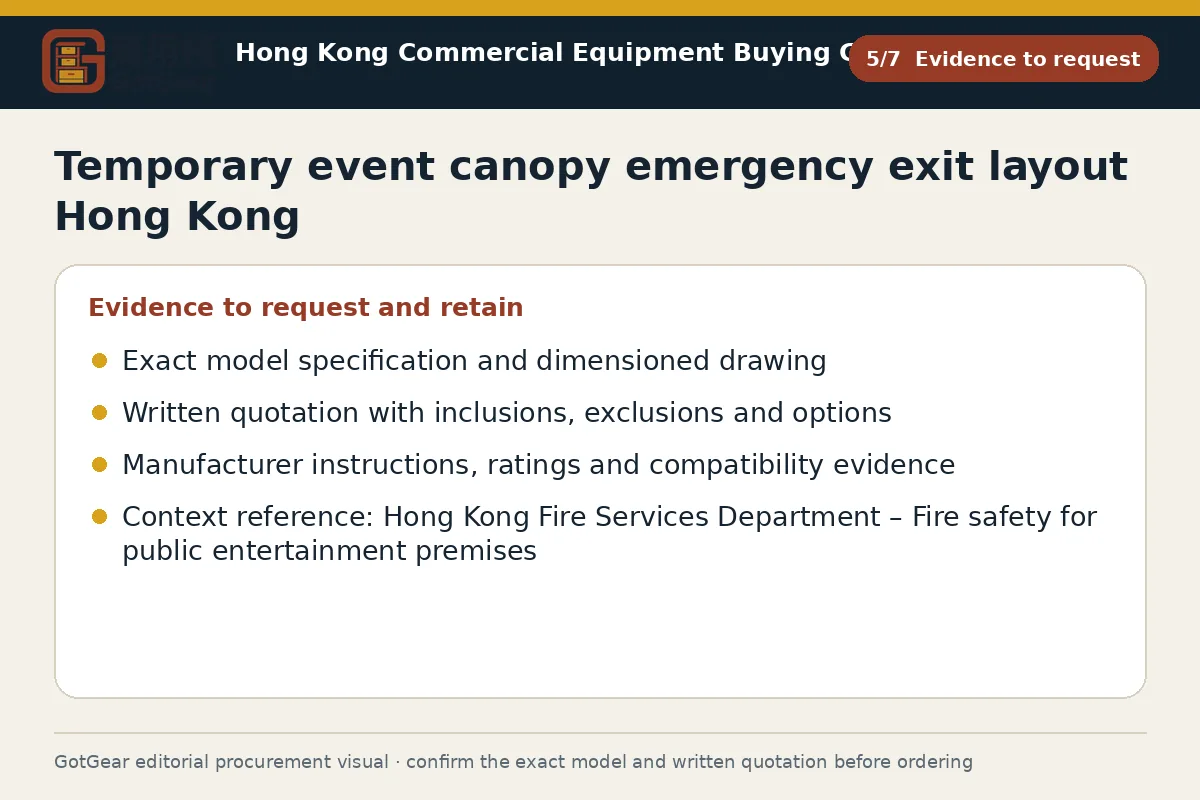
Request precise specifications from canopy suppliers for comparison: external footprint including eave overhang, baseplate dimensions, leg pitch, sidewall opening sizes and positions, and recommended anchoring zone around the frame. Ask for assembly drawings, fire-retardancy statement (where applicable) and any advisory on emergency exits in the manufacturer’s instructions. Record site constraints: goods-lift car and door sizes, turning space, floor load warnings, wind exposure and any shared escape corridors. Compare written quotations line by line against the approved route, highlighting any proposed sidewall doors, ballast locations or cable penetrations that sit within the marked path. On delivery, verify the frame footprint, baseplates and sidewall configuration against the quotation and drawings before layout begins.
Visitor flow and signs for temporary event canopy emergency exit layout Hong Kong
Plan visitor flow so that the exit path remains intuitive without steward prompts in normal conditions. Keep queues, merchandise rails and tasting points fully outside the marked route and its sightlines. Where queues must run near the path, use low-profile barriers to create a parallel channel and leave a measured buffer to the exit line; as an example starting point, confirm whether 0.5–1.0 m of buffer is acceptable with the venue. For deeper guidance on queuing geometry, see outdoor concession canopy queue layout Hong Kong.
Order signage and communication items to match the venue’s instructions. Specify bilingual Traditional Chinese/English exit arrows, colour scheme consistent with house signage, and weather-suitable materials (e.g., rigid plastic or coated board for humidity). Where the venue asks for illumination or reflectivity, request data on luminance or reflective grade from the supplier, plus mounting method and strap length that can survive wind. Walk the route at visitor eye level to mark sign positions, ensuring arrows are visible above head height yet not snagging canopies. If the safety lead mandates announcements or stewarding at peak times, build that into your staff plan and radio channel allocation.
What should buyers compare for temporary event canopy emergency exit layout Hong Kong?
| Criterion | Straightforward requirement | More complex requirement | Evidence to provide |
|---|---|---|---|
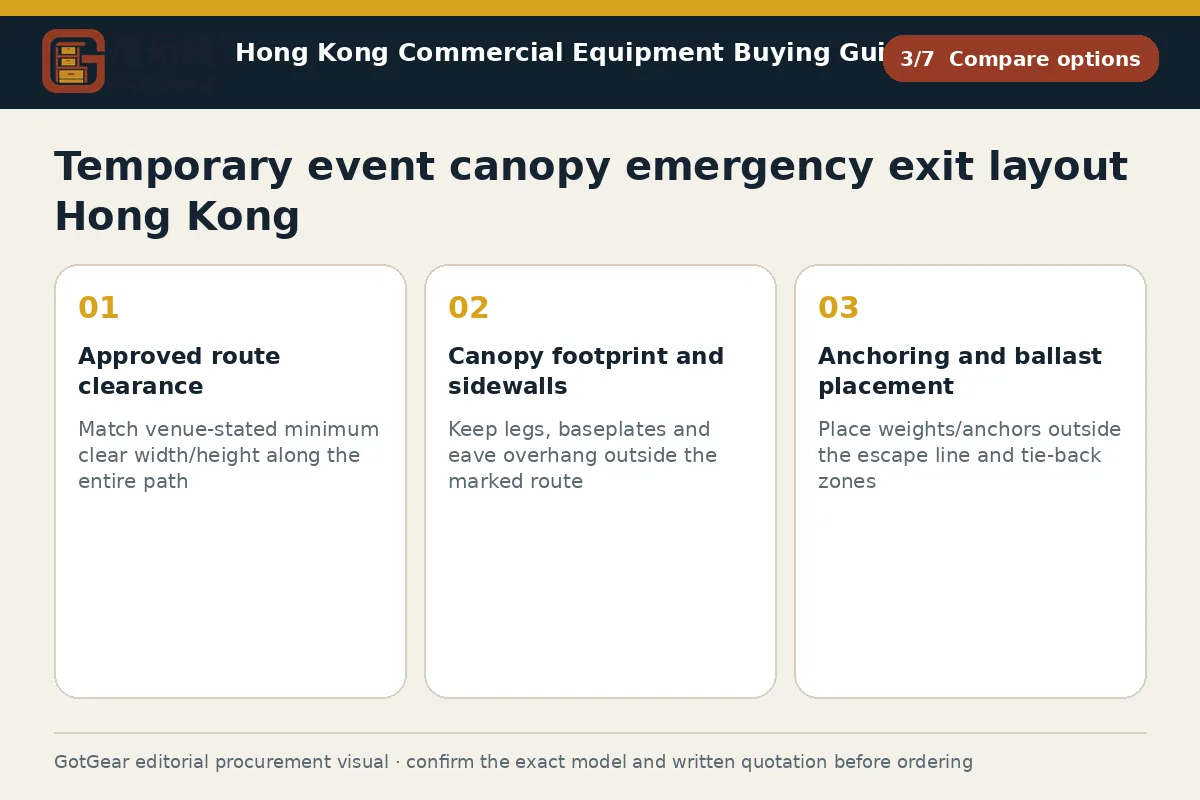
| Approved route clearance | Match venue-stated minimum clear width/height along the entire path | Account for variable widths at corners and shared corridors with stewarding triggers | Plan markup with measured widths/heights and time-stamped photos for venue sign-off |
| Canopy footprint and sidewalls | Keep legs, baseplates and eave overhang outside the marked route | Use sidewalls with door panels/clear windows located away from the path | Manufacturer drawing showing footprint, baseplate size and sidewall opening dimensions |
| Anchoring and ballast placement | Place weights/anchors outside the escape line and tie-back zones | Adopt low-profile weights or permitted ground anchors if space is tight | Anchoring plan with dimensions and venue/building manager confirmation |
| Exit signage and visibility | Provide bilingual arrows visible from typical eye level | Illuminated or reflective signs with defined mounting heights if the venue requests them | Sign schedule with sizes, mounting method, locations and sample images |
| Cables and trip control | No cable or mat crosses the approved path | If crossing is unavoidable, use rated cable ramp and steward monitoring at peaks | Ramp specification, load guidance and location sketch with venue approval |
This framework helps buyers create comparable written enquiries. Final model specifications, availability, delivery and commercial terms must be confirmed in a formal quotation.
Keeping paths clear in temporary event canopy emergency exit layout Hong Kong
Keeping routes clear is a daily discipline, not a one-off exercise. Position ballast, guy ropes and brace bars outside the marked path; if they must be close, verify the measured clearance on site and document it with photographs. Select low-profile base weights where approved by the venue. Manage spillover stock, rubbish bags and water containers in defined back-of-house zones, not in corners of an exit corridor that may appear spare to busy staff. Refer to the folding tent anchoring checklist for Hong Kong when comparing anchoring options against space constraints.
Procure cable ramps, matting and tie-off hardware before build day. Ask suppliers for ramp dimensions, load-rating information and a description of slip resistance, and confirm they fit under your canopy legs without encroaching on the route. In Hong Kong's humidity, choose tapes and ties specified for damp conditions and request the manufacturer's advisory on dwell time and surface preparation. On receipt, inspect ramps for straightness, hinge condition and end caps; check sidewalls for intact roll-up ties so exits can be pinned open without flapping into the path. Build a short, written housekeeping routine for exhibitors and stewards to reconfirm clearances after any layout change or rain response.
Escalation before changing temporary event canopy emergency exit layout Hong Kong
Do not improvise a different escape path because a canopy, queue or cable run is inconvenient. If a conflict appears during build or operation, pause works and escalate. Prepare a concise change pack: a marked plan showing the approved line and the obstruction, time-stamped photos, two or three safe alternatives sketched to scale, and any relevant manufacturer instruction pages. Submit it to the venue or event safety lead and wait for written direction before moving exits, signs or barriers.
Where sidewalls are the pinch point, request alternative panels with door zips or clear windows so stewards can see through while keeping weather out; see printed gazebo sidewall door layout Hong Kong and canopy sidewall wind flap prevention Hong Kong for design considerations to discuss with suppliers. Ask for drawings that confirm door widths, tie-back points and how panels secure against wind. If anchoring is the constraint, discuss ground-anchor permission or different base weights with the building manager and supplier, and document the outcome. Keep all approvals with the duty manager so stewards can brief changes quickly and bilingually to the public and participating exhibitors.
Temporary event canopy emergency exit layout Hong Kong decision checklist
Start with the venue-approved route drawing and walk it on site, marking clear widths and heights between hard points. Confirm any example dimensions with the venue in writing. Choose canopy models whose footprint, baseplates and sidewall openings sit outside the marked path and whose anchoring can be placed clear of it. Order bilingual exit signs, fixings suitable for humidity and any illuminated markers the venue specifies. Pre-purchase cable ramps sized to your loads and canopy geometry. Record goods-lift and doorway constraints before confirming deliveries. Compare quotations against the marked route and manufacturer drawings. On receipt, verify components match the quotation. If a conflict appears, stop, document the issue with photos and a scaled sketch, and escalate to the venue or safety lead for written direction before altering any exit, sign or barrier.
- Operating use, quantity and expected frequency
- Dimensions, capacity, material and accessory requirements
- Delivery address, floor, goods lift and loading window
- Required documents, acceptance checks and after-sales arrangements
Key points for temporary event canopy emergency exit layout Hong Kong
Hong Kong venues often load through tight goods lifts, shared lobbies and short, fixed build windows overseen by a management office. That means canopy frames, baseplates, cable ramps and signage must fit through real door and lift sizes and be staged to avoid blocking shared egress during load-in. High humidity, sudden rain and gusty conditions can loosen tapes, flapping sidewalls and paper signs, so plan weather-suitable fixings. Many venues prefer bilingual Traditional Chinese/English exit information and written approval before any route change. Coordinate early with the venue safety lead and building manager to align drawings, timings and stewarding.
Questions about temporary event canopy emergency exit layout Hong Kong
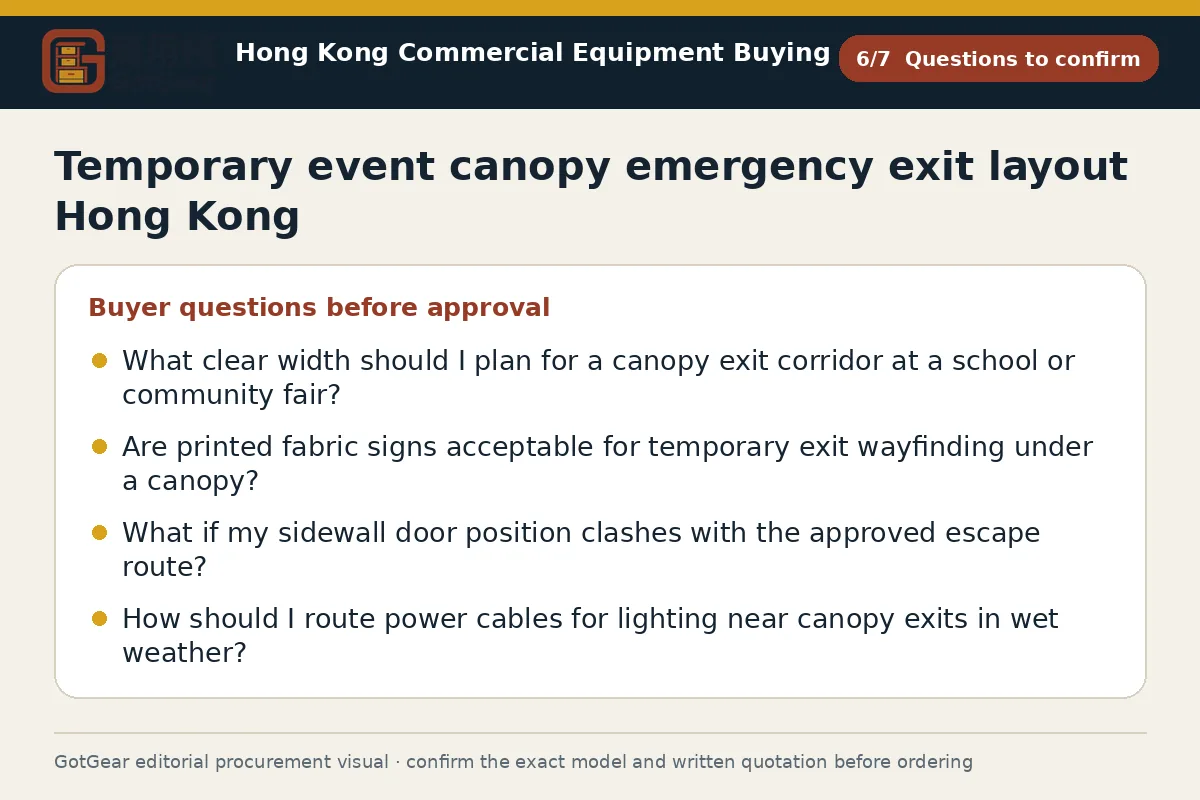
What clear width should I plan for a canopy exit corridor at a school or community fair?
Ask the venue or event safety lead for the required figure and confirm it in writing. As an example starting point, some organisers plan around 1.2 m clear width, but this must be validated for your site, crowd and insurer. Measure between rigid intrusions like legs and baseplates, not between hanging fabric, and re-check after build.
Are printed fabric signs acceptable for temporary exit wayfinding under a canopy?
They can be, if the venue approves visibility, durability and mounting. Specify bilingual Traditional Chinese/English content, weather-tolerant materials and secure fixings. Where illumination or reflectivity is requested, obtain the supplier’s data and sample photos. Mount signs so they are visible above heads without snagging the frame, and confirm positions on a site walk.
What if my sidewall door position clashes with the approved escape route?
Do not cut or move openings on your own. Options include swapping to a sidewall with a door panel or rolling and tying a panel fully open. Escalate the proposal to the venue or safety lead with drawings and photos for written approval. For design ideas to brief suppliers, see printed gazebo sidewall door layout Hong Kong.
How should I route power cables for lighting near canopy exits in wet weather?
Keep cables outside the exit path wherever possible. If a crossing is unavoidable, use a low-profile cable ramp with a slip-resistant surface and protect connections from moisture. Request ramp dimensions and load guidance from the supplier and confirm suitability with the venue. In Hong Kong humidity, choose tapes and ties rated for damp conditions.
Continue with closely related procurement topics
These pages share equipment, operating or decision-stage signals with this guide.
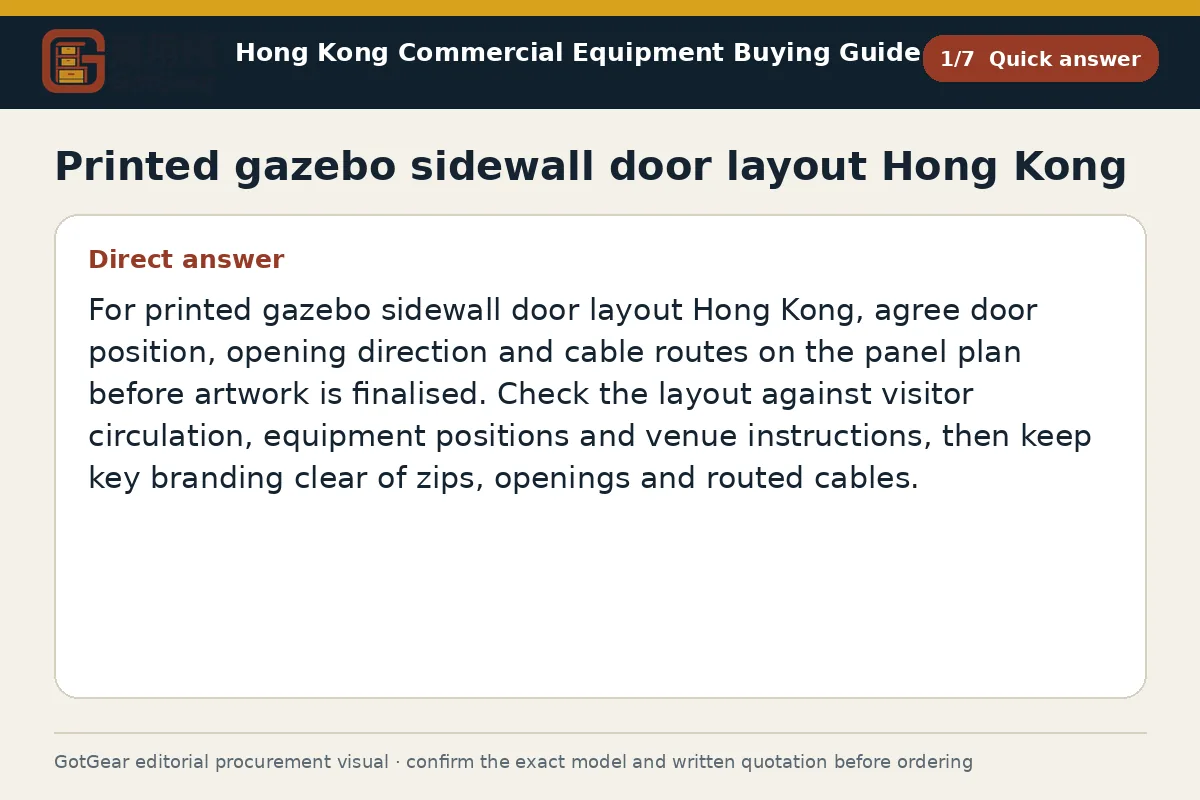
Printed gazebo sidewall door layout Hong Kong
Use this checklist to finalise door positions and visitor flow for printed gazebo sidewall door layout Hong Kong and to plan canopy sidewall cable access Hong Kong. Keep artwork clear of openings during setup with GotGear.
Read the guide
Canopy tent artwork bleed guide Hong Kong
Refer to the GotGear canopy tent artwork bleed guide Hong Kong to set bleed and safe areas. Also review canopy tent seam artwork Hong Kong and test custom canopy small text printing Hong Kong on a final-size proof.
Read the guide
Canopy tent weight distribution per leg Hong Kong
GotGear guide to canopy tent weight distribution per leg Hong Kong shows how to check each fixing and how to reassess canopy tent sidewalls wind anchoring Hong Kong and linked canopy tent anchoring Hong Kong after layout changes.
Read the guide
Outdoor tent unloading access planning Hong Kong
GotGear provides a clear brief for outdoor tent unloading access planning Hong Kong, detailing route dimensions, obstacle photographs, vehicle limits, permit requirements, access times and the receiving contact.
Read the guideRelated topic indexOpen more English procurement pages4 topics
Browse additional equipment families, applications and procurement questions relevant to a wider buying brief.