
Equipment trolley Hong Kong — Carry the defined equipment within documented capacity while keeping controls, accessories and the route manageable. Confirm model dimensions, load distribution, wheels, brakes and manufacturer instructions, then assess the complete configuration at the site.
Equipment trolley Hong Kong — Inventory equipment, accessories and combined mass
Start by listing every item the trolley must carry, not just its headline device. For a project involving an equipment trolley in Hong Kong, record make, model, dimensions (L×W×H), individual mass and any packaging or docking cradles. Include cables, power supplies, test fixtures, consumables, spare parts and personal protective equipment that travels with the load. Note if items are fragile, moisture-sensitive or must remain upright. Photograph the assembled kit for reference and mark the heaviest component.
Calculate the combined mass and how it distributes over shelves or platforms. Identify the primary handling face and the typical user height. State per-shelf load expectations and any requirement to lift items in or out. As an example starting point, you may plan a headroom allowance above the combined mass, but this must be confirmed against the manufacturer’s stated ratings in the written quotation. Indicate centre-of-gravity concerns, vibration risk and whether the trolley doubles as a workstation. If on-trolley computing is needed, outline screen size, keyboard or printer placement and cable runs; this will steer options similar in concept to a mobile workstation trolley in Hong Kong that buyers often compare, while keeping the specification anchored to your documented kit rather than a generic label.
Equipment trolley Hong Kong — Plan cable, power or sensitive-item requirements
If equipment will be powered while the trolley is moving or while parked, specify exactly which components must be energised, for how long, and from which supply. List the plug standard used on site, the number of outlets, maximum current draw per device and the total expected load. State whether surge protection or residual‑current protection is required by your venue or insurer, and whether batteries or chargers will ride on the trolley. Describe ventilation needs for heat‑generating gear, and request manufacturer instructions where through‑panel cut‑outs or enclosures are involved.
Define cable routing: glands or grommets, hook positions, retractors, tie‑down points and minimum bend radius for data or fibre. Flag electrostatic sensitivity and whether anti‑static mats, wrist‑strap posts or conductive wheels are needed. For sensitive items (medicines, assessments, cash boxes, optics), specify lockable compartments, tamper‑evident seals and a clear access protocol for public events. If additional boxed stock moves with the trolley, indicate how this differs from a mobile storage cart in Hong Kong, commonly used by teams for bulk replenishment. Where heavy or top‑heavy devices are present, reference your intended restraint method and inspection approach so suppliers can address trolley load securing in Hong Kong and reflect local practices in their offer.
What should buyers compare for equipment trolley Hong Kong?
| Criterion | Straightforward requirement | More complex requirement | Evidence to provide |
|---|---|---|---|
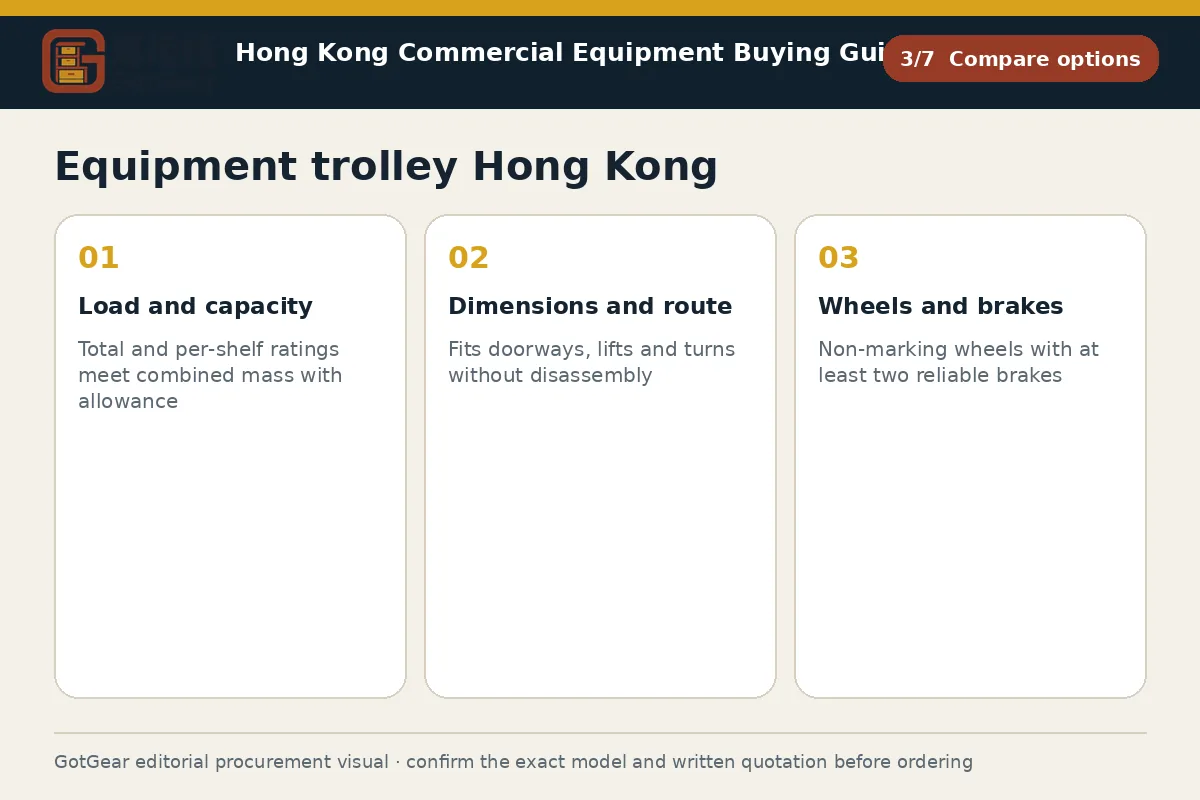
| Load and capacity | Total and per‑shelf ratings meet combined mass with allowance | Stability under off‑centre loads and on gradients addressed | Manufacturer datasheet, load distribution note, written ratings |
| Dimensions and route | Fits doorways, lifts and turns without disassembly | Manages tight lobbies, thresholds, ramps and sensitive floors | Measured route survey, turning template, annotated photos |
| Wheels and brakes | Non‑marking wheels with at least two reliable brakes | Directional locks/total‑stop, sealed bearings, conductive or outdoor‑suitable | Wheel diameter/material/hardness, brake type, bearing spec |
| Retention and security | Side rails or lips and basic straps hold items | Lockable compartments, foam inlays, tamper seals and audit trail | Drawings with lip height, strap rating, lock type, keying plan |
| Power and cabling | Cable hooks/retractors and defined outlet count and rating | Ventilated enclosures, battery/charger integration and ESD control | Electrical layout, ventilation note, charger manual, ESD method |
This framework helps buyers create comparable written enquiries. Final model specifications, availability, delivery and commercial terms must be confirmed in a formal quotation.
Equipment trolley Hong Kong — Define retention, storage and point-of-use access
Translate the inventory into retention and storage features that protect items while maintaining smooth workflows. Specify the shelf lip height, perimeter rails, end‑stops, adjustable dividers and foam inlays where form‑fit protection is required. Define strap quantity, location and quick‑release type, and request the strap’s rated capacity in writing. If drawers are required, specify internal clearances, locks and duty cycle. Note bin sizes for small parts and whether labels, barcodes or colour coding are needed. Mention any requirement for wipe‑clean surfaces or corrosion‑resistant finishes because plant rooms are humid.
Describe point‑of‑use access step by step: which side faces the operator, which controls must be reachable without moving the load, and the sequence of tasks. Set maximum and minimum working heights, specify handle style, and include foot‑operated brakes if one‑handed operation is expected. Indicate corridor pinch points and turning space outside rooms. As an example starting point, record a 900 mm corridor and an 800 mm doorway; these dimensions must be confirmed on a measured route survey. Where heavy or fragile items demand extra assurance, specify the restraint details and state that the manufacturer's guidance on trolley load securing in Hong Kong will govern the final configuration in the written quotation.
Equipment trolley Hong Kong — Verify dimensions, capacity, mobility and parking
Confirm the trolley envelope against your route. Measure doorway widths, lobby turns, lift car size and sill thresholds, and record gradients, expansion joints and drain grates. Request overall trolley dimensions with and without handles, turning radius and a drawing showing wheelbase and overhang. Ask for both static and rolling capacity ratings, plus per‑shelf ratings, from the manufacturer’s data. Note the intended load distribution so suppliers can advise on stability and tip limits at your site.
Match wheel material and diameter to your floors. For smooth tiles and resin, non‑marking tread may suffice; for mixed docks and pavements, larger diameters and sealed bearings may ride better. State if directional locks, total‑stop brakes or wheel guards are required. If this is still under review, request options and supporting notes referencing caster wheel selection Hong Kong. Define where the trolley will park, whether bay bumpers or chocks are needed, and any charging or ventilation clearance. On receipt, inspect dimensions, frame welds, fasteners, shelf flatness, wheel rotation, brake hold, strap anchors and finishes. Record serials, file the bilingual manual if provided, and confirm the supplied configuration matches the signed, model‑specific quotation—those specifications prevail.
Equipment trolley Hong Kong decision checklist
Finalise a written inventory with dimensions, individual masses and combined load, then map the route with measured clearances and gradients. Translate tasks into retention, drawer and shelf details, including strap ratings and quick‑release needs. Define wheel type, diameter, brakes and any directional locks, plus parking and charging arrangements. If power is on‑board, state outlets, load, ventilation and cable routing. Ask for manufacturer datasheets showing total and per‑shelf capacities and stability notes. Compare quotations line by line against these fields and request drawings. Before approval, confirm delivery timing with the management office and any institutional sign‑off. On receipt, check dimensions, capacity markings, wheels, brakes, fasteners, finishes and documentation; the model specification and signed quotation prevail.
- Operating use, quantity and expected frequency
- Dimensions, capacity, material and accessory requirements
- Delivery address, floor, goods lift and loading window
- Required documents, acceptance checks and after-sales arrangements
Key points for equipment trolley Hong Kong
Hong Kong sites often involve tight lifts, narrow service corridors and scheduled loading windows managed by building offices. Plan a measured route survey through goods lobbies and confirm lift car dimensions, door widths and allowable wheel types to avoid floor damage complaints. Coastal humidity and air‑conditioned to street transitions can corrode untreated steel and affect bearings, so request finishes and wheel seals suited to your environment. For public venues and schools, security access and supervision may be required; align with venue and insurer conditions. Treat any permits or documentation as site‑specific requirements rather than blanket rules, and rely on the model specification and written quotation for final acceptance.
Questions about equipment trolley Hong Kong
How do I choose wheels for mixed indoor corridors and outdoor loading bays?
Use larger‑diameter, sealed‑bearing wheels with a tread suited to both smooth floors and uneven surfaces; many buyers pick non‑marking rubber indoors and robust compounds for docks. Confirm building floor protection rules, slopes and thresholds. Ask for wheel diameter, material, hardness and bearing type in writing, plus brake style, and verify performance at your site with the manufacturer’s guidance.
Do I need brakes on all wheels for safety?
Two high‑quality braked casters often provide adequate holding on level floors, while total‑stop systems or directional locks can improve control on slopes or in lifts. The right choice depends on combined mass, gradient, task and venue rules. Request the brake type, location and rated holding method in the quotation, and confirm with your EHS or building manager.
What capacity margin should I specify beyond my combined load?
Provide a clear combined mass and ask for the manufacturer’s capacity ratings to exceed it. As an example starting point, some teams plan 25% headroom, but this must be validated against the specific model’s static, rolling and per‑shelf ratings and the task. State load distribution and centre‑of‑gravity so the supplier can address stability in the written quotation.
What acceptance checks should I perform when the trolley arrives?
Measure the delivered unit, verify wheel diameter and brake function, check frame welds and fastener torque, and test shelf flatness and strap anchors. Inspect finishes for corrosion or transport damage, and confirm accessories, keys and documents match the quotation. File the bilingual manual if provided and escalate any variance to the supplier; the written, model‑specific quotation governs resolution.
Continue with closely related procurement topics
These pages share equipment, operating or decision-stage signals with this guide.
Gas cylinder trolley Hong Kong
GotGear's checklist for a gas cylinder trolley Hong Kong outlines key considerations such as cylinder size, filled mass, valve guards, correct loading, safe gradients, and checks with the trolley manual and site rules.
Read the guide
Panel trolley Hong Kong
GotGear offers a practical guide to panel trolley Hong Kong that helps facilities record dimensions, mass, surface finishes, support angles, contact materials, retention methods and route clearances.
Read the guide
Glass trolley Hong Kong
GotGear guide to glass trolley Hong Kong explains how to specify equipment and plan sites by comparing rated capacity, support geometry, contact materials and restraints, pane size, loading method and route clearances.
Read the guide
Pipe trolley Hong Kong
For pipe trolley Hong Kong enquiries to GotGear, please provide pipe length and diameter, bundle mass and form, support spacing, end overhang, and restraint and turning clearance.
Read the guide