
Material handling equipment Hong Kong — Match the handling method to the load, route, lifting or positioning need and the people doing the work. Shortlist only after checking capacity information, dimensions, controls and manufacturer instructions against the intended task.
Material handling equipment Hong Kong — Separate carrying, rolling, lifting and positioning tasks
Start by separating the job into distinct modes: carrying (manual lifts), rolling (on wheels), lifting (raising/lowering through height), and positioning (fine alignment at the destination). Teams sourcing material handling equipment in Hong Kong should first classify work into carrying, rolling, lifting and positioning. For each load, note the outer dimensions, the approximate centre of gravity, packaging type, surface fragility, and any overhangs that affect stability. Record start and finish heights and whether the item must be rotated, tipped or precisely aligned on arrival.
Map each mode to appropriate categories: hand trucks, dollies and platform trolleys for rolling; pallet trucks, stackers and lifters for lifting; and turntables, rotators or articulated heads for positioning. Be realistic about Hong Kong passages: tight lift cars, narrow back-of-house corridors and thresholds can make long decks or fixed handles impractical. Wheel choice should reflect floor type (polished tile, epoxy, outdoor rough) and expected moisture. Consider corrosion-resistant finishes and non-marking tyres for malls and schools. Where repetitive bulk moves dominate, an equipment trolley in Hong Kong, specified with side rails, brakes and lashing points, often helps keep loads controlled on ramps and during elevator entry/exit.
Material handling equipment Hong Kong — Build a task schedule from weights, dimensions and move frequency
Build a simple task schedule that can be shared across operations, EHS and procurement. For each move, capture: item ID, width × depth × height, estimated mass (As a starting point, only, 60 kg), centre-of-gravity notes, packaging, start/finish heights, route sketch with clearances and turning space, floor types, kerbs/ramps, and whether the load is stable when braked. Add frequency per day/shift, seasonal peaks, and who performs the task. All figures must be confirmed in the written brief issued to suppliers.
Log site constraints specific to Hong Kong: goods-lift internal dimensions (As a starting point, only, 1,200 × 1,200 mm), door widths, loading-bay booking windows and any requirement to move through public areas outside trading hours. Cross-reference your manual handling risk assessment Hong Kong so push/pull force limits and team sizes are clear. Where vertical adjustment is frequent, flag candidates such as a scissor lift table Hong Kong. Teams use these to keep work at waist height. Include route photos, short videos, and bilingual annotations so technicians, building management and approvers can review the same evidence quickly.
What should buyers compare for material handling equipment Hong Kong?
| Criterion | Straightforward requirement | More complex requirement | Evidence to provide |
|---|---|---|---|
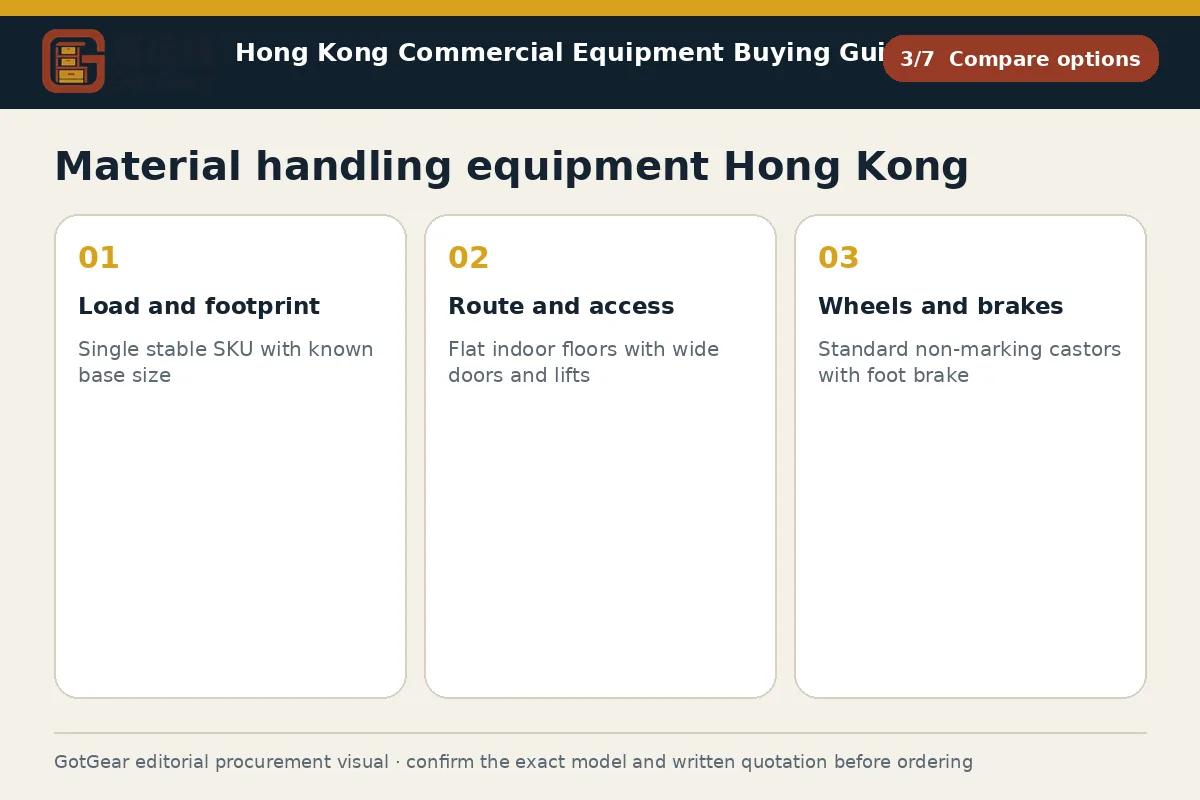
| Load and footprint | Single stable SKU with known base size | Mixed sizes, offset centres of gravity or fragile edges | Provide dimensions, mass (example starting point), base sketch and stability notes |
| Route and access | Flat indoor floors with wide doors and lifts | Ramps, thresholds, tight lifts/turns or public‑area crossings | Provide route photos, lift/door dimensions, gradients and timing limits |
| Wheels and brakes | Standard non‑marking castors with foot brake | Directional locks, larger diameters, special treads or ESD | Specify diameter, material, bearings, brake/lock type and floor types |
| Operator fit and controls | Fixed handle and simple brake acceptable | Adjustable handles, twin brakes, retention rails or clamps | State operator stature range, push/pull limits and retention needs |
| Documentation and delivery | Basic manual and kerbside delivery | Bilingual manuals, to‑floor delivery, assembly and method statement if required | Request language, delivery point, assembly details and any site paperwork |
This framework helps buyers create comparable written enquiries. Final model specifications, availability, delivery and commercial terms must be confirmed in a formal quotation.
Material handling equipment Hong Kong — Compare load, route and operator demands before shortlisting
Before shortlisting, reconcile three demands: the load’s behaviour, the route’s realities and the operator’s capability. Capacity must exceed the confirmed maximum mass and be appropriate for the item’s footprint and centre of gravity, not merely a headline rating. Check deck or fork size against the load’s base and whether side rails, lips or clamps are required. Wheel diameter, material, tread and bearing type directly affect push/pull effort, noise and floor protection; caster wheel selection should reflect the actual surfaces, thresholds and ramps at your Hong Kong site.
Compare quotations line‑by‑line using the same specification fields: model code, load rating and duty description; deck/fork dimensions; overall length/width/height; handle height and adjustability; wheel size, material and bearing; brake type (foot, hand, directional lock); finish (stainless, galvanised, powder‑coated); accessories (rails, straps, bins); and any stated push/pull guidance from the manufacturer. Ask suppliers to confirm assembly method, packaging size for lift access, delivery arrangements to the floor, and the documentation language. If your site or venue requires method statements or insurance particulars, request them with the quote. The supplier’s formal written quotation and the manufacturer’s instructions always prevail.
Material handling equipment Hong Kong — Turn operational evidence into a clear purchasing brief
Turn the schedule and route evidence into a clear purchasing brief. Summarise the tasks, loads and frequencies; attach route sketches, lift/door dimensions, photos, and any time restrictions or public‑area controls. State environmental factors (humidity, cleaning chemicals), hygiene/ESD requirements if relevant, and internal push/pull thresholds. Specify acceptance criteria and the documentation you expect on delivery: operating manual and maintenance guidance in English and Chinese, parts list, and a manufacturer’s load‑rating declaration or test information where applicable. Use this guide to compare specifications and prepare a structured written enquiry.
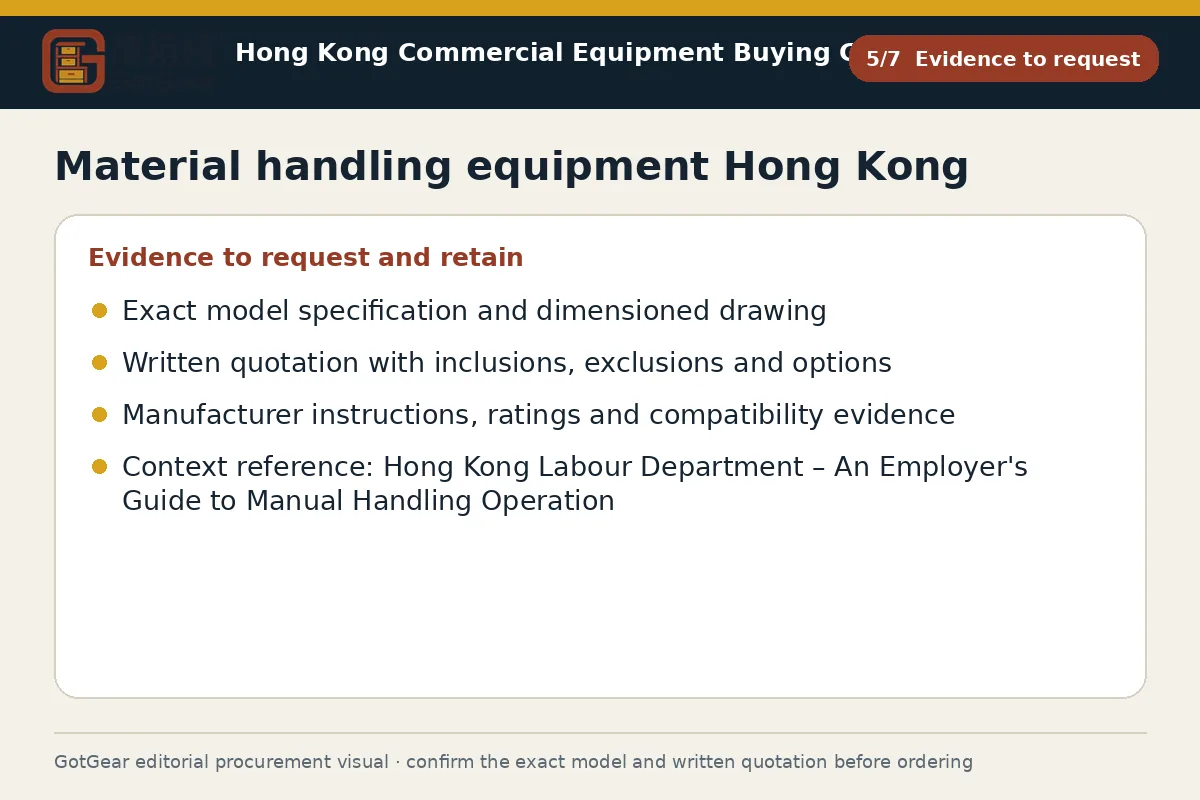
Plan receipt checks in advance. On arrival, verify model code against the quotation, load‑rating plate, deck/fork dimensions within your tolerance (As a starting point, only, ±5 mm), wheel material and diameter, and brake/steer function including any directional locks. Inspect welds, fixings and finish for damage from transit and confirm that moving parts are lubricated and free‑running. For powered units, only if proposed, follow the manufacturer’s commissioning steps and confirm battery/charger details. Test push/pull on the real route during a controlled trial, documenting results and any adjustments required before sign‑off.
Material handling equipment Hong Kong decision checklist
Confirm the heaviest and bulkiest item to be moved, then check its base dimensions and stability. Walk the route end‑to‑end, measuring doorways, lift car interiors, turning spaces and ramp gradients, and note any thresholds. Match wheel material and diameter to real floors, noise expectations and moisture. Decide on finish for humidity and cleaning. Define push/pull limits and team sizes from your internal assessment and training. Specify deck or fork size, handle height, brakes and retention features. Prepare bilingual documentation expectations and coordinate with building management on loading windows and access requirements. Request written quotations using identical fields and confirm delivery to floor and assembly. Plan receipt checks and a short, observed trial on the actual route before acceptance.
- Operating use, quantity and expected frequency
- Dimensions, capacity, material and accessory requirements
- Delivery address, floor, goods lift and loading window
- Required documents, acceptance checks and after-sales arrangements
Key points for material handling equipment Hong Kong
Hong Kong sites often constrain movement more than the load itself. Expect compact goods‑lifts, narrow corridors and tight turning spaces, especially in industrial buildings converted for multi‑tenant use or in mall back‑of‑house areas. Loading bays may require advance booking with strict windows, and moves through public areas are typically restricted to off‑peak hours by building management. High humidity and coastal air can promote corrosion; finishes and wheel materials should reflect this. Always confirm any venue, landlord or authority requirements for documentation, timing and public‑event controls with the responsible party; this page is not legal advice.
Questions about material handling equipment Hong Kong
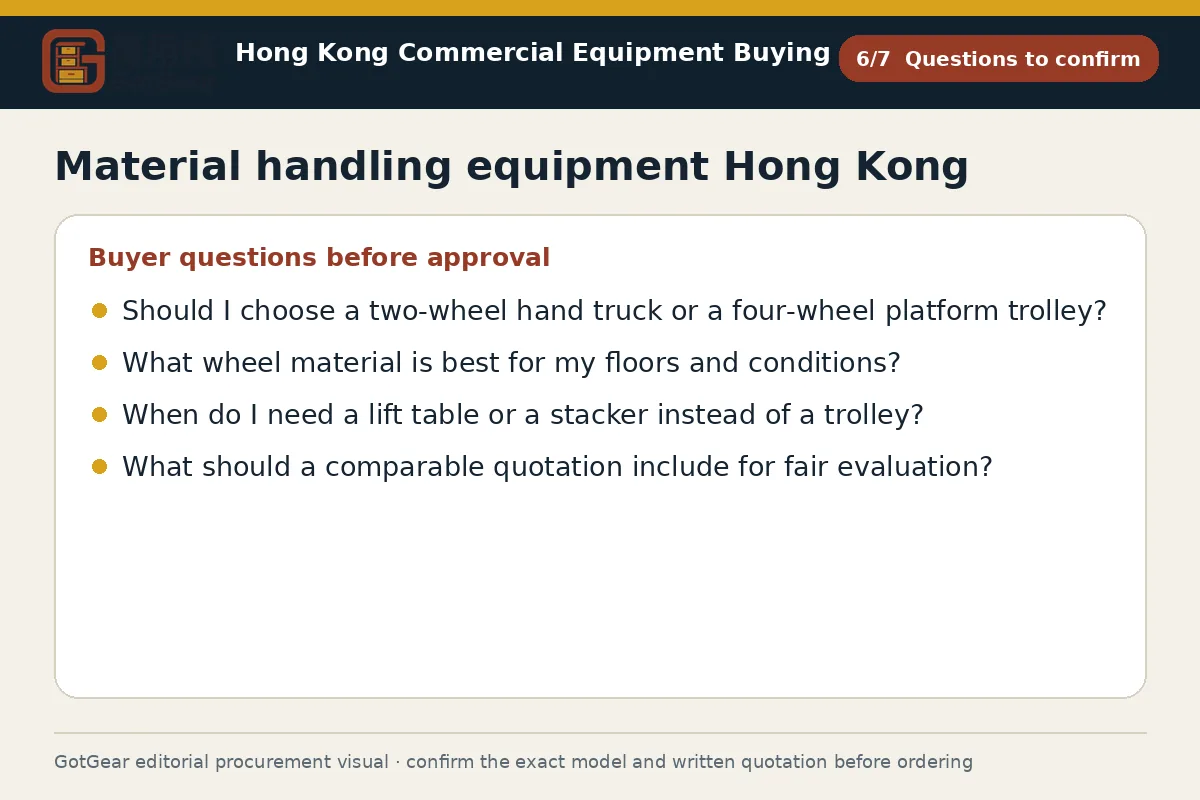
Should I choose a two‑wheel hand truck or a four‑wheel platform trolley?
Pick the format that keeps the load stable and within push/pull limits on your real route. Two‑wheel trucks suit compact, tall, boxed loads and occasional stairs. Four‑wheel platforms suit heavier, wider or unstable items and long, flat corridors and lifts. Always confirm turning space, thresholds and elevator size, and choose rails or straps where needed.
What wheel material is best for my floors and conditions?
Non‑marking rubber or polyurethane suits polished tiles and epoxy, while larger diameters help over thresholds. Pneumatics cope with rough outdoor surfaces; nylon or stainless options can resist wet or corrosive areas. Noise restrictions may favour softer treads. Ask suppliers for push/pull and noise data, and where possible verify on a short trial along your actual route.
When do I need a lift table or a stacker instead of a trolley?
Use a lift table when frequent height changes are needed at the workstation to keep handling near waist level; use a stacker when you must raise pallets or loads to shelving. Confirm floor rating, turning space, and operator training needs. If used in public‑facing areas, check finish, noise and movement timing with building management.
What should a comparable quotation include for fair evaluation?
Request model code, duty description, load rating, deck or fork size, overall dimensions, wheel size/material/bearings, brake type, finish, accessories, documentation language, delivery to floor and assembly method. Ask for manufacturer instructions and any available push/pull guidance. The supplier’s formal written quotation and instructions always take precedence over summaries.
Continue with closely related procurement topics
These pages share equipment, operating or decision-stage signals with this guide.
Manual handling risk assessment Hong Kong
GotGear explains what to record during a manual handling risk assessment Hong Kong and how to use a manual handling safety checklist Hong Kong. The guide also describes how to prioritise material handling risk controls Hong Kong.
Read the guide
Trolley inspection checklist Hong Kong
GotGear’s trolley inspection checklist Hong Kong and trolley preventive maintenance Hong Kong explain how to inspect wheels and brakes, log defects and schedule servicing under maker guidance.
Read the guide
Trolley load securing Hong Kong
GotGear provides guidance on trolley load securing Hong Kong, explaining how to check the centre of gravity, identify restraint points and compare straps, rails and clamps. It also covers trolley load stability Hong Kong.
Read the guide
Trolley anti-slip deck Hong Kong
GotGear explains how to assess a trolley anti-slip deck Hong Kong by reviewing load retention, material, contamination and contact risks. It also outlines considerations for trolley bumper protection Hong Kong.
Read the guideRelated topic indexOpen more English procurement pages3 topics
Browse additional equipment families, applications and procurement questions relevant to a wider buying brief.