
ESD trolley Hong Kong — Do not rely on an ESD label alone; electrical properties depend on the complete trolley configuration and its interface with the site system. Request model-specific test information and follow manufacturer instructions plus the applicable site and Hong Kong requirements.
ESD trolley Hong Kong — Define the electrostatic-control area and process limits
For an ESD trolley Hong Kong briefing, first define the ESD‑controlled area boundaries and the process limits that the trolley must respect. Record the route the trolley will take through the site, noting any transitions between ESD‑protected areas, general warehouse zones, and clean or laboratory spaces. Confirm the flooring types and their maintained resistance to ground, the presence of earth bonding points, and whether a conductive floor finish or plates are installed where the trolley will dwell. Capture ambient conditions (relative humidity and temperature) and any contamination risks such as waxes or detergents that could insulate floors.
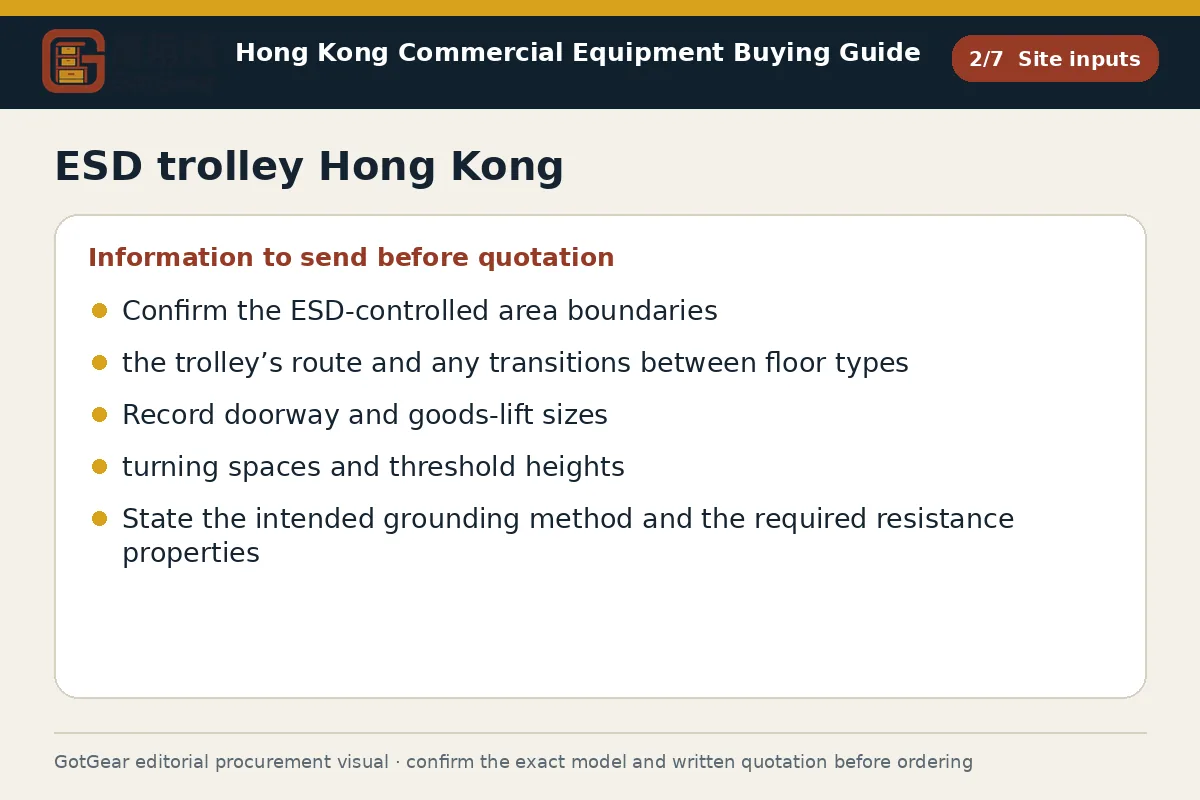
Translate this into an enquiry pack: a simple plan of the route, photos of key thresholds, doorway and goods‑lift sizes, and turning spaces. If you include example limits (for instance, a starting point of 1×10^5 to 1×10^9 ohms for resistance‑to‑ground), state clearly they are examples only and must be confirmed by the responsible manufacturer or site authority. Note operational constraints unique to Hong Kong—tight lift cars, short loading windows set by the management office, and bilingual operator instructions. Specify the required load capacity, dimensions, braking, and the intended grounding method so suppliers can confirm compatibility in their formal written quotation and model specification.
ESD trolley Hong Kong — Check wheels, shelves and accessories as one system
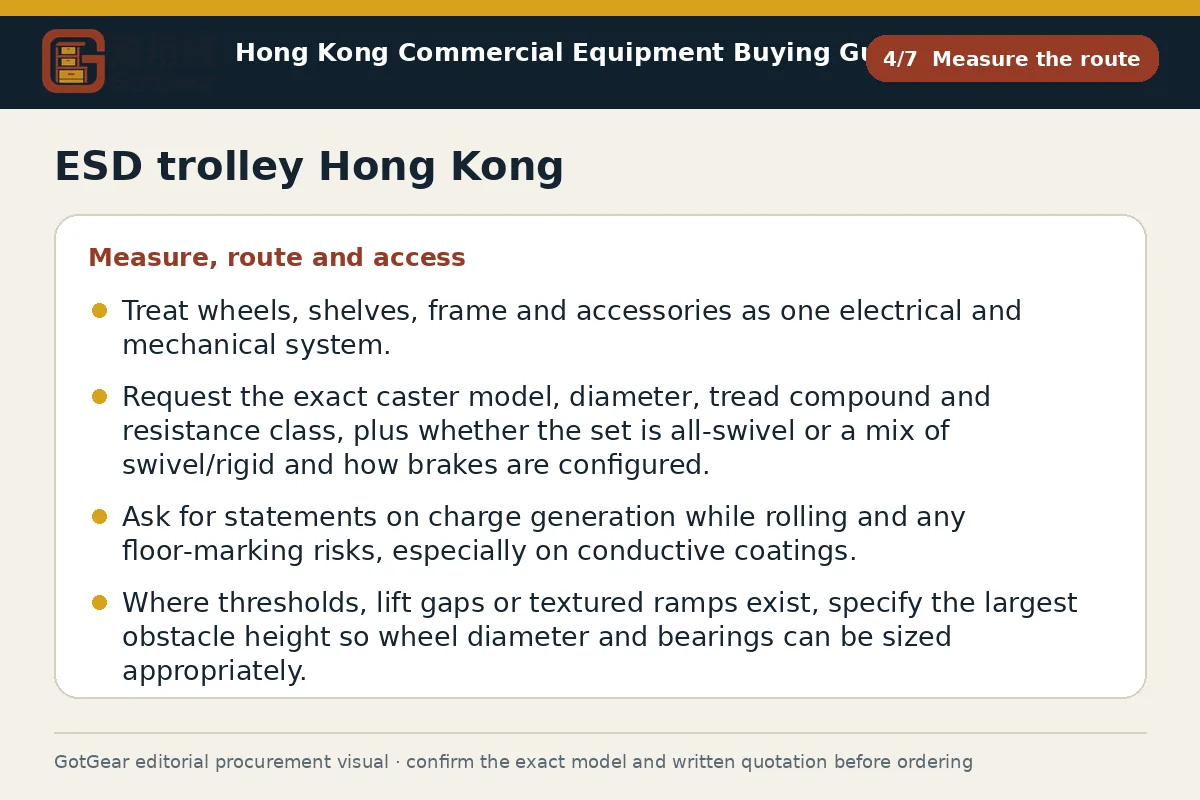
Treat wheels, shelves, frame and accessories as one electrical and mechanical system. Request the exact caster model, diameter, tread compound and resistance class, plus whether the set is all‑swivel or a mix of swivel/rigid and how brakes are configured. Ask for statements on charge generation while rolling and any floor‑marking risks, especially on conductive coatings. Where thresholds, lift gaps or textured ramps exist, specify the largest obstacle height so wheel diameter and bearings can be sized appropriately.
For shelves and accessories, request the base material (metal, dissipative laminate or plastic), surface resistance, and how each component bonds to the frame. Identify removable parts—tote rails, bin panels, ESD‑safe bins, document clips—and require a bonding path for each. Ask for a grounding feature (drag chain or tether point) that remains effective even when accessories are fitted. In your evaluation, look for a clear conduction path from the top shelf to ground through the frame and casters, with example acceptance checks such as point‑to‑point continuity between shelves and the ground path, to be verified against the manufacturer’s instructions.
What should buyers compare for ESD trolley Hong Kong?
| Criterion | Straightforward requirement | More complex requirement | Evidence to provide |
|---|---|---|---|
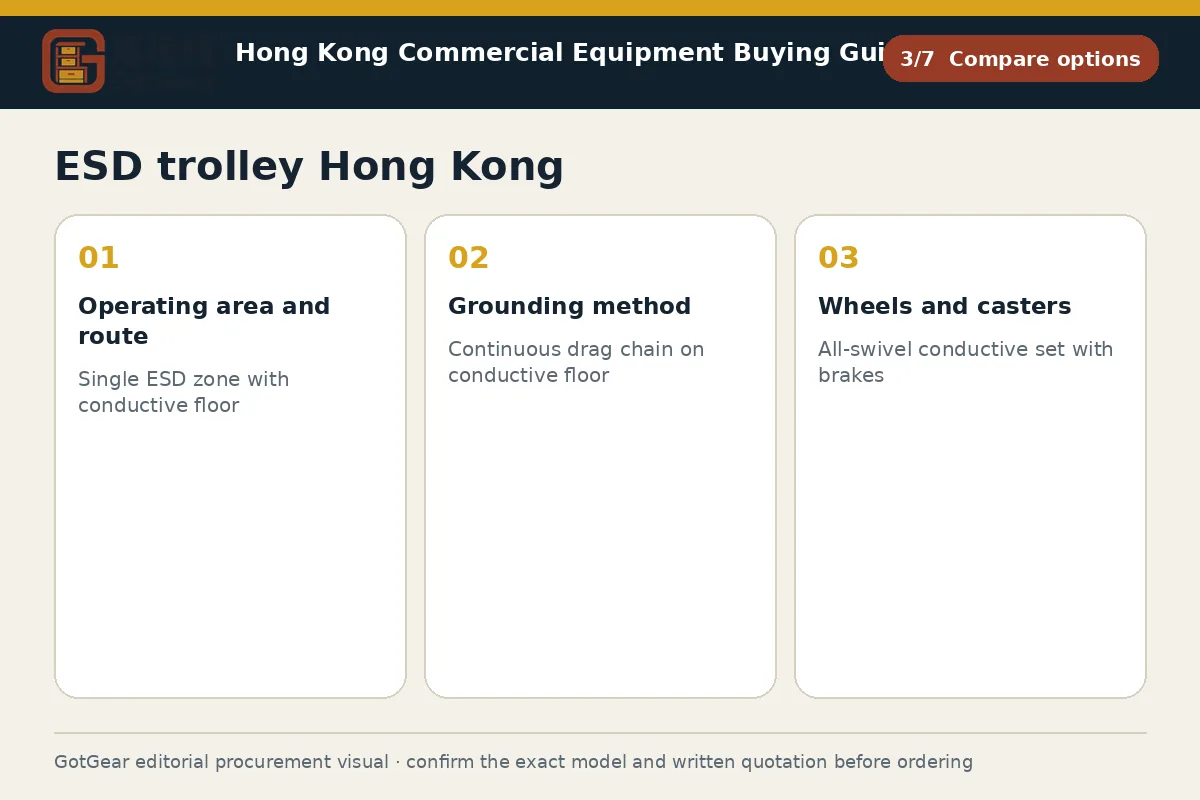
| Operating area and route | Single ESD zone with conductive floor | Multiple zones with transitions and non-conductive areas | Route map, floor types, lift/door sizes, threshold heights |
| Grounding method | Continuous drag chain on conductive floor | Tether point or docking plate where floors vary | Grounding diagram, example resistance targets, confirmation method |
| Wheels and casters | All-swivel conductive set with brakes | Mixed swivel/rigid, towable set, non-marking constraint | Caster model codes, tread compound, resistance class, diameter |
| Shelves/frame/accessories bonding | All-metal shelves bonded to frame | Mixed materials with straps and accessory bonding | Point-to-point resistance plan, BOM, bonding hardware details |
| Verification and upkeep | Periodic continuity checks per site plan | Integrated audits, spares, bilingual SOPs | Test points, tools, intervals, record format and responsibilities |
This framework helps buyers create comparable written enquiries. Final model specifications, availability, delivery and commercial terms must be confirmed in a formal quotation.
ESD trolley Hong Kong — Request resistance, grounding and material information
Specify the electrical properties you require and the evidence you need to see in writing. Request the trolley’s resistance‑to‑ground (through at least one wheel or drag chain), point‑to‑point resistance across shelves and frame, and surface resistance of shelf materials. Ask for the test method, instrument range, test voltage, and environmental conditions (example starting point: 23 °C, 50% RH), confirming that the vendor’s method and site programme are aligned. Require model‑specific data sheets and a grounding diagram showing how charge drains from shelves to floor.
Detail the grounding arrangement you intend to use—continuous drag chain on conductive flooring, or a dedicated tether to an earthing point where floors are not conductive. If a docking plate or floor contact pad will be used, ask for installation guidance and resistance targets. For wheels, request the tread compound, any carbon‑loading statement, and marking on the hub identifying the caster model. For quotations, ask vendors to declare the exact model code, wheel set, shelf material, frame finish, grounding hardware, and any accessories, with batch‑level changes disclosed. The formal model specification and written quotation prevail.
ESD trolley Hong Kong — Align verification and upkeep with the site ESD programme
Plan verification and upkeep within your site ESD programme so the trolley remains compliant in service. Define receipt checks: continuity from top shelf to the grounding feature, caster model codes, correct wheel type and brake layout, and bonding of all fitted accessories. Confirm that grounding hardware (drag chain or tether) contacts the intended surface. Where the trolley will operate across different floor types, note the verification method for each zone and record results in your maintenance system.
Set inspection intervals that match your internal audits and risk profile; for example, align trolley checks with routine ESD workstation verifications, subject to your competent person’s approval. Specify cleaning methods that avoid insulating residues, and request the manufacturer’s guidance in English and Chinese. Keep spare conductive casters and drag chains if your usage is intensive. If towing is planned, confirm tow brackets and wheel ratings with the vendor. For schools, laboratories or public‑event venues, seek the necessary institutional or insurer approvals before first use. Retain the manufacturer’s instructions and site records to demonstrate ongoing control.
ESD trolley Hong Kong decision checklist
Confirm the ESD‑controlled area boundaries, the trolley’s route and any transitions between floor types. Record doorway and goods‑lift sizes, turning spaces and threshold heights. State the intended grounding method and the required resistance properties, noting that any example ranges are starting points only. Request model‑specific data sheets, grounding diagrams, caster codes, shelf material details and accessory bonding statements. Ask vendors to declare test methods and conditions, plus any batch change controls. Compare quotations line‑by‑line against the same fields, and require bilingual instructions. On receipt, perform continuity checks and verify the configuration against the written quotation. Site approvals and the formal model specification prevail.
- Operating use, quantity and expected frequency
- Dimensions, capacity, material and accessory requirements
- Delivery address, floor, goods lift and loading window
- Required documents, acceptance checks and after-sales arrangements
Key points for ESD trolley Hong Kong
Hong Kong sites often involve narrow corridors, small goods‑lift cars and managed loading windows. Measure door and lift apertures, turning spaces and threshold gaps, then confirm with the building manager how deliveries are booked and escorted. Humid summers can alter charge behaviour and cleaning practices may introduce insulating films, so floor condition should be verified before acceptance tests. Bilingual (English/Chinese) instructions help with multi‑shift operations. These are practical planning points, not legal advice; your site programme and the written model specification prevail.
Questions about ESD trolley Hong Kong
Should I choose conductive or static-dissipative wheels?
Choose the wheel type that matches your floor and grounding method: conductive on conductive floors for fast bleed, dissipative where a slower discharge is preferred. Confirm with your site programme and manufacturer advice. Request the wheel compound, resistance class and caster model code in the quotation, and verify continuity after fitting accessories.
Can one trolley serve both cleanroom and warehouse routes?
It can, if the design and upkeep suit both environments and your approvals allow it. Specify the cleanroom class or housekeeping limits, materials that resist particle shedding, and the grounding method for each floor type. Ask the vendor to declare cleaning compatibility and provide a bonding diagram, then verify performance on both routes before release.
Two vendors quote different resistance ranges. Which is right for us?
Select the range that aligns with your site ESD programme and floor system, then test to that. Ask each vendor for model-specific test results, method, voltage and environmental conditions. If numbers are examples, label them as such and seek confirmation from your competent person or manufacturer. The written model specification and quotation should govern.
What delivery-day checks work best in high-rise Hong Kong buildings?
Book the lift and loading window with the management office, then confirm the trolley fits measured apertures. On arrival, check for transit damage, caster codes, wheel type, brakes, grounding hardware, and accessory bonding. Perform quick continuity checks to your planned points and keep bilingual instructions. Record any issues before signing the delivery note.
Continue with closely related procurement topics
These pages share equipment, operating or decision-stage signals with this guide.
Pipe trolley Hong Kong
For pipe trolley Hong Kong enquiries to GotGear, please provide pipe length and diameter, bundle mass and form, support spacing, end overhang, and restraint and turning clearance.
Read the guide
Drum trolley Hong Kong
This quotation checklist helps facilities and EHS teams plan for drum trolley Hong Kong. It guides you on drum size, filled mass, orientation, pickup method, retention and route conditions, and is provided by GotGear.
Read the guide
Gas cylinder trolley Hong Kong
GotGear's checklist for a gas cylinder trolley Hong Kong outlines key considerations such as cylinder size, filled mass, valve guards, correct loading, safe gradients, and checks with the trolley manual and site rules.
Read the guide
Panel trolley Hong Kong
GotGear offers a practical guide to panel trolley Hong Kong that helps facilities record dimensions, mass, surface finishes, support angles, contact materials, retention methods and route clearances.
Read the guide