
Panel trolley Hong Kong — Support the intended sheet geometry without unstable overhang and protect the relevant faces and edges. Confirm model capacity, allowable load dimensions and restraint instructions, then assess the proposed configuration on the actual route.
Panel trolley Hong Kong — Record panel dimensions, mass, surface and batch size
For projects involving panel handling in Hong Kong, start by capturing the physical facts of what will be moved. This guidance applies to panel trolley Hong Kong. Measure the maximum panel height, length and thickness in the actual orientation you intend to load. Note the mass of a single panel and the combined mass per trip, including any protective wrapping or fixtures. Identify surface sensitivity: plain timber, coated sheet, laminate, stone or glass each tolerates contact differently. Confirm edge condition and whether corners are sharp, fragile or protected. Record batch size per movement and the frequency of runs during a shift.
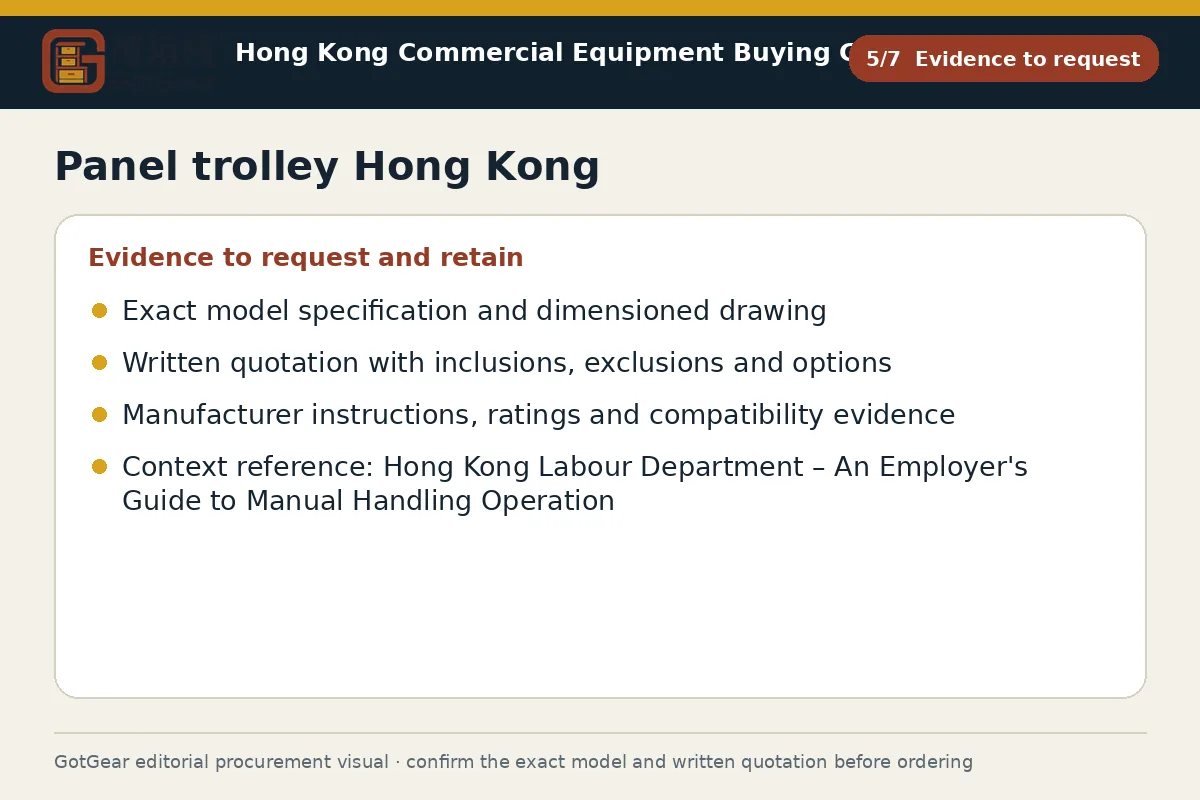
Turn those facts into an enquiry pack the supplier can configure against. Provide clear photos of typical and worst‑case panels, with a tape or scale visible. State whether panels will be handled by one or two persons, the preferred handle height range, and any no‑marking requirement. Ask the supplier to state usable support length, overall footprint, support angle or range, contact materials, retention method, wheel type and brake arrangement, and a frame finish suitable for humid conditions. Include a request for the allowable load dimensions and restraint instructions to be confirmed in writing. Make it explicit that model specifications and the supplier’s formal written quotation will prevail over any preliminary discussion.
Panel trolley Hong Kong — Map doorways, corners, gradients and loading points
Walk the entire route from the storage or delivery point to the work area, recording constraints with photographs and measured notes. Confirm clear door widths and heights, floor transitions, thresholds, and any skirting or handrails that reduce effective width. For corners and lift lobbies, sketch the available turning spaces, and ask the supplier to state the required turning circle or to advise on trolley turning radius in Hong Kong. Ask the supplier to provide any related guidance separately. Capture lift car and door dimensions, rated load, and whether goods‑lift access and controls are shared with tenants.
Map gradients, docks, kerbs and ramps, noting surface type, drainage grates and expansion joints that could snag wheels. Identify loading windows set by property management and any need for spotters or temporary barricades during public hours. Provide the supplier with a simple plan view marked with door swings, tight corners, lift call‑button positions and resting bays. If floors vary—polished concrete, tiles, epoxy or outdoor paving—flag them, and reference any existing material handling floor condition checklist in Hong Kong. That checklist may be the one used by your EHS team. These route details let the supplier propose wheel materials, brake types and retention that will work on your actual path, not a theoretical layout.
What should buyers compare for panel trolley Hong Kong?
| Criterion | Straightforward requirement | More complex requirement | Evidence to provide |
|---|---|---|---|
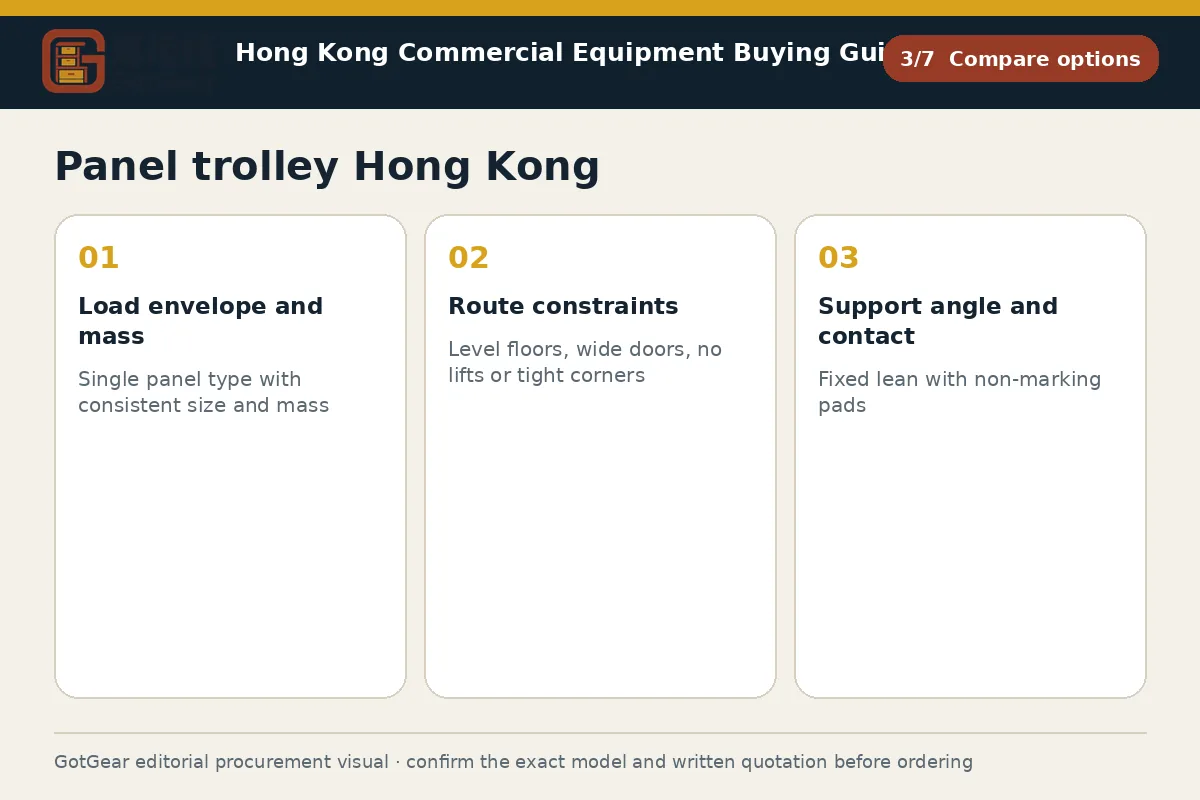
| Load envelope and mass | Single panel type with consistent size and mass | Mixed sizes, variable thickness, occasional overhang | Max height/length/thickness, mass per panel and combined mass, photos of worst‑case |
| Route constraints | Level floors, wide doors, no lifts or tight corners | Narrow doors, shared goods‑lift, gradients and thresholds | Measured door/lift clearances, turning spaces, surface notes, route photos |
| Support angle and contact | Fixed lean with non‑marking pads | Adjustable angle, replaceable pads and dividers | Desired angle or range, pad material and care, need for adjustability |
| Retention and restraint | Simple straps with standard anchor points | Combination of straps, clamps or crossbars with defined positions | Retention method preference, strap quantity, anchor locations, special notes |
| Wheels and brakes | Indoor smooth floors, basic swivel castors with brake | Mixed floors, corrosion‑resistant components and total‑stop brakes | Floor types, obstacles/thresholds, gradient presence, brake preference |
This framework helps buyers create comparable written enquiries. Final model specifications, availability, delivery and commercial terms must be confirmed in a formal quotation.
Panel trolley Hong Kong — Compare support angle, edge protection and retention
Evaluate how the load will be supported and restrained before comparing quotations. Specify whether you need an A‑frame, dual‑sided support, or a near‑vertical platform. The support angle affects stability, reach into doorways and operator effort. As an example starting point, many teams begin trials with a shallow lean for stability, then adjust to clear door widths; ask the supplier for their recommended angle or adjustment range for your panel geometry and mass. Request drawings showing the centre of contact and ground clearance.
Edge and face protection should match the surface. Ask for contact material type (e.g., rubber, EVA, UHMW or felt), hardness, thickness, replacement method and cleaning advice, and require confirmation that it is non‑marking on your finish. For retention, state if you prefer straps, clamps or crossbars, and where anchor points should be. Clarify how many retention points are standard and any secondary retention for transport over uneven floors. Seek written guidance on trolley load stability for Hong Kong that is relevant to your route, including how to position mixed‑size panels. Compare quotations line‑by‑line on angle setting or adjustability, pad specification, retention hardware, and whether wear parts are standard catalogue items with part numbers.
Panel trolley Hong Kong — Confirm capacity and load geometry with the supplier
Before ordering, ask the supplier to confirm in writing the model’s rated capacity, the allowable load envelope (height, length and thickness limits), any overhang tolerances, and the required restraint method for your batch size. Provide them with your measured masses and route notes so they can advise on wheel selection, brake configuration and operator handling on gradients. Request general‑arrangement drawings or datasheets, and, where appropriate, a site assessment or trial using off‑cut panels under supervision.
On receipt, verify the data plate shows model, capacity and serial number, and that warnings and instructions are provided in bilingual Chinese and English. Inspect welds, frame finish, pads and fixings, operate brakes and castor swivels, and check that straps, clamps and handles match the written quotation. Confirm wheels roll without flat spots and that the trolley tracks through your narrowest doorway and lifts as planned. Keep delivery photos, manuals and any manufacturer or venue‑requested documentation together for your internal approval file. If the trolley will be used in public‑facing or institutional areas, confirm any extra controls with your venue, insurer or building manager before first use.
Panel trolley Hong Kong decision checklist
Confirm the largest panel dimensions, unit and combined masses, surface sensitivity and batch size, then compile photos and a short written brief. Walk the route and record door, lift and corner constraints, gradients, resting bays and loading windows. Ask suppliers to state usable support length, support angle or range, contact materials, retention method, wheel and brake type, and the allowable load envelope. Compare quotations against the same specification and route notes, requesting drawings and restraint instructions. Before approval, verify that property management accepts the proposed movement plan. On delivery, check data plates, bilingual instructions, welds, pads, wheels, brakes and all retention hardware against the written quotation, then test the configuration on the real route with sample panels under competent supervision.
- Operating use, quantity and expected frequency
- Dimensions, capacity, material and accessory requirements
- Delivery address, floor, goods lift and loading window
- Required documents, acceptance checks and after-sales arrangements
Key points for panel trolley Hong Kong
Hong Kong routes often hinge on tight goods‑lifts, narrow service corridors and booked loading windows controlled by property management. Older industrial buildings may have small lift cars and lobbies that limit turning, while humid conditions and occasional wet floors challenge wheel grip and corrosion resistance. Crowd and event controls can restrict daytime movements in malls, campuses and hotels. Plan for bilingual labelling and manuals to support mixed crews. None of this is legal advice; confirm venue, building‑manager and insurer expectations for your exact site before deployment.
Questions about panel trolley Hong Kong
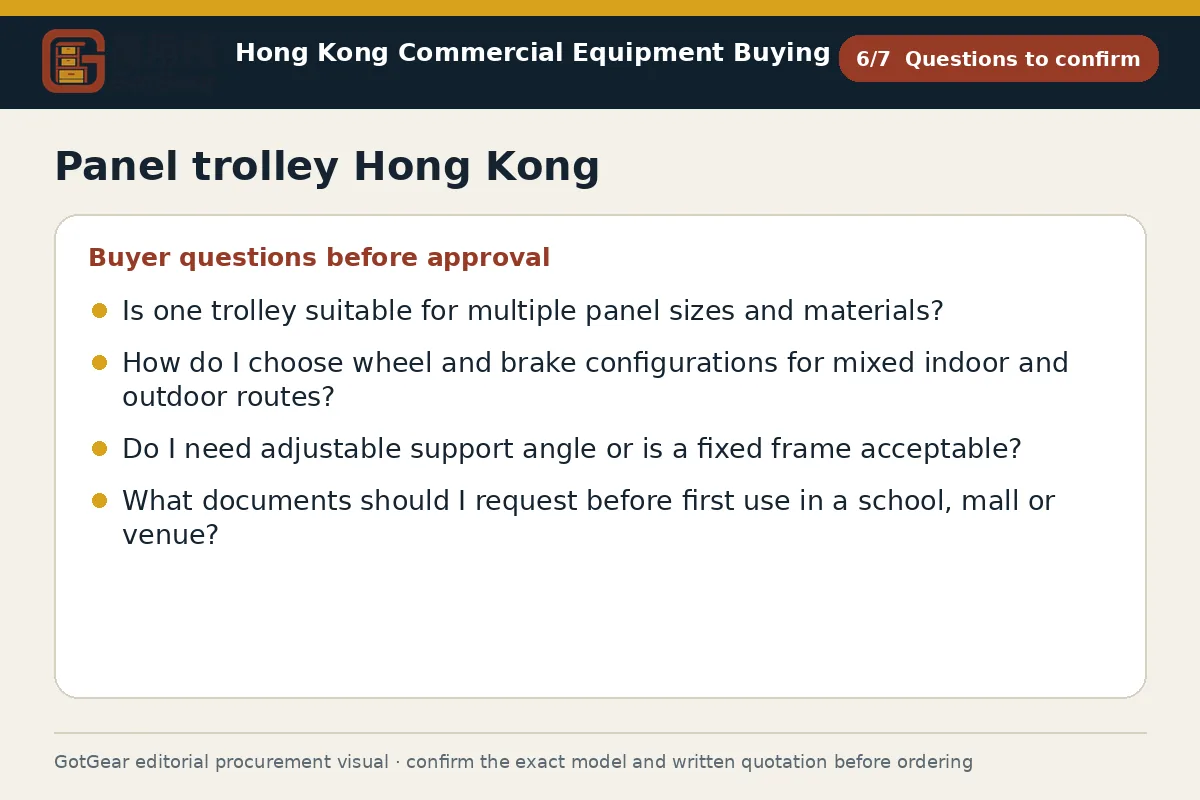
Is one trolley suitable for multiple panel sizes and materials?
Often yes, if the support angle, pad material and retention can accommodate the smallest and largest panels you move. Ask for adjustable stops, extra pads or removable dividers. Provide your worst‑case dimensions and mass so the supplier can confirm the allowable envelope. If glass or highly finished panels are included, request non‑marking contact materials and clear restraint instructions.
How do I choose wheel and brake configurations for mixed indoor and outdoor routes?
Select wheels based on floor types, thresholds and gradients on your actual path. Non‑marking, resilient wheels with reliable total‑stop brakes suit smooth indoor floors; sealed bearings and corrosion‑resistant fittings help in humid or occasionally wet areas. Share route photos and surfaces so the supplier can match wheel material, diameter and brake arrangement. Confirm their recommendation in the written quotation.
Do I need adjustable support angle or is a fixed frame acceptable?
If your panels are consistent, a fixed angle can be simpler and more robust. Where sizes vary or doors are tight, adjustable angle helps balance stability and clearance. Treat any suggested angle as an example starting point and request the supplier’s recommendation for your load geometry. Ask for drawings and instructions showing safe adjustment and restraint positions.
What documents should I request before first use in a school, mall or venue?
Ask for the manufacturer’s datasheet, instructions, data plate details and any maintenance guidance, ideally bilingual. Some venues or insurers may require a risk assessment, method statement, or confirmation of capacity and restraint, specific to your site. Check with the building manager or event organiser. Where glass is moved, request the maker’s handling recommendations for that substrate.
Continue with closely related procurement topics
These pages share equipment, operating or decision-stage signals with this guide.
Gas cylinder trolley Hong Kong
GotGear's checklist for a gas cylinder trolley Hong Kong outlines key considerations such as cylinder size, filled mass, valve guards, correct loading, safe gradients, and checks with the trolley manual and site rules.
Read the guide
Library book trolley Hong Kong
Use the GotGear procurement guide to compare capacity, dimensions, wheels and brakes, noise, route clearance and lift and aisle measurements. It helps buyers choose the right library book trolley Hong Kong for their facility.
Read the guide
Equipment trolley Hong Kong
Use this request for quotation checklist from GotGear for equipment trolley Hong Kong to confirm dimensions, total mass, load distribution, wheel and brake suitability, access routes, controls, and site fit.
Read the guide
Drum trolley Hong Kong
This quotation checklist helps facilities and EHS teams plan for drum trolley Hong Kong. It guides you on drum size, filled mass, orientation, pickup method, retention and route conditions, and is provided by GotGear.
Read the guideRelated topic indexOpen more English procurement pages1 topics
Browse additional equipment families, applications and procurement questions relevant to a wider buying brief.