
Pipe trolley Hong Kong — Support the defined load at suitable points and control rolling or shifting during travel. Confirm the proposed load geometry, capacity and restraint method with model documentation, then assess the route and handling method for the site.
Pipe trolley Hong Kong — State pipe lengths, diameters, mass and bundle form
When preparing a Hong Kong pipe trolley enquiry, state the absolute longest single piece and the heaviest bundle expected in day-to-day operations. For each pipe family, list outside diameter, approximate wall thickness if known, total length, and the mass per piece and the mass per a typical bundle. Note the surface condition (dry, oily, galvanised, plastic-wrapped), the end features (threaded, capped, flanged), and whether the load will be moved as loose singles, as strapped bundles, in stillages, or on cradles. Specify the normal and peak quantities per move and whether mixed diameters are transported together.
Provide units in millimetres and kilograms. If pipes are bundled, record bundle width and height and the strap type planned. Confirm whether pipes must be kept segregated by grade or by project. Indicate any scratch-sensitive coatings and any minimum bending-radius limits provided by the pipe supplier. If water ingress is a concern, request non-absorbent contact surfaces. Ask suppliers to respond to the exact load statement, confirming allowable pipe counts per move and any restrictions on oily or wet surfaces. Ensure all descriptions are bilingual where site procurement requires it, and specify who will supply consumables such as straps and edge protectors so quotations can be compared consistently.
Pipe trolley Hong Kong — Check turning clearance, visibility and set-down points
Survey the handling route and document clear turning spaces, aisle widths, floor transitions and the narrowest door or goods-lift opening. Measure the tightest 90° and 180° corners, low beams, sprinklers and wall protrusions. In Hong Kong buildings, goods-lift car depth and door height often control feasibility, and bookable loading windows and management escort rules can also affect timing. State gradients, expansion joints and curb ramps. Your trolley turning radius assessment for Hong Kong should record the minimum inner and outer clearances at the worst corner and note any requirement to remove fixtures temporarily.
Plan visibility and set-down points. Long loads can mask line of sight; specify whether a spotter is required and the preferred push/pull orientation. Identify safe laydown areas with level, unobstructed space for staging, and check that traffic routes and fire egress remain clear. Mark interim set-down locations at floor levels if lifts are involved. Record floor condition (smooth, tiled, grates, thresholds) and any housekeeping needed to prevent rolling. If paths are shared with the public or students, define barriers and brief stewards. Include photos and simple sketches in the enquiry pack so bidders can assess the same route and site controls.
What should buyers compare for pipe trolley Hong Kong?
| Criterion | Straightforward requirement | More complex requirement | Evidence to provide |
|---|---|---|---|
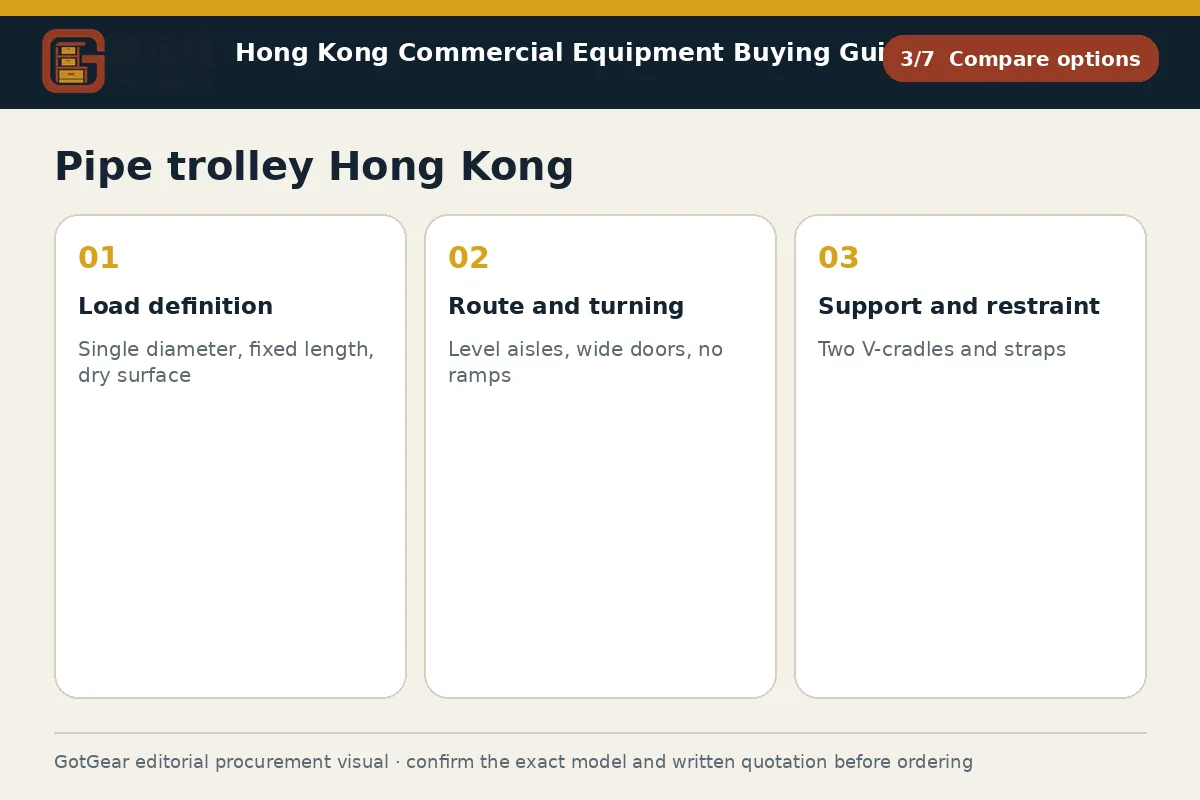
| Load definition | Single diameter, fixed length, dry surface | Mixed diameters, oily/galvanised surfaces, variable lengths and bundle counts | List lengths, ODs, mass per piece/bundle, surface and end details; photos |
| Route and turning | Level aisles, wide doors, no ramps | Tight goods-lifts/doorways, ramps, public areas, time windows | Measured widths/heights, tightest turn, slope, lift car/door sizes, sketches |
| Support and restraint | Two V-cradles and straps | Adjustable supports, defined overhangs, anti-roll chocks, liners | Required support spacing, overhang limits, strap type/rating, anchor layout |
| Capacity and geometry | UDL within deck, centred COG | Concentrated loads, off-centre COG, slope derating, overhangs | Model datasheet, geometry envelope, per-caster ratings, stability notes |
| Wheels and braking | Indoor smooth floors, non-marking tyres, parking brake | Mixed surfaces, grates/thresholds, need directional locks or chocks | Floor condition notes, min turning space, requested wheel/lock types |
This framework helps buyers create comparable written enquiries. Final model specifications, availability, delivery and commercial terms must be confirmed in a formal quotation.
Pipe trolley Hong Kong — Plan support spacing, end overhang and restraint
Translate the load definition into support spacing, allowable end overhang and restraint requirements. State where the pipe must be supported to limit sag and ovalisation, referencing any guidance from the pipe supplier. For multiple short supports, give a target centre-to-centre spacing and maximum end overhang you deem acceptable, then ask vendors to confirm feasibility or propose alternatives. If mixed diameters are expected, call for adjustable V-cradles with protective liners and stop-ends that prevent rolling while allowing controlled loading and unloading. Trolley load stability Hong Kong considerations include humid surfaces and condensation; specify non-slip liners if surfaces may be wet.
Describe the restraint method: number and placement of straps, rated capacity of each strap as an example starting point only to be confirmed in writing, and whether edge protection is required to avoid damage. Note if pipe ends must project beyond the trolley for clearance or identification and what overhang limits apply during turns and on ramps. Request drawings showing the geometry envelope (pipe diameter range, cradle height and distance between supports) and the available anchor points. Where cut lengths or short off-cuts are moved, ask for provisions to block or chock small items within the cradle without metal-on-metal contact.
Pipe trolley Hong Kong — Verify capacity and permitted load geometry by model
Before committing to a purchase, verify that the specific model’s rated capacity and its permitted geometry envelope match your defined load and route. Request the manufacturer’s datasheet and operating manual showing how capacity is stated (uniformly distributed load or point/line loads), the maximum recommended support spacing, and any derating for slopes, uneven floors or dynamic manoeuvres. Confirm that the expected centre of gravity remains within the wheelbase at all times, including during cornering and when lifting the handle. If braking while on a ramp is a possibility, ask for guidance on parking brakes, wheel chocks and directional locks.
Wheel and bearing selection must suit your floors and gradients. For example, as starting points only (to be confirmed), non-marking elastomer wheels may reduce vibration on tiles, while harder compounds can be more suitable for smooth, dry concrete. Request evidence of per-caster load ratings, turning stability notes, and the maximum allowable overhang per end for your pipe diameter. Where operations cross public spaces or sensitive venues, include a manual handling risk assessment and ensure compliance with Hong Kong requirements; ask for any available stability test reports, exploded parts diagrams and maintenance instructions. Written quotations and model documentation should explicitly confirm capacity at your declared load geometry and route constraints; those documents prevail in evaluation.
Pipe trolley Hong Kong decision checklist
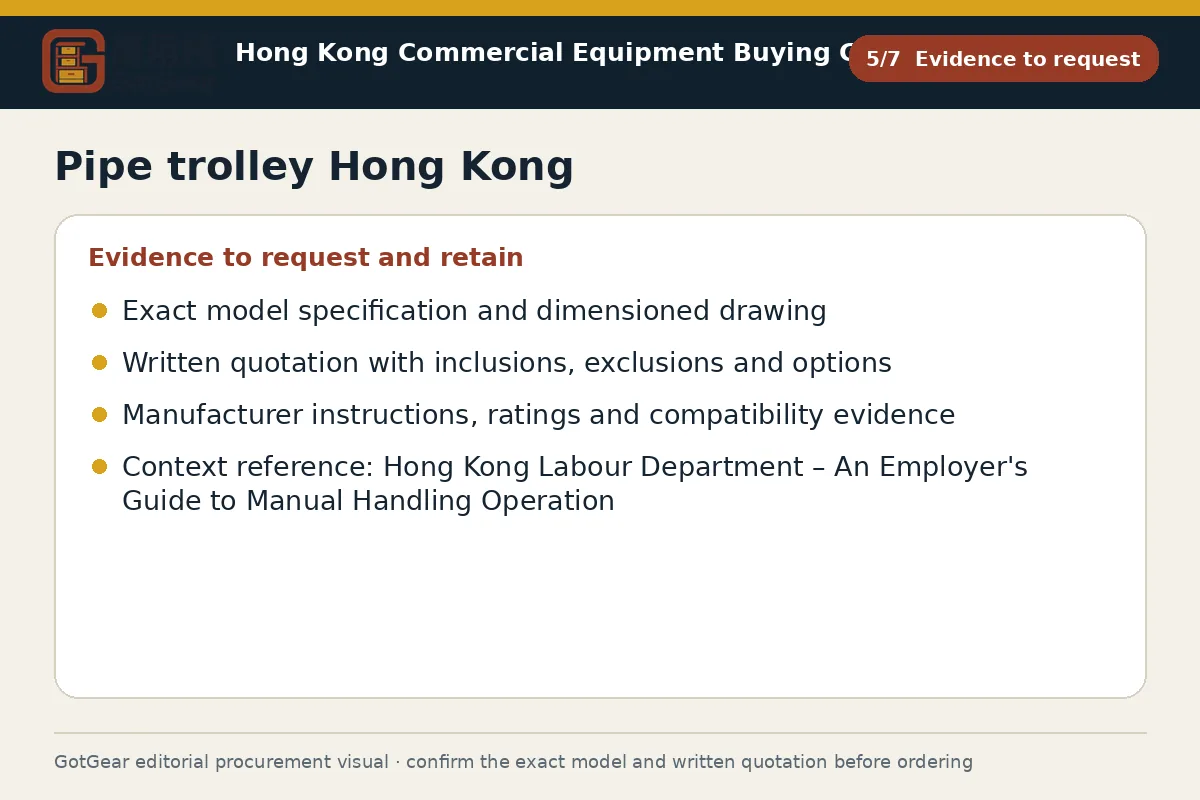
Confirm the longest pipe, largest diameter, total mass per move and surface condition, then specify bundle form and whether mixed sizes will be transported together. Map the exact route, measure the tightest turn, lowest clearance and smallest doorway or lift, and identify level set-down points. Define support spacing, maximum end overhang and the restraint method; require drawings showing anchor points and geometry. Compare written quotations line-by-line: rated capacity method at your declared geometry, wheel and brake type, cradle design, finish, and included accessories. Ask for the model datasheet, operating manual, per-caster ratings and stability guidance. On receipt, inspect welds, cradle liners, anchor points, wheel fasteners and brakes, and verify labels match the quotation and model documentation; written specification and quotation prevail.
- Operating use, quantity and expected frequency
- Dimensions, capacity, material and accessory requirements
- Delivery address, floor, goods lift and loading window
- Required documents, acceptance checks and after-sales arrangements
Key points for pipe trolley Hong Kong
Hong Kong sites often hinge feasibility on tight goods-lift cars, narrow fire doors and limited loading windows administered by property management offices. Record lift car depth, door size, allowable lift load and booking conditions; include photos for approval. Where long loads traverse public concourses or school corridors, plan marshals, barriers and quiet-hour moves to reduce conflict. Humidity and rain can leave floors wet and pipes slippery; specify non-slip contact materials and parking brakes accordingly. Request bilingual documentation if your institution requires it, and align moves with building rules before ordering.
Questions about pipe trolley Hong Kong
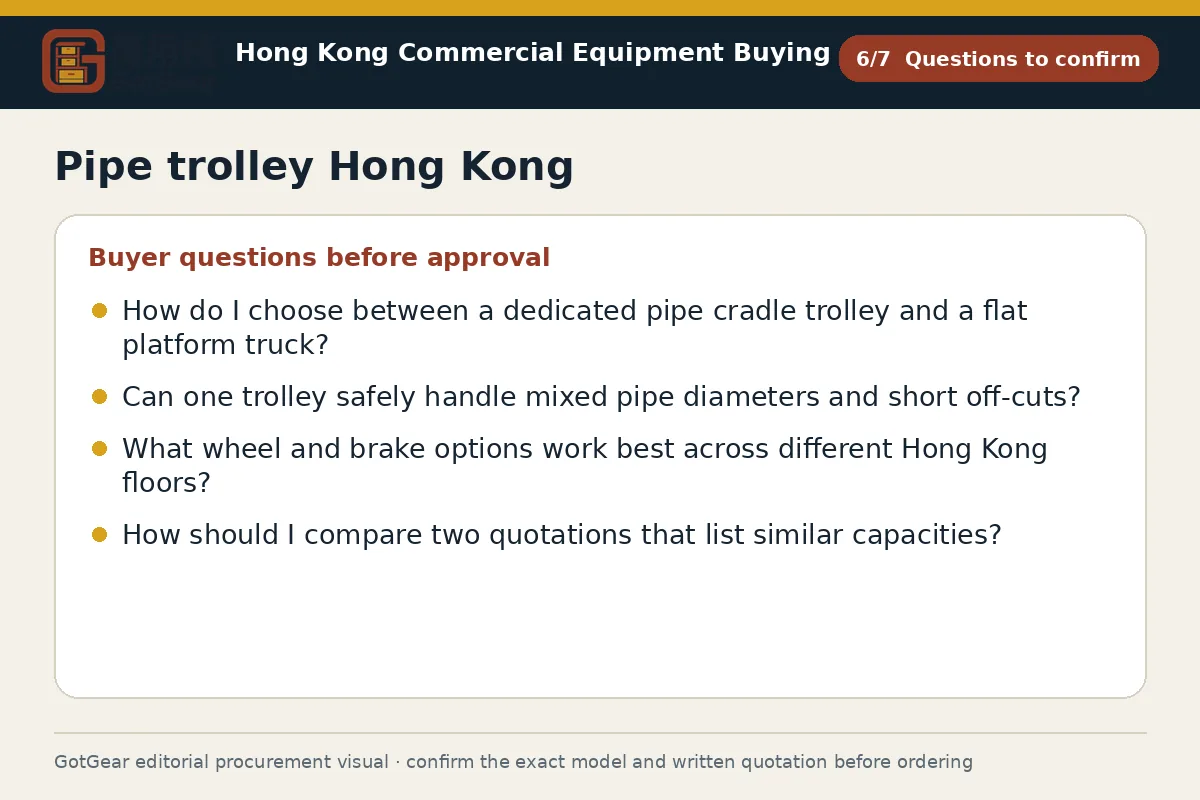
How do I choose between a dedicated pipe cradle trolley and a flat platform truck?
Use a cradle trolley when round sections must be positively located and restrained; it improves stability and reduces rolling. A flat truck suits boxed or crated pipes with flat bases. If your loads vary, ask for adjustable V-cradles or removable cradles on a flat deck. Always confirm the chosen model’s capacity and permitted load geometry in writing.
Can one trolley safely handle mixed pipe diameters and short off-cuts?
Yes, if it has adjustable cradles, low-friction height adjustment and secure strap anchor points. Specify the full diameter range and smallest lengths, then request drawings showing how small items are blocked. Stability with off-centre or partial loads may require additional chocks. The supplier’s model documentation and written quotation should confirm permitted configurations.
What wheel and brake options work best across different Hong Kong floors?
Non-marking elastomer wheels often protect indoor finishes and reduce noise; harder wheels can roll easier on smooth concrete or when loaded. Parking brakes and directional locks improve control on ramps and in tight corridors. Match wheel size, tread, bearing type and braking to your measured route; the manufacturer must confirm per-caster ratings and any slope limitations in writing.
How should I compare two quotations that list similar capacities?
Check how capacity is defined: uniformly distributed load versus point loads, permitted overhang, support spacing and stability notes. Ensure both quotes confirm capacity at your declared geometry and route. Compare cradle design, liners, strap anchors, wheel material and brakes, finish and included accessories. The model datasheet and written quotation should align; those documents govern evaluation and approval.
Continue with closely related procurement topics
These pages share equipment, operating or decision-stage signals with this guide.
Drum trolley Hong Kong
This quotation checklist helps facilities and EHS teams plan for drum trolley Hong Kong. It guides you on drum size, filled mass, orientation, pickup method, retention and route conditions, and is provided by GotGear.
Read the guide
Glass trolley Hong Kong
GotGear guide to glass trolley Hong Kong explains how to specify equipment and plan sites by comparing rated capacity, support geometry, contact materials and restraints, pane size, loading method and route clearances.
Read the guide
ESD trolley Hong Kong
This guide reviews resistance ranges, grounding, shelf and wheel materials, accessories, test evidence and maintenance checks for ESD trolley Hong Kong needs at Hong Kong sites. The information is from GotGear.
Read the guide
Equipment trolley Hong Kong
Use this request for quotation checklist from GotGear for equipment trolley Hong Kong to confirm dimensions, total mass, load distribution, wheel and brake suitability, access routes, controls, and site fit.
Read the guide