
For outdoor tent unloading access planning Hong Kong, issue a site brief with route measurements, obstacle photographs, booking or permit steps, unloading restrictions, permitted times and contact details. Confirm responsibilities with the venue and supplier, but do not treat the brief as a promise of vehicle access, delivery timing or handling capability.
Vehicle and time restrictions for outdoor tent unloading access planning Hong Kong
Clarify which vehicle types are permitted to approach the unloading point, and who authorises them. Ask the venue or building management office to confirm if box vans, tail‑lift trucks or flatbeds are acceptable, and whether dangerous‑goods restrictions, tunnel routes or estate gates affect arrival. Capture any maximum gross vehicle weight, turning radius and axle limits. If access is via a private road or podium, confirm the advance registration method for driver details and number plates in both English and Chinese where required.
Record the permitted delivery windows and any curfews. Some sites operate short loading windows controlled by security; request the booking mechanism, minimum notice period, and whether multiple trips are allowed. As an example starting point, ask if 30–60 minute slots are typical, then have the exact slot confirmed in writing by the venue. Note idling limits, designated waiting areas, and whether a standby marshal is needed for crowd control during public events. If there is height control (for example, a car‑park barrier), obtain the posted clearance as a photographed sign and measured value, both to be reconfirmed by management. Include rules on reversing with a banksman, chocking wheels on slopes, and any requirement for spill kits or fire extinguishers to be present at the unloading bay, where applicable to the model and venue.
Site contacts for outdoor tent unloading access planning Hong Kong
Name the responsible site contact for receiving coordination and provide a reachable backup. Capture job title, company, mobile number, WhatsApp, and email, and confirm language capability (e.g., Cantonese and English) so the driver and supplier can communicate effectively. Specify the hours when each contact is on duty, who has authority to sign delivery notes, and who can approve route changes on the day. If the venue uses a control room or building management office, include that hotline and incident‑reporting procedure.
Define what each contact is responsible for: lift or gate bookings, arranging temporary barriers or cones, placing floor or wall protection, and requesting additional security if the route passes through public areas. State the preferred notification sequence, such as “supplier notifies receiving contact 30 minutes before arrival; contact alerts security and the venue representative.” Add an escalation path for disputes or delays, naming the manager who can approve overtime unloading or a revised slot. If multiple stakeholders are involved (school campus, government venue, or mall), confirm which entity’s written instructions prevail, and ensure the brief is circulated in bilingual form if the site expects it.
What should buyers compare for outdoor tent unloading access planning Hong Kong?
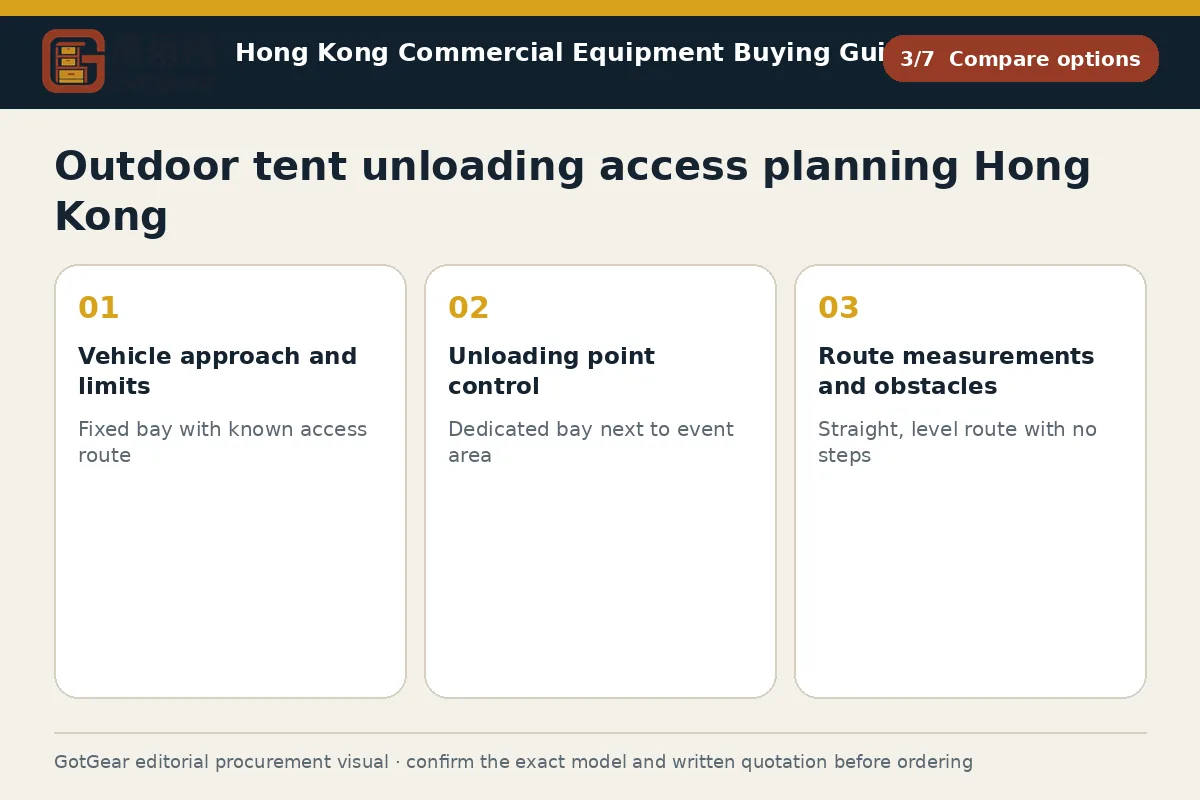
| Criterion | Straightforward requirement | More complex requirement | Evidence to provide |
|---|---|---|---|
| Vehicle approach and limits | Fixed bay with known access route | Conditional access via private road or podium ramp | Map with photos; posted height/width/weight limits; pre‑registration steps |
| Unloading point control | Dedicated bay next to event area | Shared dock with security‑booked slots and marshalling | Bay name, distance to build area, slot length, marshal contact |
| Route measurements and obstacles | Straight, level route with no steps | Mixed surfaces, kerbs, low trees or narrow turns | Measured widths/heights, gradient estimate, obstacle photos with scale |
| Permits and bookings | Simple security check‑in only | Venue permits, lift bookings, or public‑space approvals | Responsible party, lead times, bilingual forms, approval evidence |
| Receiving team and equipment | Driver unloads with tail‑lift/trolley | Venue porters or extra gear needed for heavier items | Who provides labour/equipment, method statement, storage/waste plan |
This framework helps buyers create comparable written enquiries. Final model specifications, availability, delivery and commercial terms must be confirmed in a formal quotation.
Route dimensions and obstacles in outdoor tent unloading access planning Hong Kong
Measure and document the entire movement route from kerbside to the tent build area. Start with gate width and height, then any kerbs, ramps, bollards, planters, low trees, signage, or temporary structures. Photograph each obstacle with a tape measure in view. Where gradients are present, capture a slope estimate as an example starting point (e.g., 1:10), to be verified by a competent person. For grass or soft ground, note the soil condition after rain and whether ground protection or track mats are required to move pallets and frames without damage.
Request the supplier’s packed dimensions and weights by item (e.g., longest pole bundle, heaviest crate), as example starting points to be confirmed in the model specification and formal quotation. Compare these against route constraints: lift cars (if any), door leaf clear widths, vestibules, and turning areas. If the route passes under canopies or archways, confirm clearance with a pole bundle held upright. Where steps or kerbs exist, decide if a ramp is needed and who provides it. Include a sketch with measured radii for turns in corridors or between planter beds. For outdoor tent unloading access planning Hong Kong, state whether temporary matting is approved by the venue and who installs and removes it without leaving residue or damage.
Receiving responsibility during outdoor tent unloading access planning Hong Kong
Define receiving responsibility clearly between the supplier, venue and organiser. Confirm who unloads (driver only, driver plus helper, or venue porters), what handling equipment is available (tail‑lift, pallet jack, trolleys), and who brings each item. If a crane, hoist or extra manpower might be required for heavier frames, flag this as a provisional assumption to be validated by the supplier’s written method and the venue’s approval. Identify a safe staging area under cover in wet weather, and whether security will cordon off public walkways during handling.
Set acceptance checks at handover: count packages against the packing list, inspect for obvious transit damage, verify that key items such as frame sections, canopies, guy lines, stakes, and repair kits are present, and photograph any issues before moving goods. As an example starting point, agree that discrepancies are noted on the delivery note and reported within the same day, subject to the supplier’s terms stated in the formal quotation. Confirm who removes packaging and dunnage, how waste is handled on site, and whether reusable crates must be returned immediately. If the tent build begins later, specify who stores goods, under what conditions (humidity and corrosion risk), and who assumes risk and insurance during that period.
Outdoor tent unloading access planning Hong Kong decision checklist
Confirm the permitted vehicle class, approach route and unloading slot with the venue in writing, including any pre‑registration steps for drivers and plates. Measure the route end‑to‑end and photograph obstacles with a tape or ruler for scale. Request the supplier’s packed dimensions and weights per item, handling method, and any special tools needed. Name a primary receiving contact and backup, with duty times and language preferences. State who unloads, provides trolleys or ramps, and installs temporary protection. Specify staging, storage and waste arrangements. Compare quotations on the same assumptions, then re‑confirm the plan one day before delivery. On receipt, count, inspect, note discrepancies on the delivery note, and share time‑stamped photos.
- Operating use, quantity and expected frequency
- Dimensions, capacity, material and accessory requirements
- Delivery address, floor, goods lift and loading window
- Required documents, acceptance checks and after-sales arrangements
Key points for outdoor tent unloading access planning Hong Kong
Hong Kong sites often mix private‑estate rules with public‑space controls, so confirm who sets the unloading conditions and time windows. Tight lanes, podium ramps and car‑park height bars can constrain trucks; get the posted clearances and reconfirm in writing with the management office. As an example starting point, expect short loading slots and active security oversight at malls and institutional venues. Humid and rainy weather can complicate staging, so plan a covered holding area. This guidance is operational, not legal advice; venue and supplier documentation prevails.
Questions about outdoor tent unloading access planning Hong Kong
What vehicle details should I provide for tent delivery to my site?
State the permitted vehicle type, approximate slot time, approach route, and any posted height, width or weight limits. Include driver and number‑plate registration steps, if required by the management office. Add the unloading point, waiting area, and whether reversing guidance is available. Treat all figures as site‑specific and confirm them in the venue’s written instructions and the supplier’s formal quotation.
How do I know if a tail‑lift or extra manpower is necessary?
Ask the supplier for packed weights and longest item lengths, plus their recommended handling method. Compare these with your route, slopes and obstacles. If items exceed safe manual handling or must clear kerbs and steps, request a method statement and venue approval. Consider this an example assessment only; the supplier’s model specification and written quotation govern the final method.
What should I compare in delivery and unloading sections of quotations?
Check inclusion or exclusion of unloading labour, tail‑lift, trolleys, ramps, ground protection, and waste removal. Align time assumptions (slot length, overtime) and confirm who books loading bays and security. Verify packed dimensions, weights and delivery timing commitments. Use the same site brief for all bidders so differences are clear. The supplier’s formal written quotation and the venue’s conditions take precedence.
What if access changes on the day due to weather or venue instructions?
Escalate to the named receiving contact and their manager, document the change, and agree a revised route or slot before proceeding. If wet weather affects ground conditions, consider moving to a covered staging area or delaying unloading with venue consent. Treat any workaround as temporary and subject to written confirmation by the venue and supplier, whose documentation prevails.
Continue with closely related procurement topics
These pages share equipment, operating or decision-stage signals with this guide.
Folding tent anchoring checklist Hong Kong
Use the folding tent anchoring checklist Hong Kong to assess surface exposure, confirm layout and anchoring, and inspect fixings and ballast. Record checks, assign monitoring and include GotGear in your documentation.
Read the guide
Custom canopy Pantone colour matching Hong Kong
GotGear explains how to prepare files and request proofs for custom canopy Pantone colour matching Hong Kong. It also covers custom canopy gradient printing Hong Kong and custom canopy photo resolution printing Hong Kong.
Read the guide
Printed gazebo sidewall door layout Hong Kong
Use this checklist to finalise door positions and visitor flow for printed gazebo sidewall door layout Hong Kong and to plan canopy sidewall cable access Hong Kong. Keep artwork clear of openings during setup with GotGear.
Read the guide
Canopy tent weights for concrete Hong Kong
See the GotGear guide to canopy tent weights for concrete Hong Kong, pop up gazebo weights for tiled floor Hong Kong and canopy tent ground anchors for grass Hong Kong. Check venue approval and installation requirements.
Read the guide