
Kitting trolley Hong Kong — Present the correct parts in the required order and orientation while keeping the load stable in transit. Confirm dimensions, capacity and accessories for the exact kit, and trial access and replenishment before wider deployment.
Kitting trolley Hong Kong — Define kit content, sequence and replenishment method
Start by freezing the bill of materials for each kit: item codes, descriptions, quantities, lot/serial handling, and any orientation or side-specific presentation notes. Map the pick/use sequence so components are presented left-to-right or top-to-bottom in the order the technician needs them. If documentation or a traveller is part of the kit, state the size, language and protection level for sleeves or clipboards, and whether signatures are required at handover.
Define the replenishment principle before you engage suppliers. State whether you will run two-bin, card-based kanban, e-kanban, or a timed min–max review, plus who initiates the trigger. Record the packaging you receive from upstream (e.g., tote size, inner bags) so bin sizes and dividers are compatible. As an example starting point only, you might request an inclined shelf pitch of 10–15 degrees to maintain first-in-first-out and visibility; confirm any angle in the written brief. Ask each supplier for a simple kit map drawing showing bin layout, presentation order and operator reach. Include a trial plan: the pilot area, duration, and pass/fail criteria for access, stability, mis-pick rate and replenishment time, with the understanding that model specifications and a formal written quotation prevail.
Kitting trolley Hong Kong — Plan identification, error prevention and access
Specify how every location and container will be identified and how errors will be prevented at source. Request label holders sized for bilingual English/Chinese inserts, durable barcodes (state symbology), and colour rules (e.g., fasteners blue, gaskets green). For higher control, note if you require RFID-ready positions, photo labels, or shadow-board outlines. Add poka‑yoke details such as keyed dividers or shaped foam so wrong parts will not fit, and highlight any EHS flags (sharp edges, pinch points) that need warnings.
Access planning should match the operator and the aisle. Declare working side(s) (one-sided against a line, or two-sided for shared cells), maximum reach depth for safe pick, handle height range, and whether shelves need tool-free adjustability. State whether lids, doors or covers are required and how they will be latched during motion. Include caster type (quiet, non-marking), brake arrangement (total lock or directional), and antistatic options if electronics are present. Request site photos of the narrowest doorway or goods lift and note turning spaces at corridor corners. Ask suppliers to describe their proposed error-proofing and identification bill-of-materials in the quotation, including any proprietary holders they intend to use.
What should buyers compare for kitting trolley Hong Kong?
| Criterion | Straightforward requirement | More complex requirement | Evidence to provide |
|---|---|---|---|
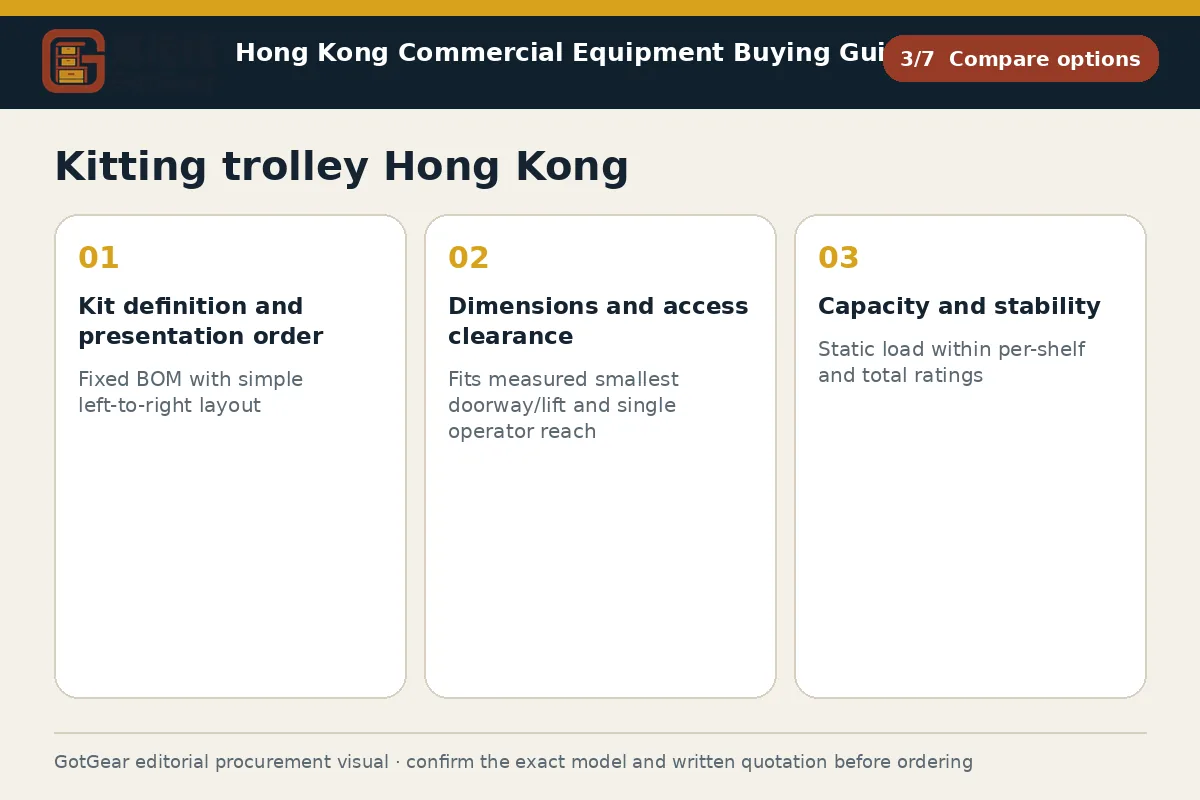
| Kit definition and presentation order | Fixed BOM with simple left-to-right layout | Sequence with orientation cues, mixed fasteners and documents | Provide BOM, photos of ideal presentation, required language for labels |
| Dimensions and access clearance | Fits measured smallest doorway/lift and single operator reach | Multi-site route with tight bends and public-area passages | Submit doorway/lift sizes, turning diagram, reach limits, site photos |
| Capacity and stability | Static load within per-shelf and total ratings | Dynamic movement over ramps, thresholds and lifts | List example max kit weights, heaviest container, ramp gradient; confirm in brief |
| Identification and error-proofing | Colour labels and fixed holders for paper IDs | Barcodes/RFID, photo labels, shaped dividers or foam | Share label artwork, symbology, IT contact, and any EHS warnings |
| Replenishment and empty handling | Two-bin manual kanban and simple empty return | Closed-loop with e-kanban and dedicated empty racks | Provide process map, trigger points, container types, and return staging areas |
This framework helps buyers create comparable written enquiries. Final model specifications, availability, delivery and commercial terms must be confirmed in a formal quotation.
Kitting trolley Hong Kong — Size locations for parts, containers and documents
Size storage locations to the actual containers and paperwork you will use, not to generic bins. Measure the largest tote’s external length, width and height, plus the heaviest expected fill weight, and state these in the enquiry. Record shelf depth, lip height for retention, and whether you require angled flow lanes, flat shelves, or small‑parts drawers. Specify the number and size of document holders (A4 or A3) and whether you need clipboards, magnetic pouches or sealed sleeves for humid areas.
State the overall trolley size constraints so the unit will clear tight doors and lifts, and give the minimum turning radius at the narrowest bend. As a starting point only, you might target each shelf to carry a nominal 25–40 kg with a clear safety margin; confirm required ratings in the written brief and quotation. If corrosion is a concern, ask for options such as powder‑coated frames or stainless fixings, subject to site and model. To anchor comparative engineering proposals for a kitting trolley in Hong Kong, request a dimensioned layout drawing showing bin counts, usable openings and accessory placements, and list any compatibility needs with existing containers.
Kitting trolley Hong Kong — Check route, return and empty-container handling
Walk the full route before ordering. Record the start point, every doorway, corner, gradient, threshold and lift that the trolley will cross, and note floor type and expansion joints. As an example starting point only, capture the steepest ramp you expect to climb and descend, then ask suppliers to state braking and wheel recommendations for that gradient. Confirm where the trolley will park, how it will be restrained, and whether it passes through public areas that require quiet, non-marking wheels and corner bumpers.
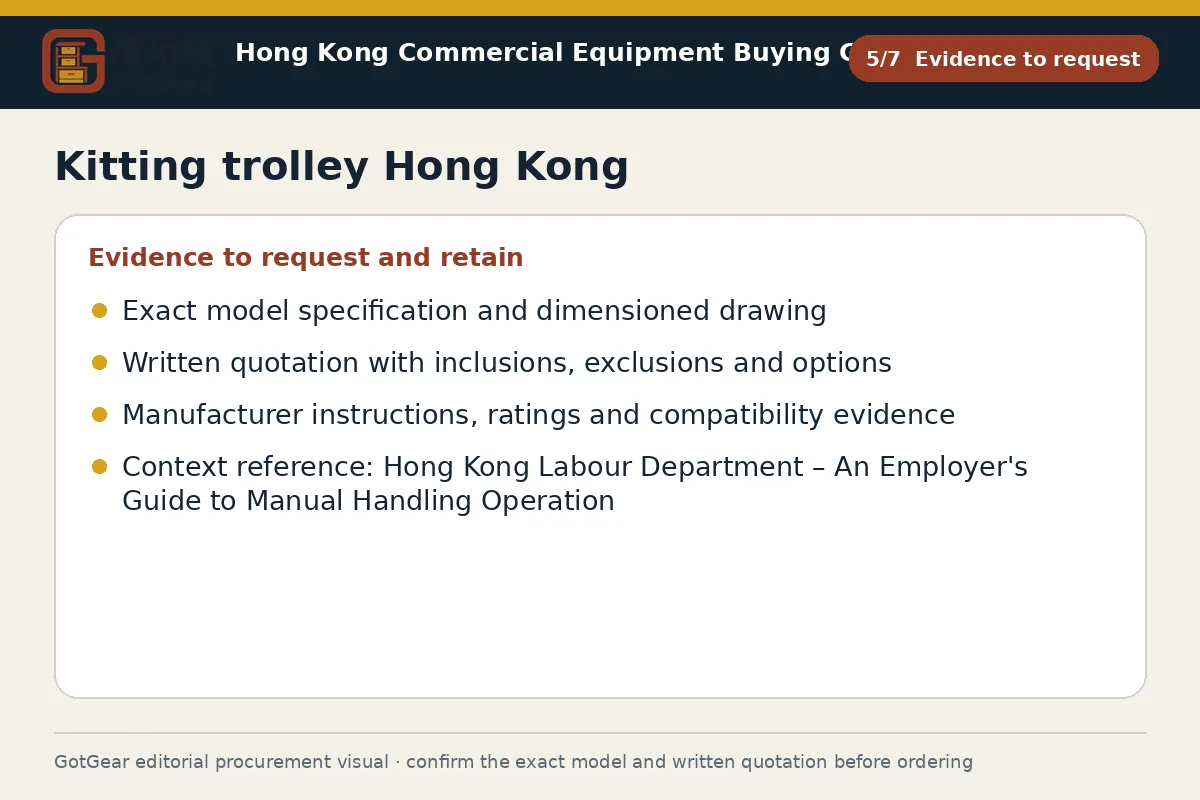
Define the return and empty-container loop. State whether empties nest, stack or need racks; how damaged parts and paperwork are quarantined; and where intermediate staging occurs during loading windows set by building management. Ask for proposals on hooks, rails or lower shelves dedicated to empties, and whether a tow-eye or train operation is envisaged. In your evaluation, compare quotations on route suitability, turning circle, and push/pull force test data where offered. On receipt, inspect dimensions, caster specification, weld quality, shelf adjustability and label fixtures; function-test brakes and directional locks. Where loads are heavy or routes include ramps, request manufacturer instructions on safe operation and maintenance, subject to your site, insurer and the selected model.
Kitting trolley Hong Kong decision checklist
Confirm the frozen kit list, presentation order and replenishment method, then measure containers, shelf openings, doorways, lifts and turning spaces. Record route constraints, gradients and public-area crossings. Request written quotations that specify overall and shelf dimensions, load ratings, caster and brake types, identification hardware, and accessories for documents and empties, plus a drawing of the proposed layout. Compare quotes line by line on the same parameters and note any exclusions. Before approval, secure management-office coordination, IT input if barcodes or RFID are used, and EHS sign-off. On receipt, verify dimensions, finish, fixings, labels and brake function, and obtain manufacturer instructions and any test data appropriate to the chosen model and your site.
- Operating use, quantity and expected frequency
- Dimensions, capacity, material and accessory requirements
- Delivery address, floor, goods lift and loading window
- Required documents, acceptance checks and after-sales arrangements
Key points for kitting trolley Hong Kong
Hong Kong sites often mix tight industrial-building corridors with busy shared lifts. Measure the narrowest doorway and goods-lift car, and book delivery and testing slots with the management office to avoid peak loading windows. Humidity can affect labels and mild-steel finishes, so specify suitable materials and document sleeves. If the kitting route passes public areas, choose quiet, non-marking wheels and bumpers. For institutional approvals, prepare bilingual identification samples and a simple route plan. Treat any example dimensions, capacities or gradients here as starting points only and confirm all requirements in the written brief and the supplier’s formal quotation.
Questions about kitting trolley Hong Kong
Which casters should we choose for mixed concrete and tile floors?
Select non-marking, quiet casters sized for your worst joints and thresholds, and match the bearing type to load and distance. If the route includes ramps or lifts, specify directional locks on at least one swivel for control. As an example starting point only, shortlist 125–160 mm diameters for smoother roll, then confirm the exact size and brake type in the written brief and the supplier’s quotation.
How should we handle labels and documents in bilingual operations?
Use rigid label holders sized for English/Chinese inserts and moisture-resistant pouches for route cards. Fix holders so they cannot shake loose in lifts or on thresholds. Where scanning is used, standardise barcode symbology and placement. Provide suppliers with sample artwork and font sizes, then confirm materials, print method and location drawings in the formal quotation to align with institutional approvals.
What evidence should we request from manufacturers for heavy kits?
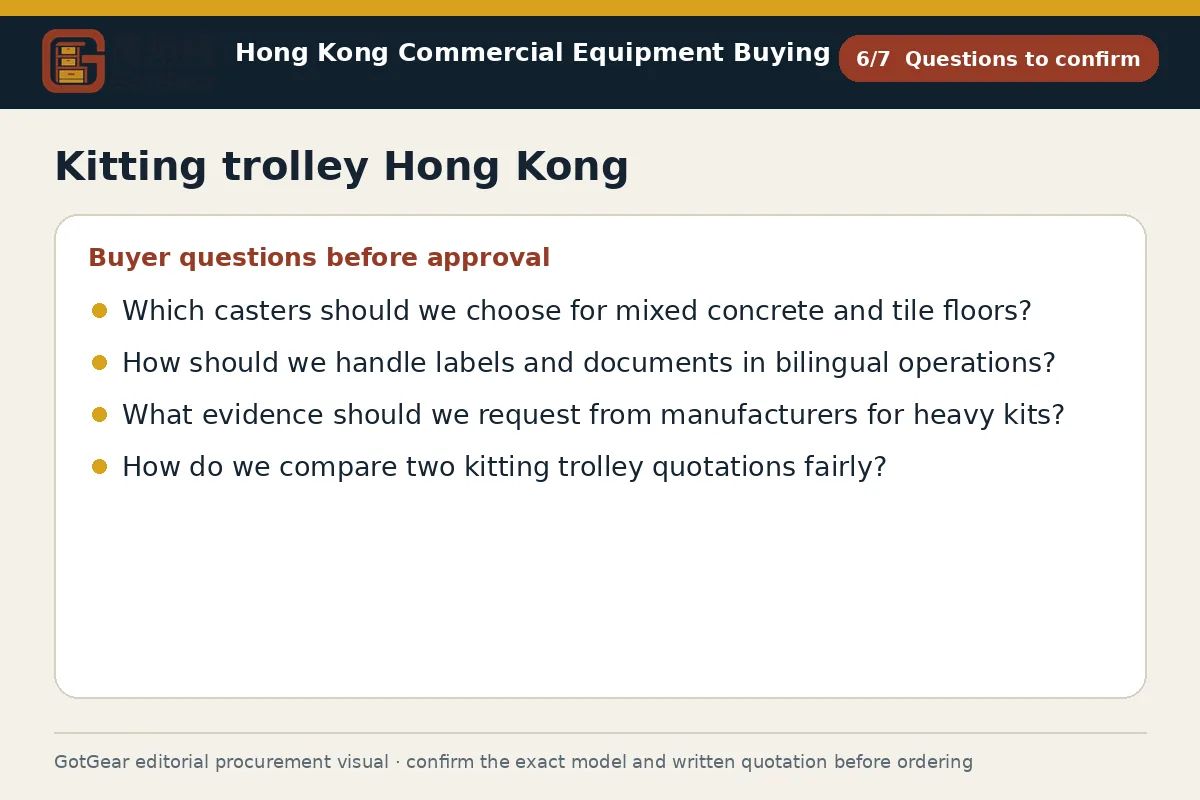
Ask for shelf and frame load ratings, caster specifications with dynamic capacities, and user instructions covering brakes and slopes. Where routes include ramps, request recommended maximum operating gradient for the proposed configuration. Treat any figures as model-specific and site-dependent, and ensure the supplier’s formal quotation and drawings carry the definitive ratings that match your measured route and containers.
How do we compare two kitting trolley quotations fairly?
Create a comparison table covering overall dimensions, usable shelf openings, total and per-shelf capacity, wheel and brake types, identification hardware, and included accessories. Note any layout drawings, exclusions and warranty statements. Validate that both quotes fit your narrowest door and lift and support your kit’s containers. Where assumptions differ, ask for revised written quotations so model specifications prevail.
Continue with closely related procurement topics
These pages share equipment, operating or decision-stage signals with this guide.
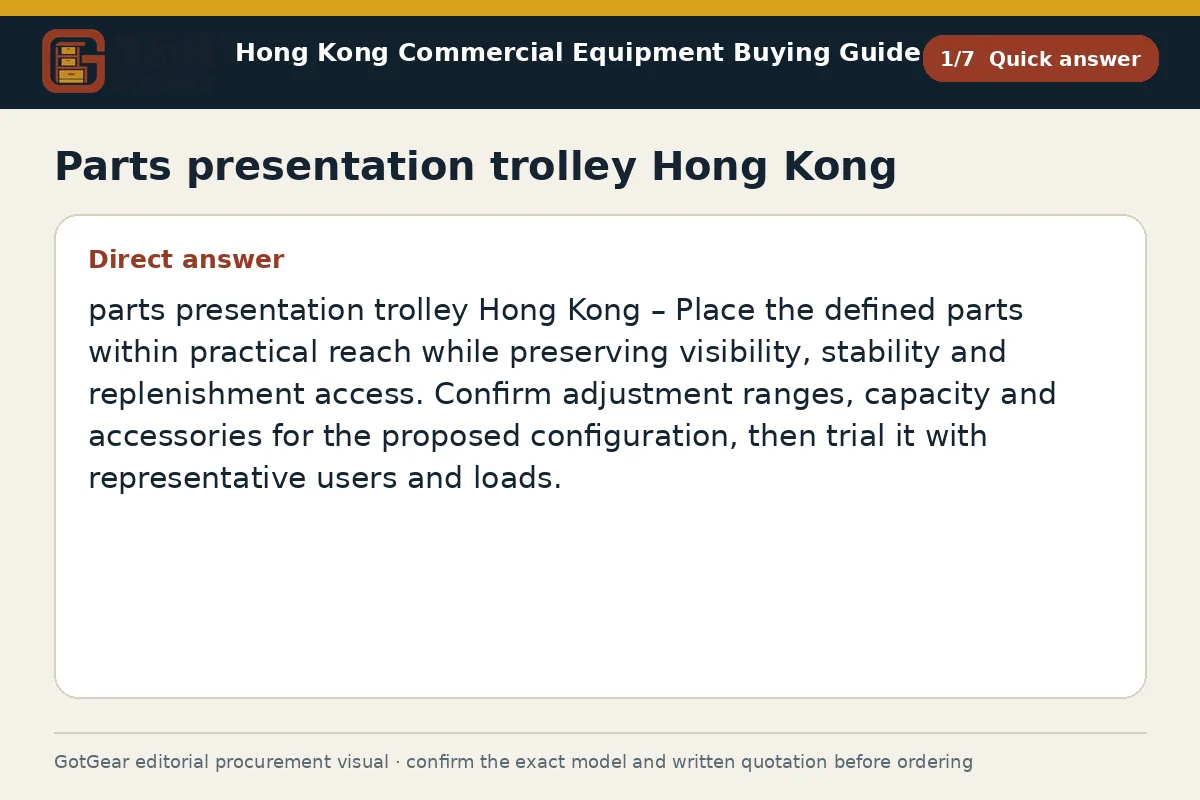
Parts presentation trolley Hong Kong
This checklist helps facilities teams define parts presentation trolley Hong Kong needs, covering part sizes, container types, presentation height and angle, replenishment, empty returns and workstation access with GotGear.
Read the guide
Drum trolley Hong Kong
This quotation checklist helps facilities and EHS teams plan for drum trolley Hong Kong. It guides you on drum size, filled mass, orientation, pickup method, retention and route conditions, and is provided by GotGear.
Read the guide
Gas cylinder trolley Hong Kong
GotGear's checklist for a gas cylinder trolley Hong Kong outlines key considerations such as cylinder size, filled mass, valve guards, correct loading, safe gradients, and checks with the trolley manual and site rules.
Read the guide
Panel trolley Hong Kong
GotGear offers a practical guide to panel trolley Hong Kong that helps facilities record dimensions, mass, surface finishes, support angles, contact materials, retention methods and route clearances.
Read the guideRelated topic indexOpen more English procurement pages1 topics
Browse additional equipment families, applications and procurement questions relevant to a wider buying brief.