
Production line trolley Hong Kong — Support takt and replenishment needs without creating excess work in progress or blocked access. Validate the loop using representative loads and users, then verify trolley dimensions, capacity and instructions for the task and site.
Production line trolley Hong Kong — Map replenishment, transfer and collection loops
Start by drawing the end-to-end loop for each material family: inbound stores to workstation, workstation to quality check, and completed items to consolidation or despatch. Note every pick and drop point, who performs each movement, and the handover signal (card, scan or call). When specifying a production line trolley Hong Kong, operations teams should first map replenishment, transfer and collection loops against takt or cycle triggers. Record aisle widths, turning spaces, floor transitions, slopes and lift access, then mark quiet zones near offices where noise and traffic must be minimised.
Capture constraints others often miss: door clear openings, corner radii, thresholds, mezzanine changes and weekend or night loading windows. Time real routes with representative loads, not empty trials. As an example starting point (to be confirmed onsite), reserve a minimum turning box slightly larger than the trolley diagonal and leave tolerance for hand clearance at pinch points. Sketch queue areas outside goods lifts and define right-of-way at main crossings. Translate this into a route sheet naming each stop, standard dwell time, maximum queue length, and contingency path when a lift is down. Only then shortlist trolley footprints, handle positions, wheel types and braking that fit the mapped loop, not the other way round.
Production line trolley Hong Kong — Separate full, empty, rejected and completed loads
Keep status separation physical and unmistakable. Allocate distinct bays, shelves or roll-cage compartments for full, empty, rejected and completed loads, and label them in bilingual format. Colour-coded totes, shelf-edge sign holders and barcode plates cut errors; request these as listed components in the quotation. Where spillage is a risk, specify lips, mesh or strap points for the “full” zone. For rejected material, define a covered or lockable area with tamper-evident tagging so it cannot re-enter production by mistake.
Write the segregation logic onto the trolley itself: arrows for direction of flow, shadow labels for container count, and parking marks for brakes-on. In the enquiry, ask for options such as removable dividers, adjustable shelf pitch and tote stop-bars. If different teams manage collection and replenishment, use distinct handle colours and ID panels so “empties” are never taken to the wrong area. Where the process involves hazardous, fragile or food-contact items, request finish, liner or containment details suitable for that duty, subject to your EHS or QA sign-off and any applicable Hong Kong requirement confirmed by the competent authority or insurer.
What should buyers compare for production line trolley Hong Kong?
| Criterion | Straightforward requirement | More complex requirement | Evidence to provide |
|---|---|---|---|
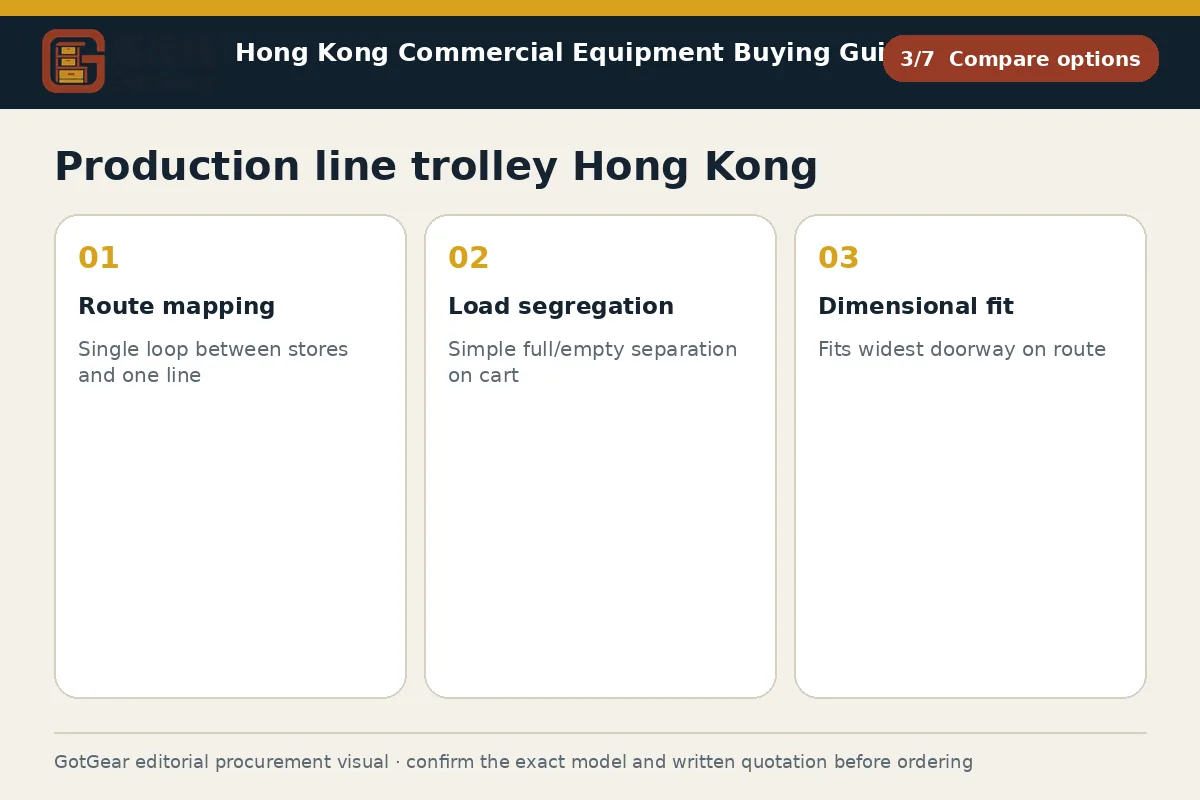
| Route mapping | Single loop between stores and one line | Multiple loops with shared corridors and lift constraints | Scaled plan with door/lift sizes, turning boxes, queue areas |
| Load segregation | Simple full/empty separation on cart | Full, empty, rejected and completed with lockable or covered zones | Bilingual labels plan, divider layout, quarantine method |
| Dimensional fit | Fits widest doorway on route | Fits lift car, lobbies and tight corners with clearance | Measured openings, corner radii, lift car drawings |
| Ergonomics and safety | Fixed shelves within general reach | Adjustable/tilting shelves, brakes, noise and push/pull limits | Height ranges, shelf pitch, brake type, wheel diameter/material |
| Documentation and acceptance | Basic spec sheet | Dimensioned drawings, maintenance/user instructions, pilot sign-off | Supplier drawings, inspection checklist, commissioning note |
This framework helps buyers create comparable written enquiries. Final model specifications, availability, delivery and commercial terms must be confirmed in a formal quotation.
Production line trolley Hong Kong — Set quantities and presentation at each workstation
Define the quantity that must be visible and reachable at each workstation without overstocking or blocking access. Use small, frequent drops where takt is tight, and set minimum/maximum levels with clear triggers. Translate that into trolley presentation: number of SKU lanes, bin footprint, orientation (labels outward), and ergonomic reach zones. As an example starting point (to be confirmed), keep first-grab parts between mid-thigh and chest height and tilt shelves slightly toward the operator for visibility without sliding in transit.
Specify interfaces, not just capacity: bin outer dimensions, label size, Kanban card pockets, and any ESD mats or liners if electronics are handled under your site policy. In Hong Kong’s humid conditions, consider galvanised or stainless components and sealed bearings where cleaning or condensation is expected; confirm material finishes in writing. Ask suppliers for dimensioned drawings showing shelf pitch increments, clear openings, guard heights and wheel centres. In quotes, compare like-for-like on footprint, usable shelf area, per-shelf and total uniform distributed load, wheel material and diameter, brake type, and handle height. On receipt, verify all dimensions, adjustability and markings match the written specification before deploying at the line.
Production line trolley Hong Kong — Test timing, route conflict and return flow
Prove the loop under real timing. Run a pilot with representative loads, operators and distances, measuring push/pull effort, door handling, lift waiting, and any queues at crossings. As an example starting point (to be validated), observe at least a full shift’s pattern so breaks, cleaning cycles and changeovers are captured. Map return-flow paths for empties and packaging and check they do not collide with inbound replenishment during peak minutes.
Resolve route conflicts early. Agree right-of-way rules with the building manager for goods-lift priority and bookable time slots. Mark passing places in long corridors and add parking bays near workstations so parked trolleys never block fire equipment or access panels. If coupling to a tug or moving in trains is envisaged, test turning at lift lobbies and ramps, and confirm drawbar heights with the supplier. Document the standard loop time, maximum train length (if used), and the trigger to redirect to the contingency path. Before sign-off, run a joint inspection of brakes, wheel fasteners, noise on expansion joints, and stability over thresholds, recording any adjustments required in the commissioning note that accompanies the written quotation.
Production line trolley Hong Kong decision checklist
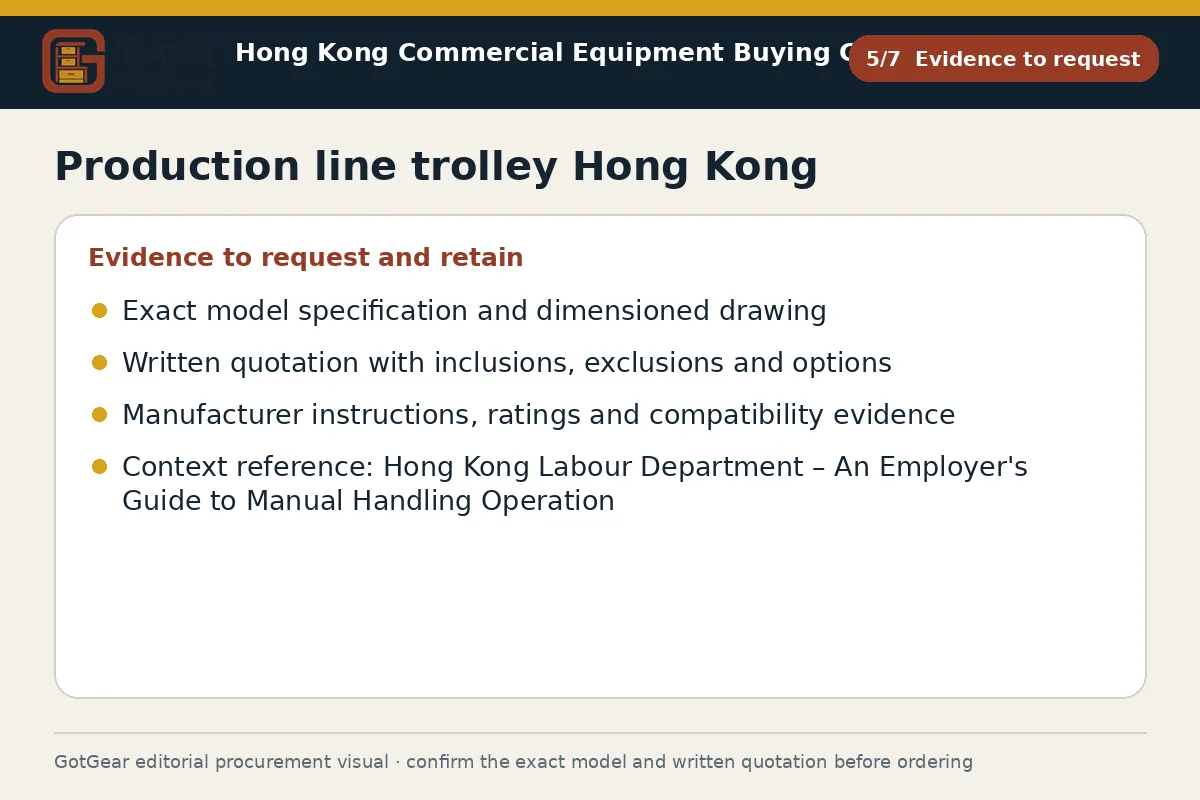
Walk the intended route and measure door clear openings, corner radii, lift car and lobby sizes, ramp gradients and floor transitions. Record takt, drop sizes and who handles full, empty, rejected and completed loads. Request drawings showing footprint, shelf pitch, usable openings, per-shelf and total UDL, wheel material and diameter, brake type, handle height, and finish. Ask for samples or photos of labels, dividers and card holders. Compare written quotations line-by-line on specifications, accessories and delivery scope. Coordinate lift-booking and loading-window constraints with management. On receipt, inspect welds, wheel fixings, brake function, shelf lips and ID holders, then run a pilot with representative loads and users before acceptance. Keep bilingual instructions with the trolley.
- Operating use, quantity and expected frequency
- Dimensions, capacity, material and accessory requirements
- Delivery address, floor, goods lift and loading window
- Required documents, acceptance checks and after-sales arrangements
Key points for production line trolley Hong Kong
Hong Kong sites combine tight lift cars, narrow corridors and scheduled loading windows controlled by building management. Before purchase, confirm clear door widths, lift car dimensions and booking rules for goods movement; these often govern trolley footprint more than the workstation itself. Many buildings require bilingual notices for back-of-house traffic and noise control near offices. Humidity, cleaning regimes and frequent level changes argue for corrosion-resistant finishes, sealed bearings and robust brakes. This summary highlights operating realities only and is not legal advice; model specifications and formal written quotations prevail.
Questions about production line trolley Hong Kong
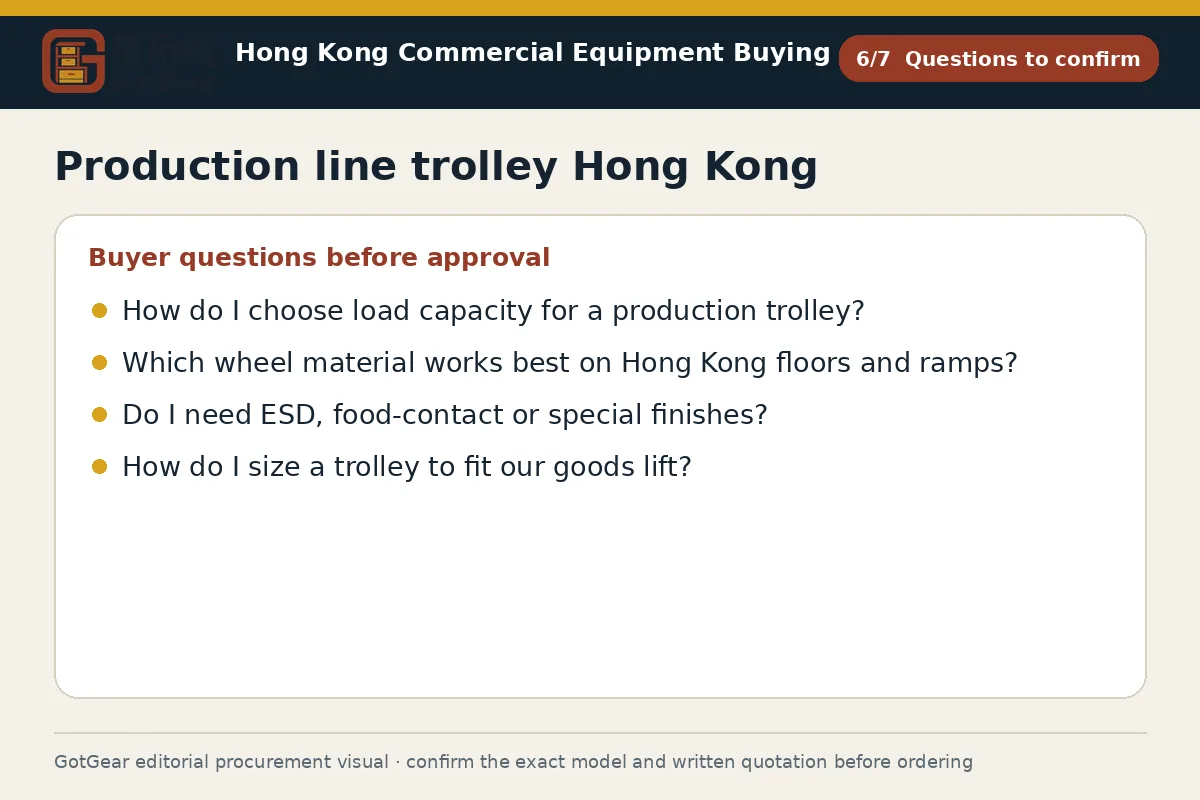
How do I choose load capacity for a production trolley?
Select capacity by the heaviest expected load on the most stressed shelf, plus margin agreed with your EHS or engineering lead. Check both per-shelf and total uniform distributed load and the supplier’s guidance on concentrated loads. As an example starting point, apply a contingency factor only if approved internally. Model specifications and the written quotation must prevail.
Which wheel material works best on Hong Kong floors and ramps?
Polyurethane-tread wheels often balance low rolling resistance with floor protection; rubber may dampen noise; nylon rolls easily but can transmit vibration. Confirm against your floor type, ramp gradients, cleaning chemicals and weight. As an example starting point, use larger diameters for thresholds and lift gaps, subject to your site’s trials and the manufacturer’s recommendation in writing.
Do I need ESD, food-contact or special finishes?
Only if your product, process or insurer requires it. For electronics, request ESD-safe shelves or liners per your in-house standard; for catering or clean areas, consider stainless or approved food-contact surfaces. In Hong Kong’s humidity, corrosion resistance and cleanability matter. Obtain the manufacturer’s material declarations and any applicable documentation as required by your QA or authority.
How do I size a trolley to fit our goods lift?
Measure the lift car’s clear width, depth and door opening, plus lobby turning space and threshold profile. Keep clearance on all sides for hands and safe turning. As an example starting point, maintain a small buffer beyond the trolley footprint to avoid snagging, then confirm fit with the building manager and the supplier’s dimensioned drawings before ordering.
Continue with closely related procurement topics
These pages share equipment, operating or decision-stage signals with this guide.
Material flow trolley Hong Kong
Explore solutions for material flow trolley Hong Kong with GotGear. Map movements, queues and status signals, and verify capacity, dimensions and triggers for work in process trolley Hong Kong.
Read the guide
Trolley inspection checklist Hong Kong
GotGear’s trolley inspection checklist Hong Kong and trolley preventive maintenance Hong Kong explain how to inspect wheels and brakes, log defects and schedule servicing under maker guidance.
Read the guide
Trolley load securing Hong Kong
GotGear provides guidance on trolley load securing Hong Kong, explaining how to check the centre of gravity, identify restraint points and compare straps, rails and clamps. It also covers trolley load stability Hong Kong.
Read the guide
Trolley anti-slip deck Hong Kong
GotGear explains how to assess a trolley anti-slip deck Hong Kong by reviewing load retention, material, contamination and contact risks. It also outlines considerations for trolley bumper protection Hong Kong.
Read the guideRelated topic indexOpen more English procurement pages2 topics
Browse additional equipment families, applications and procurement questions relevant to a wider buying brief.