
Parts presentation trolley Hong Kong — Place the defined parts within practical reach while preserving visibility, stability and replenishment access. Confirm adjustment ranges, capacity and accessories for the proposed configuration, then trial it with representative users and loads.
Parts presentation trolley Hong Kong — List part sizes, containers and consumption sequence
For a parts presentation trolley in Hong Kong, buyers should start by mapping the actual pick items and containers. List each part number, container type (e.g., tote, KLT, returnable bin), external dimensions, and filled mass. Note the consumption sequence at each workstation, hand dominance, and the target pick rate. As a starting point, record the minimum run‑time without replenishment (e.g., 60–90 minutes), then confirm the exact value in your brief and with the process owner.
Capture the footprint the trolley must occupy at the point of use and along the route: clear doorway widths, lift car dimensions, turn radii, and aisle widths common in Hong Kong industrial buildings. Photograph tight corners and thresholds. Specify label formats (barcode/QR orientation, bilingual text), ticket sizes, and any ESD or food‑contact requirements. Request that quotations include usable shelf width and depth, rail pitch, bin stop type, per‑shelf and overall capacity, caster diameter, brake type, finish, and corrosion resistance. Ask for a general‑arrangement drawing showing container outlines in the intended order (left‑to‑right or top‑to‑bottom). If different container families are used, state which levels must be adjustable and whether tool‑free adjustments are preferred. Model specifications and the formal written quotation prevail over any examples here.
Parts presentation trolley Hong Kong — Plan identification, empty returns and error control
Define how operators identify the correct part quickly, how empties return, and how mistakes are prevented. State if the trolley carries its own empty-return lane, if empties are stacked on a base shelf, or if a separate return route is used. As an example starting point, set a safe stack height for empties (e.g., three nested totes), then confirm with EHS and the supplier. Specify whether labels stay with the bin or the location and how labels are protected from humidity and cleaning.
Include error-proofing: keyed locations, colour banding by sequence, shelf lips to prevent container creep, and positive stops that match bin footprints. Require document holders for A5/A4 route cards, and define whether bilingual instructions are needed. For traceability, request barcode scannability at the chosen presentation angle without glare. If electronics or sensitive assemblies are involved, ask whether ESD-safe materials are required by your site or insurer. Set exception handling: where to place rejects, how to mark quarantined items, and who clears them. In quotations, ask suppliers to list identification accessories, attachment methods, and replacement part codes so ongoing control is practical. Model specifications and the formal written quotation prevail.
What should buyers compare for parts presentation trolley Hong Kong?
| Criterion | Straightforward requirement | More complex requirement | Evidence to provide |
|---|---|---|---|
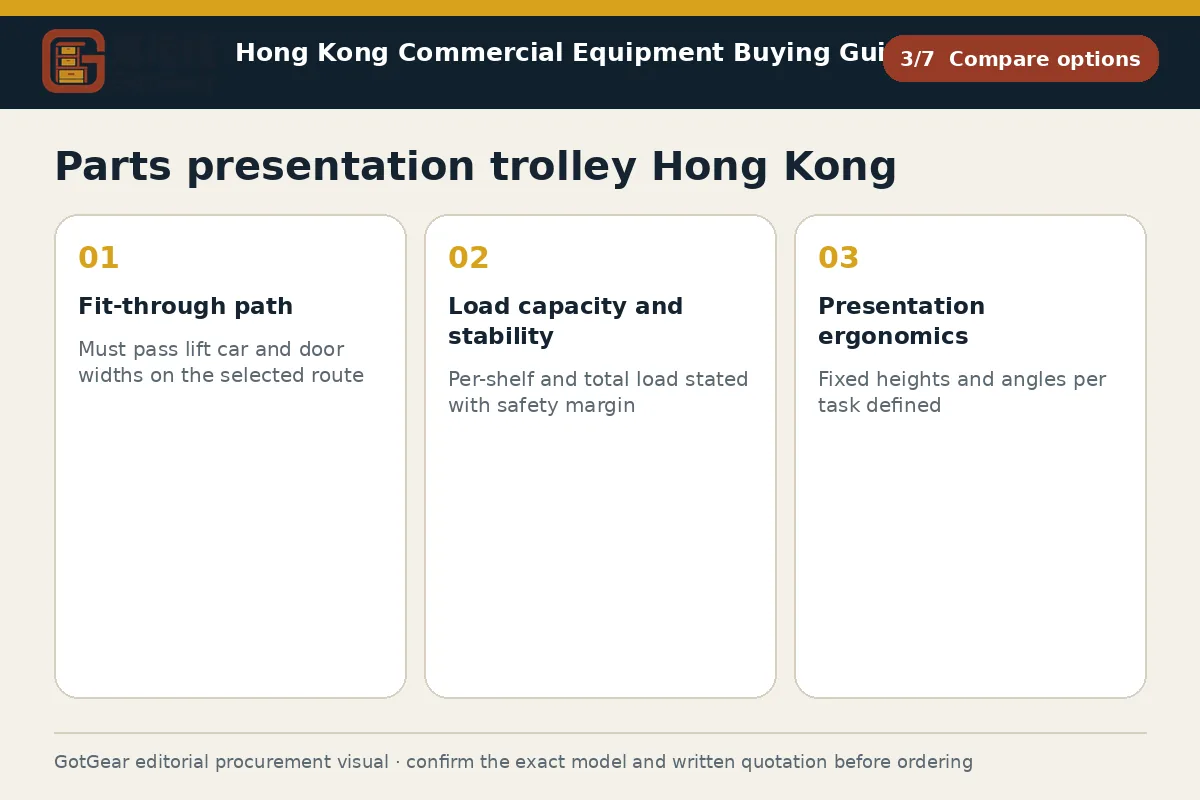
| Fit-through path | Must pass lift car and door widths on the selected route | Include tight turns, thresholds and temporary obstructions on the plan | Measured widths/heights, lift sizes, route photos, turning radii |
| Load capacity and stability | Per-shelf and total load stated with safety margin | Limits by angle, centre-of-gravity and container footprint defined | Load table, angle-lock method, stability notes (if required) |
| Presentation ergonomics | Fixed heights and angles per task defined | Tool-free adjustment ranges and increments specified | Operator reach data, angle range, increment size, handle height |
| Identification and control | Simple label holders and sequence markers provided | ESD, barcode orientation, bilingual docs and exception zones detailed | Label formats, card sizes, ESD requirement, quarantine process |
| Replenishment and returns | Front-load with base shelf for empties | Rear-feed with segregated empty-return lane and guards | Replenishment side, empty flow map, drawings showing guards |
This framework helps buyers create comparable written enquiries. Final model specifications, availability, delivery and commercial terms must be confirmed in a formal quotation.
Parts presentation trolley Hong Kong — Define presentation angle, height and replenishment side
Fix the picking posture first, then the hardware. Define the preferred presentation heights by task: knuckle-to-shoulder for frequent picks and lower levels for heavier items. As an example starting point, consider shelf pitch adjustability in small increments (e.g., 25–50 mm), then confirm with the manufacturer. State the maximum reach distance for your operators and the minimum sight line they require to read labels without twisting.
State clearly whether replenishment occurs from the rear or the front. Rear-feed supports one-way flow and reduces cross-traffic, but it needs access behind the station and may reduce overall capacity. Same-side replenishment suits tight aisles, provided you define a safe pause point and brake type. Ask for specification fields covering angle range and locking method, per-shelf and overall load ratings, caster size and tread, brake configurations, push-handle height, and total weight when fully equipped. Request drawings showing the replenishment side, clearances to obstructions, and any guards. If integration with kitting or production line trolleys is anticipated, note common interfaces (bin sizes, labels, and handle heights) to simplify fleet standardisation. The model specification and formal written quotation prevail over examples.
Parts presentation trolley Hong Kong — Verify stability and access with representative loads
Before approval, verify stability, access and manoeuvrability with representative containers and weights. Load the proposed layout to its intended maximum and test push, cornering and braking on your actual route. As an example starting point, include a threshold or kerb ramp typical of your site and a gentle gradient, then confirm test details with EHS. Observe caster tracking, operator posture, visibility of labels, and whether any bins creep on angled shelves.
Check anti-tip behaviour when shelves are angled and when a high centre-of-gravity bin is removed. Evaluate parking brakes and, if specified, directional locks for lift entry. Confirm that handholds are usable while wearing gloves and that sharp edges, burrs or protrusions are absent. For humid conditions, verify coatings resist tackiness and labels remain legible. Acceptance on receipt should include dimensional checks against the drawing, weld and fastener inspection, brake function, and correct accessories (stops, holders, dividers). Where your venue, insurer or manufacturer requires it, ask for a basic stability statement, material declarations, or ESD conformity notes. Document any variances and obtain written supplier confirmation before use. The formal quotation and approved drawings prevail.
Parts presentation trolley Hong Kong decision checklist
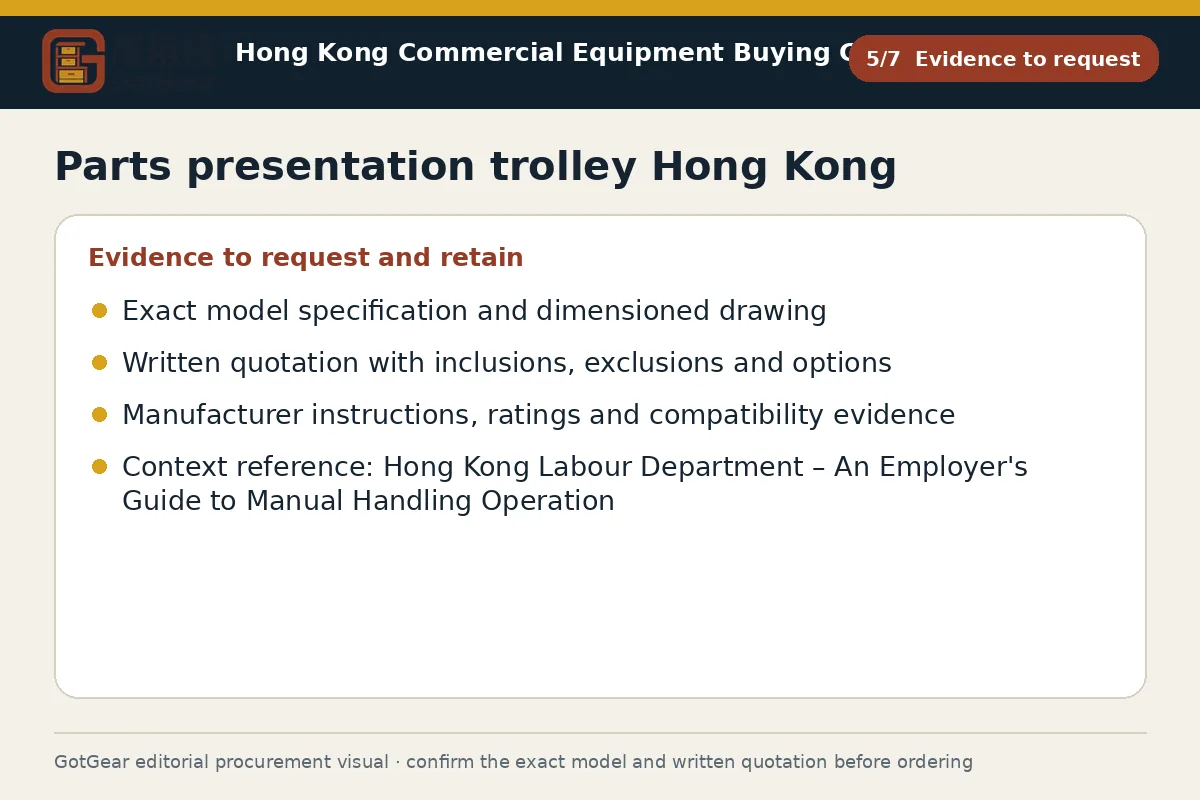
Confirm the parts list, container sizes, filled masses and the precise consumption sequence. Fix the pick posture, required presentation heights and angle range, then define whether replenishment is rear- or same-side. Record the full access route: lift car and door dimensions, turning radii, thresholds and floor type. Specify caster diameter, tread and brake type, per-shelf and overall load capacity, label formats and document holders. Ask for drawings with container outlines, stated adjustment increments and accessories. Compare written quotations line-by-line against your brief. On receipt, check dimensions, finish, welds, fasteners, brakes and all accessories. Where the site, model, insurer or venue requires it, request stability notes or ESD statements. The approved model specification and formal quotation prevail.
- Operating use, quantity and expected frequency
- Dimensions, capacity, material and accessory requirements
- Delivery address, floor, goods lift and loading window
- Required documents, acceptance checks and after-sales arrangements
Key points for parts presentation trolley Hong Kong
Hong Kong sites often involve tight lifts, narrow service corridors and managed loading windows. Measure the full route from loading bay to point-of-use, including lift car size, door widths and turning spaces, and share photos of pinch points. Building management may require advance booking and bilingual delivery paperwork. Humid summers can affect coatings and labels, so request corrosion-resistant finishes and sealed label holders if your environment warrants it. Public venues and institutions may also impose additional access controls or documentation; confirm any special conditions with the venue or authority before finalising the specification.
Questions about parts presentation trolley Hong Kong
Should we choose rear-feed replenishment or same-side loading for our line?
Rear-feed supports one-way flow and reduces picker–replenisher conflict. Same-side works in tight aisles if you define safe pauses and robust brakes. Decide based on available rear access, aisle width, and takt. Request drawings that show the replenishment side and confirm clearance and guarding in the written quotation and approvals.
Can one trolley handle several bin sizes without becoming unstable?
Yes, if rails, dividers and stops are adjustable and loads are balanced. Specify the smallest and largest container footprints, filled masses and required levels. Ask for angle-lock details, per-shelf ratings and centre-of-gravity limits. Trial with representative loads on your route before approval, and let the final quotation state the configured limits.
What caster and wheel material should we request for Hong Kong floors?
Match tread to floor and thresholds: softer treads for tiles and ramps, harder for smooth epoxy, and larger diameters for gaps and lift sills. Provide photos and note slopes and drains. As an example starting point, consider sealed bearings for humid areas. Ask the supplier to confirm load per caster and brake type in writing.
What documentation is typically needed for institutional or venue approval?
Commonly requested items include a general-arrangement drawing, materials/finish list, weight data, and accessory details. Where relevant to your site, request ESD statements, basic stability notes, or coating information. Public venues may also require bilingual labels and delivery particulars. Confirm exact documentation with your institution, venue or insurer before ordering.
Continue with closely related procurement topics
These pages share equipment, operating or decision-stage signals with this guide.
Kitting trolley Hong Kong
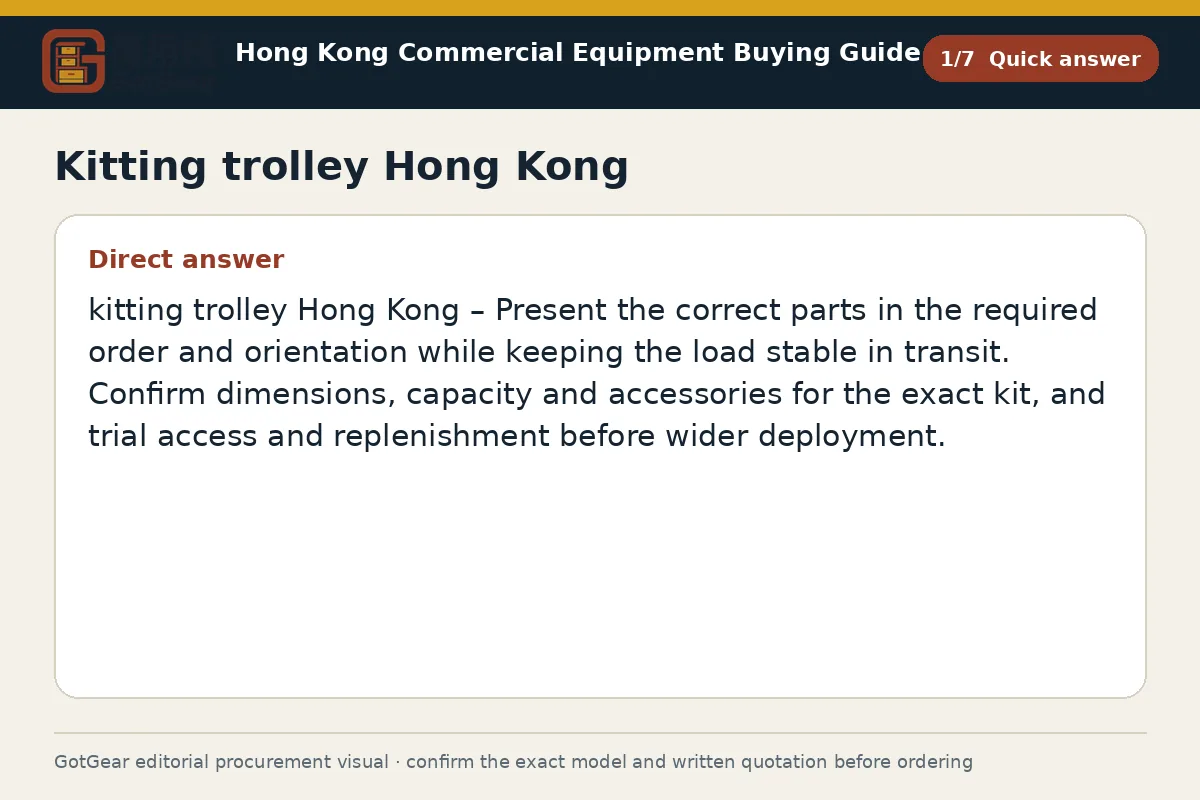
The GotGear request for quotation checklist for kitting trolley Hong Kong covers kit contents, capacity, container sizes, pick order, identification and replenishment.
Read the guide
Drum trolley Hong Kong
This quotation checklist helps facilities and EHS teams plan for drum trolley Hong Kong. It guides you on drum size, filled mass, orientation, pickup method, retention and route conditions, and is provided by GotGear.
Read the guide
Gas cylinder trolley Hong Kong
GotGear's checklist for a gas cylinder trolley Hong Kong outlines key considerations such as cylinder size, filled mass, valve guards, correct loading, safe gradients, and checks with the trolley manual and site rules.
Read the guide
Panel trolley Hong Kong
GotGear offers a practical guide to panel trolley Hong Kong that helps facilities record dimensions, mass, surface finishes, support angles, contact materials, retention methods and route clearances.
Read the guideRelated topic indexOpen more English procurement pages1 topics
Browse additional equipment families, applications and procurement questions relevant to a wider buying brief.