
Material flow trolley Hong Kong — Give each load a defined route, quantity, owner and status, with clear movement and replenishment triggers. Trial the loop and verify equipment capacity and dimensions before using it as a work-in-process control.
Material flow trolley Hong Kong — Map each move, queue and ownership change
Start by charting every actual hand‑off rather than buying more storage. For any material flow trolley for use in Hong Kong that your team shortlists, document the physical origin and destination, the person or role handing over, and the next owner. Note where loads wait, how many units typically queue there, and what information the receiver needs to proceed. Record whether items are loose, cased, in totes or on returnable racks, and whether any sealing, labelling or scanning step is required before release.
Walk the full route and capture constraints. Measure the tightest doorway, corridor and turning space the trolley must pass through, and record the goods‑lift cabin size, door clear opening and the landing turning area. Example starting points: record overall height limit, a notional 1,200 mm x 700 mm footprint and 1,000 mm turning radius, then confirm exact values with the building manager and supplier drawings. Log thresholds, ramps, floor joints and gradients. Ask for dimensioned drawings showing outer footprint, shelf usable area, handle height, brake type, corner protection and caster specification (diameter, tread, bearing, plate size). In written enquiries, state the maximum load per shelf and total load required, the expected daily trips, and any rule for clean/dirty separation. The model specification and formal written quotation should prevail over site notes.
Material flow trolley Hong Kong — Set container quantities and replenishment triggers
Set quantities before choosing hardware. Define standard container sizes in use, the batch size per move, and the acceptable minimum and maximum levels at each step. Decide the trigger to move or replenish: a two‑bin card, a “min level” marker, or a scanned instruction. As an example starting point, you might plan for 10 pieces per tote and two totes per location, then verify with production and quality. Align empty‑return rules so that containers reappear where needed without ad‑hoc chasing.
Translate this into trolley features. Specify the tote footprint, divider spacing, shelf pitch and retention (lips, rails or straps) that keep containers stable in motion. Request options for document pouches, barcode/QR plates, bilingual label holders and colour panels to show state. State the per‑loop capacity (e.g., number of containers a trolley must carry to fulfil one route) and the restocking frequency you expect during a shift, as a starting point for supplier confirmation. If kitting is involved, note any compatibility with a kitting trolley Hong Kong — one that teams already use — so container formats remain consistent. Confirm that replenishment triggers are visible from a normal walking distance without opening covers.
What should buyers compare for material flow trolley Hong Kong?
| Criterion | Straightforward requirement | More complex requirement | Evidence to provide |
|---|---|---|---|
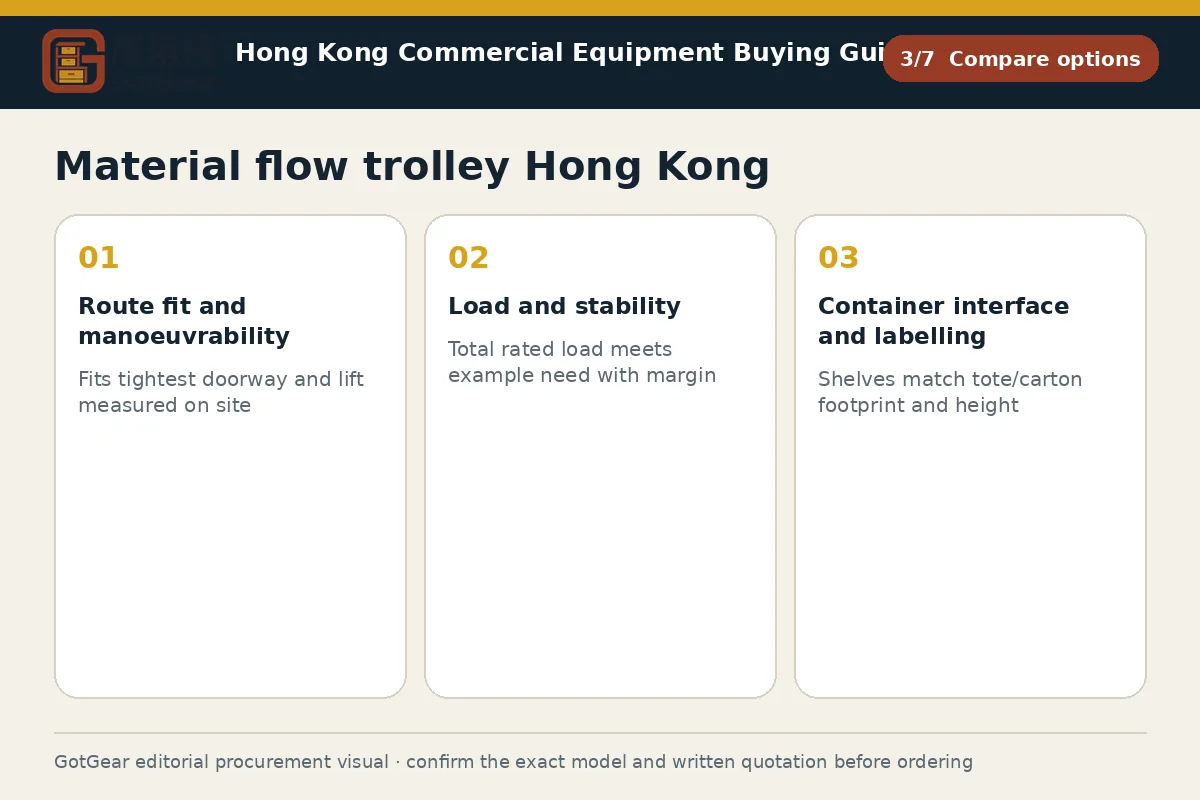
| Route fit and manoeuvrability | Fits tightest doorway and lift measured on site | Meets turning circle within congested aisles and lift lobbies | Provide door and lift clear openings, lobby dimensions, tightest turn sketch |
| Load and stability | Total rated load meets example need with margin | Per‑shelf load and centre‑of‑gravity control for tall items | State total and per‑shelf loads, item heights, need for lips/straps |
| Container interface and labelling | Shelves match tote/carton footprint and height | Dividers, angle, and retention tailored to mixed SKUs | List tote sizes, divider pitch, label/QR plate and document pouch sizes |
| Environment and noise | Wheel tread suits smooth indoor floors | Low‑noise, corrosion‑resistant setup for humid or public areas | Describe floor types, thresholds, noise limits, cleaning chemicals exposure |
| Documentation and approvals | Dimensioned drawings and load declaration | Site‑specific guidance for towing, covers, or special venues | Request CAD or PDF drawings, finish spec, maintenance/user instructions |
This framework helps buyers create comparable written enquiries. Final model specifications, availability, delivery and commercial terms must be confirmed in a formal quotation.
Material flow trolley Hong Kong — Work in process trolley Hong Kong: Use visible states for work in process
Make the state of each load obvious at a glance to avoid interruptions. Build an agreed set of statuses such as To Do, In Process, Complete, Hold and Reject, then assign each colour and symbol. Fit durable, bilingual cards and holders sized for your route sheets or travellers; add scannable IDs only if your site uses them. On trolleys that pause at quality or inspection points, provide a distinct parking zone and clear signage so parts are not mistaken for free stock.
Where corridors, schools, hospitals or public-event spaces are shared, select closable fronts or shrouds that hide sensitive contents and reduce tampering risk, and use quieter wheels to respect noise controls. If the line feeds directly, coordinate with any teams that operate production-line trolleys in Hong Kong so state colours and label formats match. When a work-in-process trolley in Hong Kong must pass between departments, agree ownership changes in writing and specify who clears exceptions. For presentation at the point of use, ensure shelf angles and stops mirror the parts presentation trolley preferred by buyers in Hong Kong, so operators see the same orientation in every area.
Material flow trolley Hong Kong — Measure delays, empty returns and route conflicts
After mapping steps and states, verify the loop in motion. Time typical trips end‑to‑end, note waits at lifts and bottlenecks, and count empty returns. As a starting point, sample a few runs per shift on busy and quiet periods, then confirm the study scope with operations. Highlight route conflicts where two flows cross, and mark parking zones that block fire equipment or access if misused. Use this evidence to set fleet size and to adjust aisle priority rules.
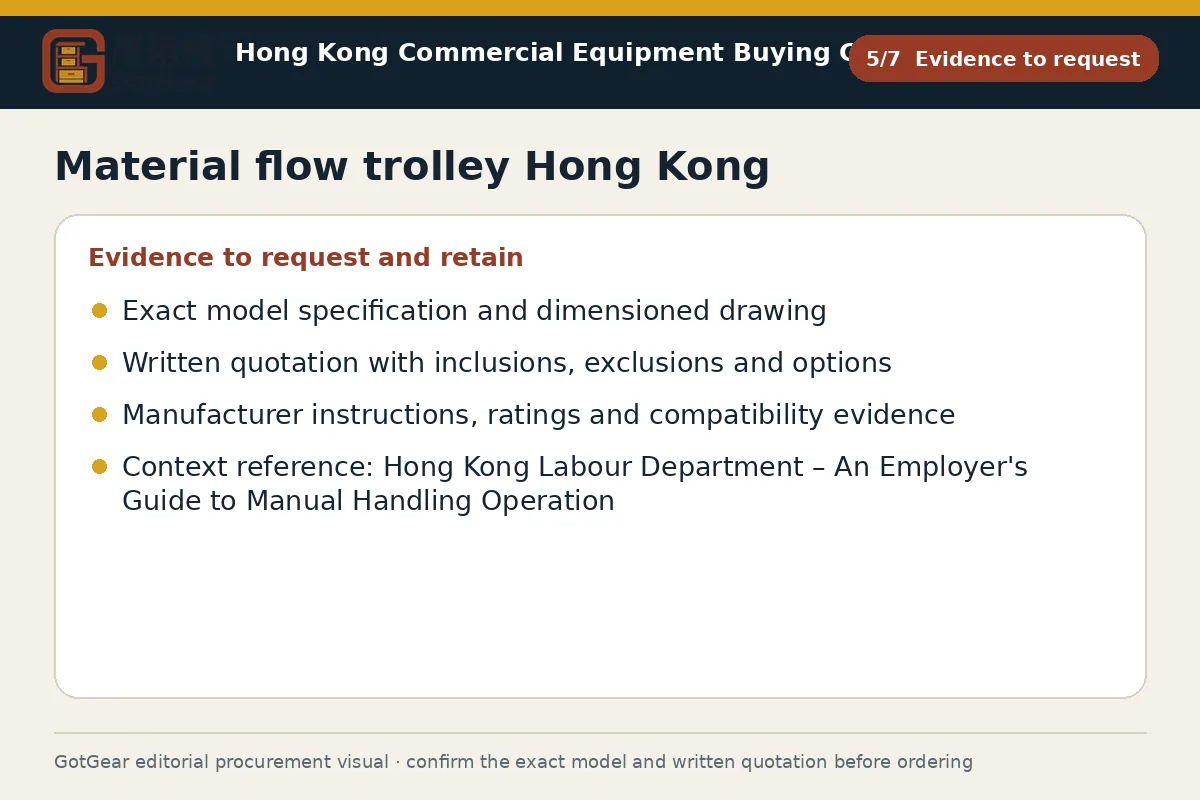
Translate findings into specifications. Request wheel diameter, tread and bearing type suited to your floor, with options for swivel locks or directional locks on long straight runs, and brakes that can be set while loaded. Ask for corner bumpers, push‑bar ergonomics, noise‑reduction features, and finish/coating details that tolerate humid plant rooms. If towable use is considered, state this as conditional and ask for the manufacturer’s guidance. On receipt, inspect welds, fasteners, caster plates, alignment and labelling; roll the trolley through the tightest doorway and lift you measured. Request the maker’s rated load declaration, user instructions and maintenance guidance; the final model specification and written quotation prevail.
Material flow trolley Hong Kong decision checklist
Confirm the mapped route, owners and queue points, then record the smallest doorway, corridor and lift the trolley must pass. Define container sizes, batch quantities and the movement/replenishment triggers you will use. Write an enquiry that states footprint, height, shelf pitch, load per shelf and total load, wheel specification, brakes, document holders and visibility of status. Attach site photos and a simple route sketch. Ask for dimensioned drawings, finish details and maintenance guidance, and state any noise, tow, or cover preferences as conditional. Compare written quotations line by line against your specification. On delivery, check dimensions against your measurements and roll‑test along the planned path. The final model specification and formal written quotation should prevail.
- Operating use, quantity and expected frequency
- Dimensions, capacity, material and accessory requirements
- Delivery address, floor, goods lift and loading window
- Required documents, acceptance checks and after-sales arrangements
Key points for material flow trolley Hong Kong, work in process trolley Hong Kong
Hong Kong sites commonly face tight goods‑lifts, narrow fire doors and booked loading windows managed by the building office. Measure cabin depth, door clear width and lobby turning space before committing to any fleet, and confirm lift booking rules for delivery and daily movements. Humid basements and seaside air can accelerate corrosion, so wheel, bearing and finish choices matter. Public‑facing venues may need quieter wheels and closable fronts. Provide bilingual status cards where mixed crews work. Always confirm constraints and any required permissions with your building manager, venue operator or competent adviser before placing an order.
Questions about material flow trolley Hong Kong
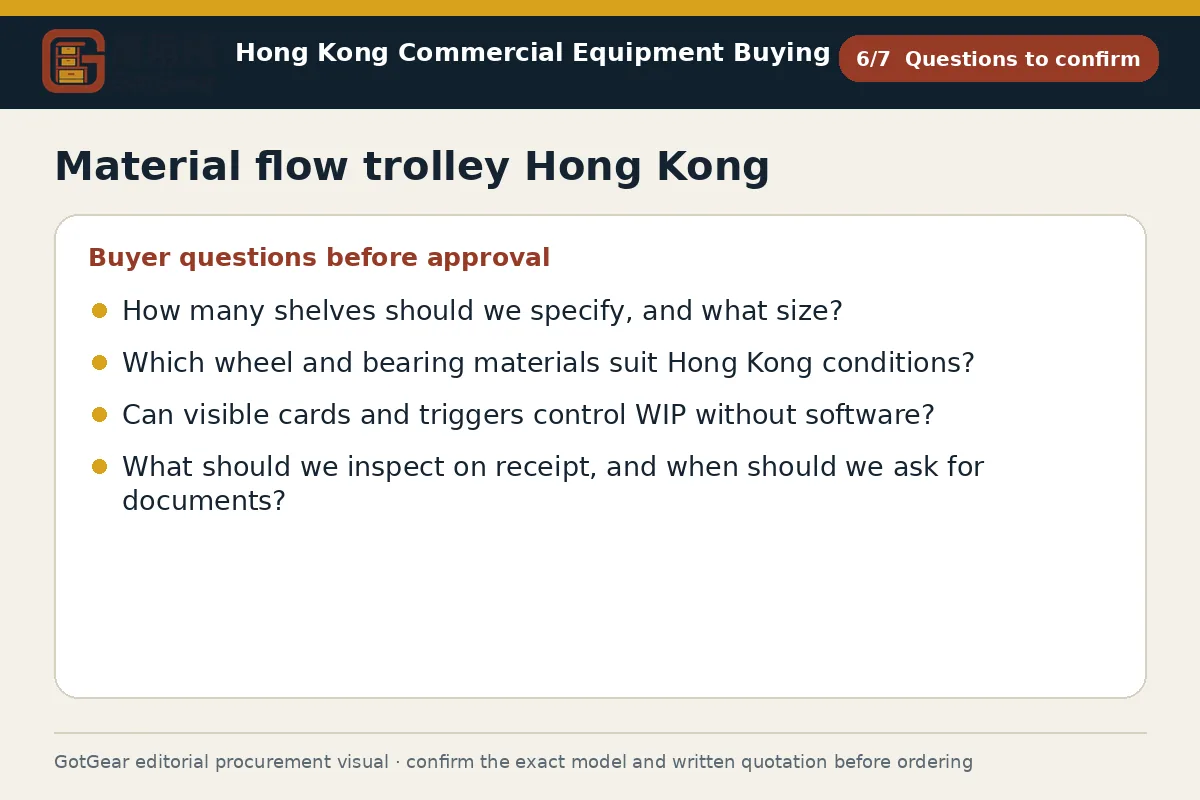
How many shelves should we specify, and what size?
Choose the shelf count and spacing to match your containers and hand heights at the point of use, keeping the top shelf below eye level for visibility. Start by measuring the tallest loaded container and the reach of your shortest operator, then ask the supplier for drawings with usable shelf dimensions. Confirm final shelf pitch and lip design in the written quotation and a sample if available.
Which wheel and bearing materials suit Hong Kong conditions?
Polyurethane treads with sealed bearings often roll quietly and resist humid plant rooms and loading docks; rubber may offer extra grip on tiles. If floors include thresholds or drains, a larger diameter reduces jolting. Where corrosion risk is high, consider stainless hardware as an option. Treat these as starting points and confirm suitability with your supplier and building manager’s floor data.
Can visible cards and triggers control WIP without software?
Yes. Clear states, bilingual cards, and defined movement and replenishment triggers can stabilise work‑in‑process on a loop. Add unique IDs and simple count rules so ownership and quantities are unambiguous at each hand‑off. If your site later adopts scanning, choose holders that accept barcode or QR plates. Agree the method in writing and test the loop before scaling fleet size.
What should we inspect on receipt, and when should we ask for documents?
Verify overall footprint, height, shelf clear sizes and stability, then roll through the tightest route measured. Check welds, fasteners, caster mounting, brake function and finish quality. Request the manufacturer’s rated load statement, user instructions and maintenance guidance where available; seek any special approvals only if your venue, insurer or process demands them. The model specification and written quotation prevail.
Continue with closely related procurement topics
These pages share equipment, operating or decision-stage signals with this guide.
Production line trolley Hong Kong
For production line trolley Hong Kong setups, map routes, cadence, loads, conflicts and return flow to assess layout and movement effectively. GotGear explains how to check capacity and dimensions against takt time.
Read the guide
Manual handling risk assessment Hong Kong
GotGear explains what to record during a manual handling risk assessment Hong Kong and how to use a manual handling safety checklist Hong Kong. The guide also describes how to prioritise material handling risk controls Hong Kong.
Read the guide
Trolley inspection checklist Hong Kong
GotGear’s trolley inspection checklist Hong Kong and trolley preventive maintenance Hong Kong explain how to inspect wheels and brakes, log defects and schedule servicing under maker guidance.
Read the guide
Trolley load securing Hong Kong
GotGear provides guidance on trolley load securing Hong Kong, explaining how to check the centre of gravity, identify restraint points and compare straps, rails and clamps. It also covers trolley load stability Hong Kong.
Read the guideRelated topic indexOpen more English procurement pages1 topics
Browse additional equipment families, applications and procurement questions relevant to a wider buying brief.