
Mobile storage cart Hong Kong — Organise the stated contents without unstable loading and fit every doorway, lift and storage position on the route. Verify dimensions, capacity, caster and brake details and any assembly or care instructions before selection.
Mobile storage cart Hong Kong — Define stored items, access frequency and users
Begin by listing the exact contents to be stored and moved, including the largest dimensions of any single item and the lightest and heaviest pieces. Note the frequency of access by shift, who is authorised to use the cart, and whether use is back-of-house only or involves public areas. For mixed teams, agree bilingual labelling conventions before placing the order. If your stakeholders are searching for a mobile storage cart in Hong Kong that buyers can standardise on, this scoping step keeps different models comparable.
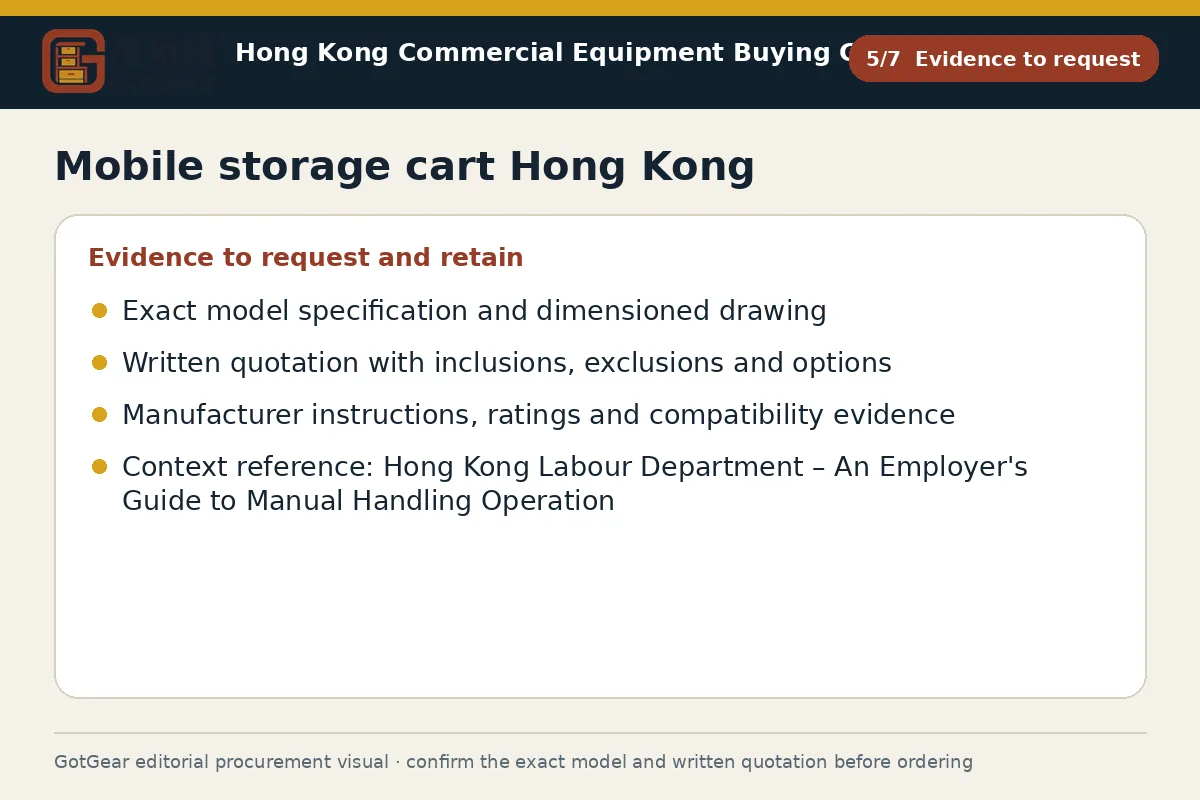
Convert the scoping into a clear enquiry pack. Include a contents matrix showing item dimensions (length, width, height), with an example starting point that adds a clearance margin to be confirmed with your supplier. State the maximum piece weight, expected total loaded weight per cart, and pick frequency. Specify any tote, bin or divider formats to be accommodated. Record user constraints: preferred handle height range, push/pull direction, noise limits and use while wearing gloves. Flag hygiene, antistatic or corrosion considerations for humid plant rooms or waterfront venues. Define authorised users and custody (e.g., facilities vs. teaching staff) and the approval path required by your management office. This clarity allows vendors to respond with matched models; always let the model specification and the formal written quotation prevail.
Mobile storage cart Hong Kong — Check shelf adjustment, labelling and load distribution
Translate the storage plan into shelf and compartment requirements. Ask vendors to state shelf adjustability pitch and method, with an example starting point such as a small increment to suit varied totes—then confirm with the manufacturer. Request per-shelf and total dynamic load ratings, recommended load distribution, centre-of-gravity guidance, and whether shelf lips, liners or anti-slip mats are included. Where parts bins are used, confirm divider compatibility and maximum bin height at the front and back.
For identification, specify labelling provisions: integrated label holders, barcode/QR visibility, and bilingual card sizes. If the cart will be cleaned frequently, request coating type and corrosion resistance suitable for humid conditions, plus care instructions. In your quotation comparison, line up: shelf material and thickness, number of usable shelf positions, the tool-free adjust mechanism, and any reinforcement under top shelves used as work surfaces. Ask for dimensional drawings showing shelf clearance at each position, exploded diagrams for field-replaceable parts, and a written statement of the test basis used by the manufacturer for their load ratings. On receipt, verify the actual shelf pitch, fit of bins, and that casters/brakes support the stated load without drift.
What should buyers compare for mobile storage cart Hong Kong?
| Criterion | Straightforward requirement | More complex requirement | Evidence to provide |
|---|---|---|---|
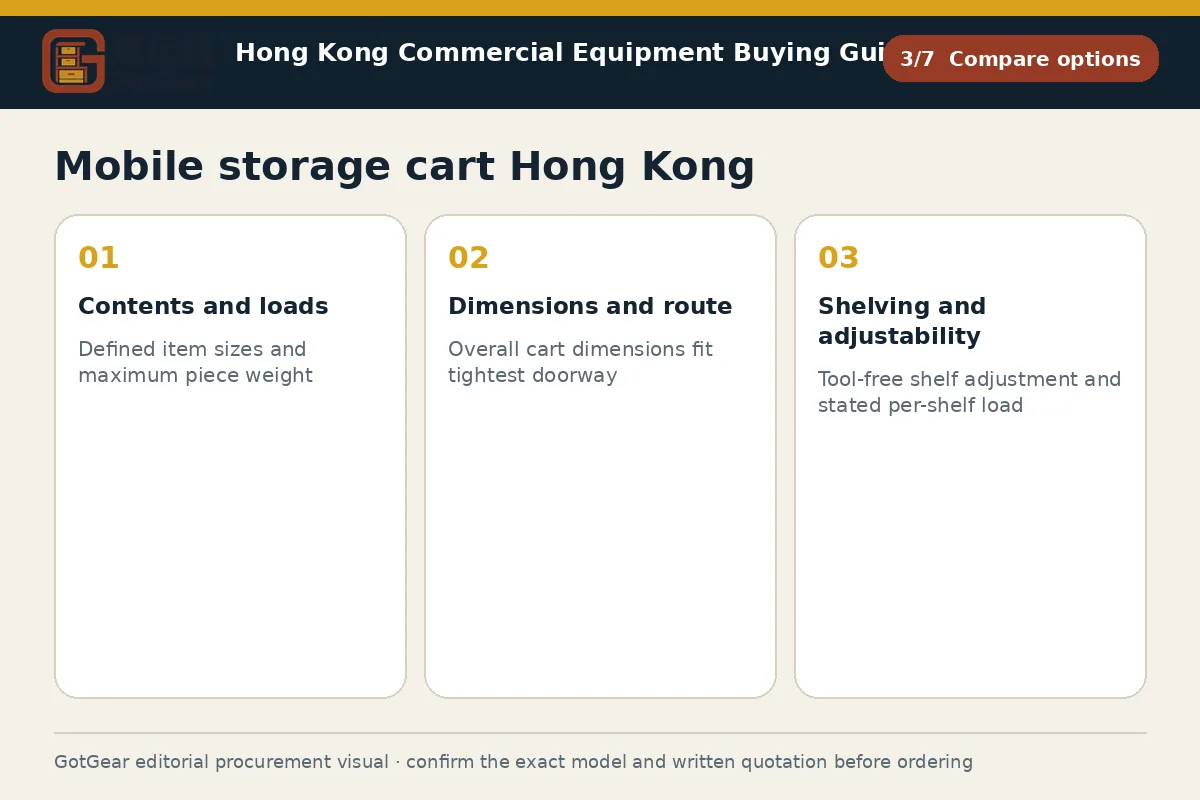
| Contents and loads | Defined item sizes and maximum piece weight | Matrix of SKUs with bin/tray compatibility and duty cycle | Dimensions (L×W×H) per item, heaviest piece, total loaded weight, pick frequency |
| Dimensions and route | Overall cart dimensions fit tightest doorway | Evidence of turning within lift and storeroom | Scaled drawings including handles, bumpers and open-door projection; route measurements |
| Shelving and adjustability | Tool-free shelf adjustment and stated per-shelf load | Dividers, lips and anti-slip with load-distribution guidance | Shelf pitch, material/thickness, usable positions, divider/bin model numbers |
| Security and enclosure | Basic door or tambour with padlock hasp | Keyed/combination locks with master-keying and ventilation | Lock mechanism type, key quantities, door swing clearance, panel material and thickness |
| Casters and brakes | Non-marking wheels with total-lock brakes | Directional lock, low-noise wheels and corrosion-resistant bearings | Wheel diameter/tread, bearing type, swivel offset, dynamic rating, brake type |
This framework helps buyers create comparable written enquiries. Final model specifications, availability, delivery and commercial terms must be confirmed in a formal quotation.
Mobile storage cart Hong Kong — Choose open, enclosed or lockable organisation
Choose the enclosure level by matching access control, visibility and environmental protection. Open carts suit fast pick operations and supervised back-of-house routes. Enclosed carts limit dust and cross-contamination for libraries, clinics, catering prep or archives. Lockable variants are advisable in public corridors, school foyers and event spaces. Consider visibility through perforated or clear panels where quick identification is needed without opening, and specify noise-dampening bumpers if working near guests or classrooms.
In your enquiry pack, state whether you require doors, tambour shutters or hinged lids; swing direction and clearance; and how locking should work (padlock hasp, keyed cam lock, or combination). Request details on the quantity of keys, master-keying options, and spare-key arrangements, and confirm who will hold them under your site policy. Ask for ventilation slots or mesh where off-gassing or drying is relevant, and for wipe-clean interiors where hygiene is monitored. For quote comparison, align panel material and thickness, hinge type, latch mechanism, and door-retainer features for loading. If the proposed lock interfaces with privacy, safeguarding or insurance conditions at your venue, request the manufacturer’s documentation on the lock construction and provide it to your competent manager or insurer for confirmation before approval.
Mobile storage cart Hong Kong — Measure routes, thresholds and parking space
Survey the complete movement route from storage to workstations. Measure every doorway, corridor pinch point, ramp, and the goods-lift door width, internal depth and ceiling height. Record floor transitions, thresholds and any cable protectors. Note turning areas and whether the cart must rotate inside lift cars or small storerooms. An example starting point is to test the largest cart diagonal against the narrowest clearance, but confirm feasibility with scaled drawings from the supplier. Request overall dimensions including handles, bumpers and open-door projection; unladen and laden turning circle; and the caster specification (wheel diameter, tread material, bearing type, swivel offset) with a written dynamic load rating.
Plan the parking footprint at rest: bay size, orientation, and required brake type (total-lock vs. directional lock). Identify noise limits for residential hours and floor-protection needs for vinyl, timber or polished concrete. Coordinate delivery windows and lift booking with the management office, especially in industrial buildings with restricted access. On receipt, inspect welds, panels and coatings for transport damage; confirm wheels spin freely without wobble, brakes hold on your floor, and doors close squarely. Check that assembly instructions, care guidance and parts lists are supplied, ideally bilingual, and that keys, dividers and label holders match the quotation. Record the model and serial details for your asset register before release to users.
Mobile storage cart Hong Kong decision checklist
Confirm the stored contents, maximum piece weight, total loaded weight and pick frequency, then define authorised users and any hygiene or EHS constraints. Measure your full route, noting the tightest doorway, lift dimensions, thresholds and the intended parking bay. Issue an enquiry pack covering overall dimensions (with handles), shelf adjustability, per-shelf and dynamic capacity, caster and brake type, enclosure and locking, labelling and finish. Compare written quotations line by line against those fields, plus drawings and care instructions. Before approval, align key control and public-area use with site policy. On receipt, check fit, finish, brake holding, door operation and that documentation and accessories match. The model specification and supplier’s formal quotation should prevail.
- Operating use, quantity and expected frequency
- Dimensions, capacity, material and accessory requirements
- Delivery address, floor, goods lift and loading window
- Required documents, acceptance checks and after-sales arrangements
Key points for mobile storage cart Hong Kong
Hong Kong routes often hinge on tight goods-lift cars, narrow fire doors and shared back-of-house corridors. Book delivery and lift access with the building manager, and plan around fixed loading windows. Humid plant rooms, sea air and frequent cleaning favour corrosion-resistant finishes and stainless fasteners; ask suppliers to confirm suitability in writing. For shared spaces, bilingual labelling and clear key-control arrangements ease institutional approval and handover. Always validate measurements, capacity and turning needs with scaled drawings and the formal written quotation for your selected model.
Questions about mobile storage cart Hong Kong
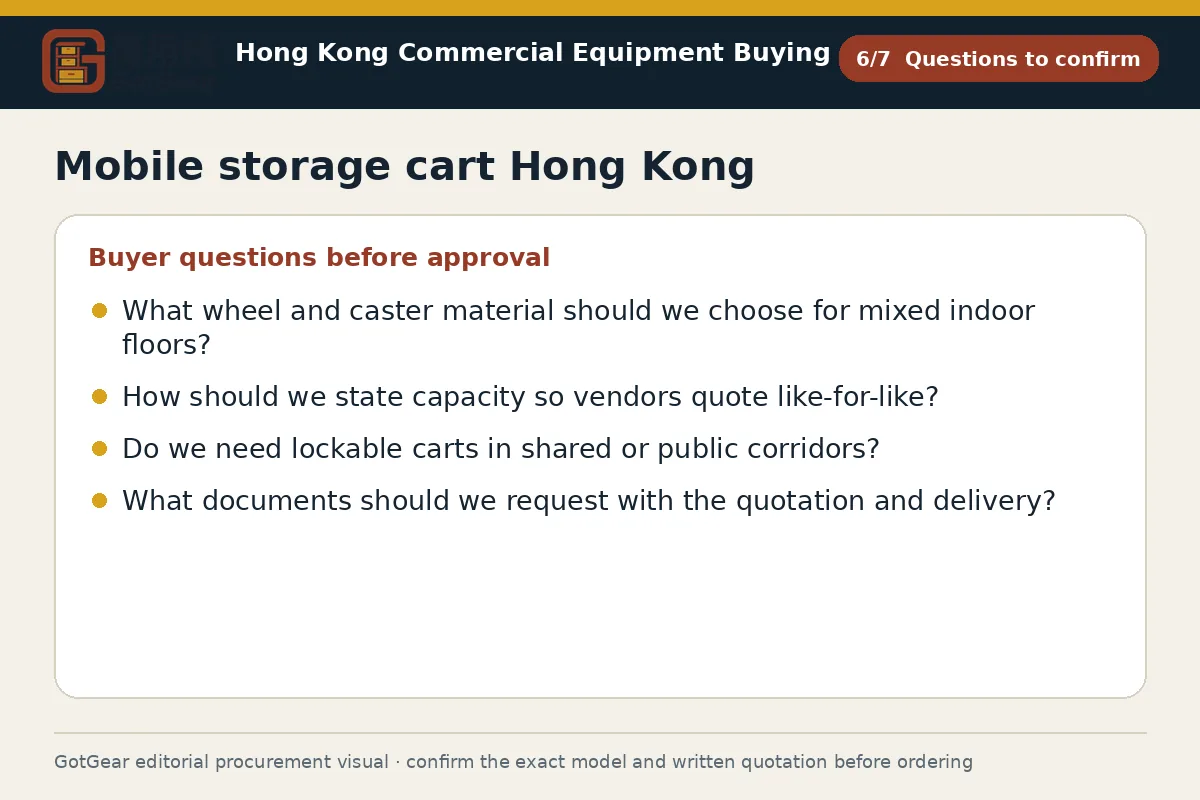
What wheel and caster material should we choose for mixed indoor floors?
Non-marking rubber or TPR treads are a safe first choice for vinyl, tile and concrete, balancing quiet running with floor care. For heavier loads or longer routes, polyurethane offers lower rolling resistance. In wet or corrosive areas, ask for stainless or sealed bearings. Confirm compatibility with your actual floors and slope transitions with the supplier’s written specification and a route survey.
How should we state capacity so vendors quote like-for-like?
Request both total dynamic load per cart and per-shelf load ratings, with guidance on load distribution and centre of gravity. Specify your maximum expected loaded weight and the heaviest single item. Ask for the manufacturer’s written rating basis. An example starting point is to state the duty cycle and route length, then confirm suitability against the model specification in the supplier’s quotation.
Do we need lockable carts in shared or public corridors?
If carts pass through or park in public areas, lockable compartments reduce tampering and loss. Align the locking choice with your site’s security, privacy and safeguarding policy, and agree key control with stakeholders. Request written details of the lock type and master-keying. Where insurance or venue rules apply, seek confirmation from the responsible manager or insurer before approval.
What documents should we request with the quotation and delivery?
Ask for dimensional drawings, parts lists, assembly and care instructions, and a written statement of load ratings and caster specifications. Where hygiene or corrosion resistance matters, request material and finish details. For lockable models, ask for keying details. On delivery, verify that documents and accessories match the quotation, ideally in bilingual format for operations and EHS teams.
Continue with closely related procurement topics
These pages share equipment, operating or decision-stage signals with this guide.
Instrument trolley Hong Kong
This procurement checklist for facilities covers instrument trolley Hong Kong and lists instruments, trays and dimensions. It compares shelf and drawer layouts, raised edges, brakes, materials and cleaning regime from GotGear.
Read the guide
Drum trolley Hong Kong
This quotation checklist helps facilities and EHS teams plan for drum trolley Hong Kong. It guides you on drum size, filled mass, orientation, pickup method, retention and route conditions, and is provided by GotGear.
Read the guide
Gas cylinder trolley Hong Kong
GotGear's checklist for a gas cylinder trolley Hong Kong outlines key considerations such as cylinder size, filled mass, valve guards, correct loading, safe gradients, and checks with the trolley manual and site rules.
Read the guide
Panel trolley Hong Kong
GotGear offers a practical guide to panel trolley Hong Kong that helps facilities record dimensions, mass, surface finishes, support angles, contact materials, retention methods and route clearances.
Read the guideRelated topic indexOpen more English procurement pages2 topics
Browse additional equipment families, applications and procurement questions relevant to a wider buying brief.