
Ask how any recycled-content statement is measured and documented. Review that evidence with manufacturer handling data, expected reuse and the intended recovery route.
Recycled plastic pallets Hong Kong — Request Clear Material Declarations
For projects involving recycled plastic pallets in Hong Kong, request clear, component-level material declarations from the outset. Ask suppliers to state the polymer family for deck and runners, the proportion of post‑consumer and post‑industrial content by mass, and any virgin blend. Require the basis of calculation (for example, batch average or mass‑balance accounting), the validity period of the claim, the production plant, and the traceability level (lot, shift, or mould cavity). Where a range is quoted, ask for typical, minimum and method notes, and ensure the formal written quotation repeats the same figures.
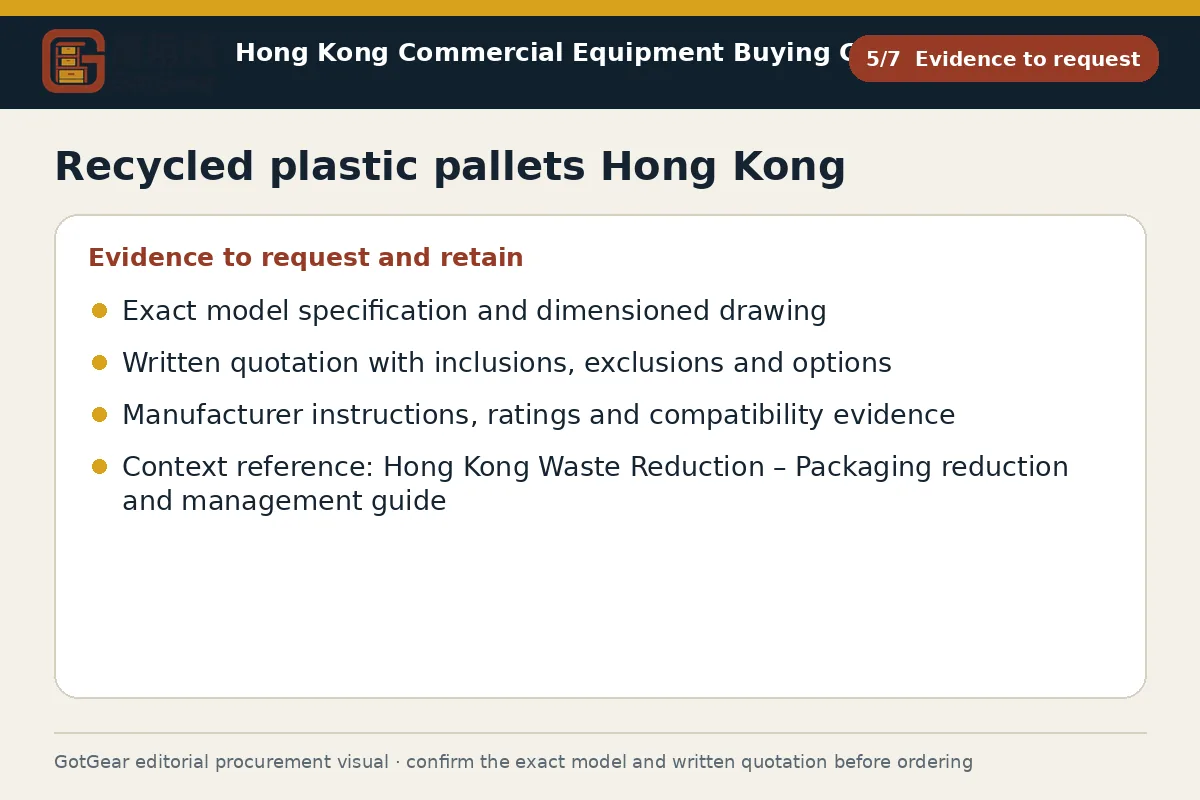
Evidence should be readable by Hong Kong stakeholders. Request a signed manufacturer declaration on letterhead, a current technical data sheet, and photographs of material ID markings on the pallet (polymer code and recycling symbol). Ask for an additive disclosure: colourants, UV stabilisers, mineral fillers, glass fibre or metal reinforcement, plus any food‑contact or hygiene notes where relevant to your site. If reinforcement is used, confirm the recyclability impact and removal method at end of use. Include packaging in scope: state whether cartons, stretch wrap or corner boards contain recycled content. Ask for bilingual (Chinese/English) documentation and name the person authorised to sign content statements for audit trails.
Recycled plastic pallets Hong Kong — Compare Supplier Evidence Consistently
Compare suppliers using the same fields so claims are judged on equal footing. Build a side‑by‑side sheet with: model code and revision; deck style (open/closed) and runner configuration; external dimensions and nesting height; declared recycled content (typical/minimum), content type (post‑consumer/post‑industrial), and calculation method; available evidence (signed declaration, batch record, photo of markings); load data (static, dynamic, racking) with test basis and temperature notes; surface features (anti‑slip, perimeter lips); and cleaning compatibility stated by the manufacturer. Ensure the formal written quotation mirrors the specification fields you will evaluate.
When samples arrive, verify the paperwork against the physical item. Weigh each unit with a calibrated scale and record the reading against the quoted mass tolerance (agree the tolerance with the supplier). Measure key dimensions and check fork‑entry chamfers and pallet‑jack wheel fit. Inspect mould quality, ribs and weld lines for voids and warpage. Photograph mould date stamps and serials to match to batch evidence. In Hong Kong buildings, confirm the stacked height and footprint pass goods‑lift and loading‑bay restrictions before authorising bulk delivery. Keep all records bilingual where site approval requires it.
What should buyers compare for recycled plastic pallets Hong Kong?
| Criterion | Straightforward requirement | More complex requirement | Evidence to provide |
|---|---|---|---|
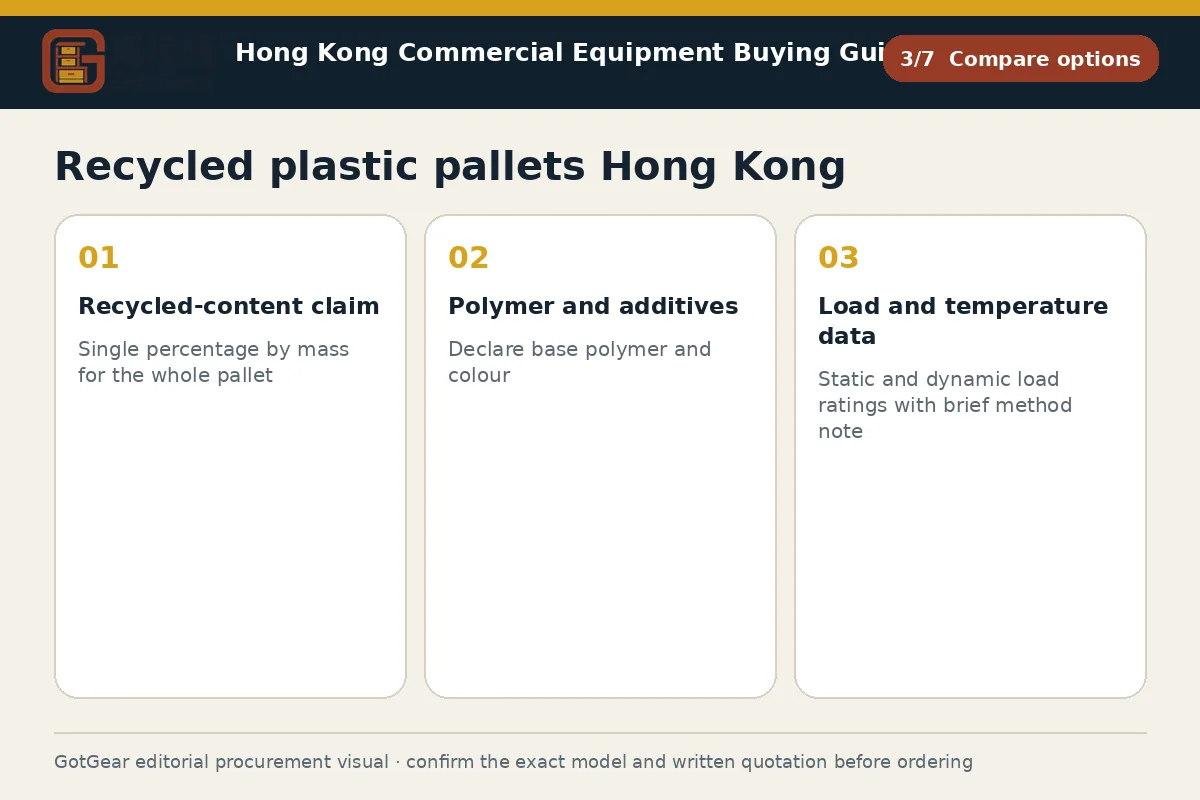
| Recycled-content claim | Single percentage by mass for the whole pallet | Component-level (deck/runners) with typical and minimum, post‑consumer vs post‑industrial split | Signed declaration, calculation method, plant and date range, batch/lot reference |
| Polymer and additives | Declare base polymer and colour | Full additive list (UV, fillers, FR, glass/metal) with recyclability and hygiene notes | Technical data sheet, additive disclosure, photos of polymer/recycling marks |
| Load and temperature data | Static and dynamic load ratings with brief method note | Racking data with deflection limit and temperature conditions for testing | Manufacturer test summary or report referencing the exact model code |
| Handling and hygiene | Deck style and anti‑slip noted | Cleaning chemistry compatibility and label removal process documented | Manufacturer statement on detergents, sample wash results, label/ink spec |
| End-of-use route | General recyclability statement | Named recycler or take‑back with prep steps and contamination limits | Written acceptance, contact details, photos of dismantling if reinforcement used |
This framework helps buyers create comparable written enquiries. Final model specifications, availability, delivery and commercial terms must be confirmed in a formal quotation.
Recycled plastic pallets Hong Kong — Plan Reuse and End-of-Use Routes
Plan reuse loops before purchase so the pallet design, markings and quantities align with real movements. Map shipping and return routes, who owns the pallet at each node, and the cleaning and quarantine points. For operations exploring returnable transport packaging across Hong Kong, define stack heights for lifts and doorways, turning space in older industrial corridors, and the booking process with the building management office for loading windows. Document asset identification (durable barcode, QR or RFID) and the method for label removal to avoid adhesive residue. Specify detergents and drying arrangements, noting local humidity and the need for fast turnaround between shifts.
End‑of‑use should be practical and pre‑agreed. Confirm the polymer family stamped on the pallet, the presence of glass fibre or metal skids, and acceptable contamination limits with a recycler or take‑back scheme where offered by the manufacturer. Request a written acceptance statement describing preparation steps (for example: start by removing labels and metal clips) and required segregation by colour or grade. Where cross‑boundary recovery to the Greater Bay Area is proposed, align documentation and logistics with your waste contractor and landlord’s rules. Keep signed confirmations on file for ESG reporting.
Recycled plastic pallets Hong Kong — Balance Content Goals with Handling Needs
Higher recycled content targets must not compromise handling or hygiene outcomes. Discuss how the proposed blend affects stiffness, impact resistance and temperature performance in your real environment, such as chilled rooms, outdoor yards or high‑humidity docks. As a starting point, test a sample at the lowest temperature your site expects, then repeat at ambient to compare brittleness and deflection. Choose open versus closed deck by soil load and wash frequency; verify chemical compatibility with your detergents if you are shortlisting hygiene plastic pallets for facilities in Hong Kong.
Balance safety controls with content goals. Agree racking fit, beam type and supplier‑stated deflection criteria in writing, and conduct a supervised trial load aligned to the manufacturer’s guidance and your insurer’s conditions where applicable. On receipt, follow an internal plastic pallet inspection checklist that Hong Kong teams can apply to confirm straight runners, intact corners, clean moulding, and readable material marks and asset IDs. Set site rules for stack height, banding and aisle segregation, referencing your own plastic pallet stacking safety Hong Kong. Consult that guidance alongside the building manager’s requirements. Keep any exceptions and corrective actions logged against the batch number for traceability.
Recycled plastic pallets Hong Kong decision checklist
Record site constraints first: lift dimensions, doorway widths, turning spaces, stacking limits and cleaning capacity. Define the use case, target reuse cycles and whether pallets will see racking, hand jacks, automation or public‑event areas. Request supplier declarations stating polymer family, recycled content by mass, content type and calculation method, with bilingual signatures. Align quotations to the same fields: deck style, runner layout, load ratings with test basis, cleaning compatibility and marking/traceability. Trial a sample: weigh, measure, check fork‑entry fit and observe deflection under a representative load at your coldest and ambient conditions. Confirm label removal and asset marking. Pre‑agree the recovery path with a recycler or manufacturer and note any reinforcement that affects recyclability. File all approvals, photos and acceptance statements against the batch and model noted in the written quotation.
- Operating use, quantity and expected frequency
- Dimensions, capacity, material and accessory requirements
- Delivery address, floor, goods lift and loading window
- Required documents, acceptance checks and after-sales arrangements
Key points for recycled plastic pallets Hong Kong
Hong Kong facilities face tight access, managed loading windows and humid conditions that influence pallet selection and handling. Many industrial buildings require advance booking with the management office, and older goods lifts or stair lobbies can constrain stack heights and turning space. Bilingual (Chinese/English) documentation helps internal approvals and property‑management checks. For end‑of‑use, confirm acceptance with local recyclers or contractors and consider cross‑boundary options in the Greater Bay Area if permitted by stakeholders. This is operational guidance, not legal advice; your venue, landlord, insurer or authority may set additional requirements.
Questions about recycled plastic pallets Hong Kong
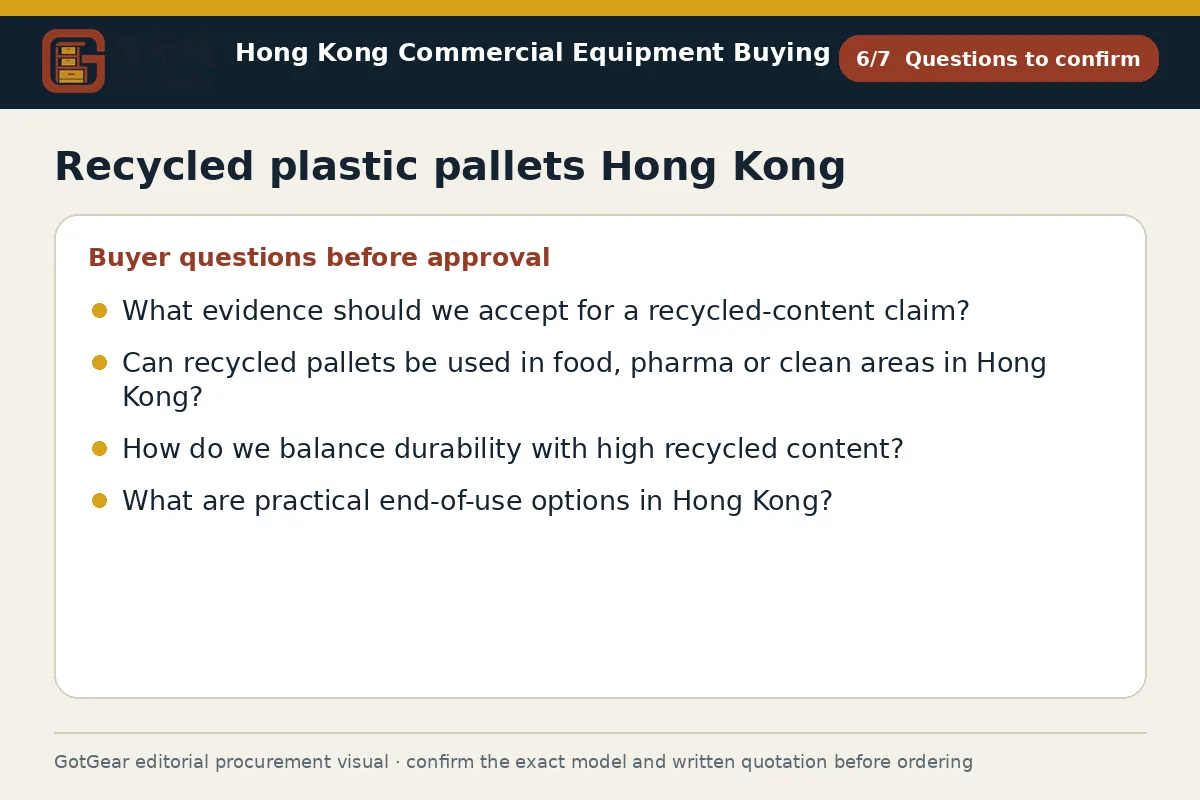
What evidence should we accept for a recycled-content claim?
Accept a signed manufacturer declaration that states polymer family, recycled percentage by mass, whether content is post‑consumer or post‑industrial, and the calculation method. Prefer batch‑level traceability and photos of material ID marks on the pallet. If third‑party verification is offered, review scope and dates. Ultimately, your comparison should follow the model specification and figures shown on the formal written quotation.
Can recycled pallets be used in food, pharma or clean areas in Hong Kong?
Yes, if the model’s design, surface and cleaning compatibility meet your site and insurer requirements. Closed decks, smooth surfaces and verified detergent resistance are commonly requested. Obtain the manufacturer’s hygiene guidance and any applicable statements, then run a site trial through your wash process. Final acceptance should follow your venue rules and competent adviser approvals where required.
How do we balance durability with high recycled content?
Run a structured handling trial that reflects your roughest use points: pallet‑jack entries, tight turns, racking and any chilled areas. Compare impact and deflection against the supplier’s data and your acceptance criteria. Where brittleness appears, discuss blend adjustments or a different deck/runner design. Document results, as the model specification and written quotation prevail over general claims.
What are practical end-of-use options in Hong Kong?
Plan a recycling route that matches the pallet’s polymer and any reinforcement. Confirm acceptance and preparation steps with a recycler or take‑back programme, and keep written confirmation. For multi‑site users, coordinate with the landlord and waste contractor on storage and collection. Cross‑boundary recovery to the Greater Bay Area can be considered where permitted by stakeholders and logistics.
Continue with closely related procurement topics
These pages share equipment, operating or decision-stage signals with this guide.
Perforated Euro containers Hong Kong
GotGear provides a checklist to compare perforated Euro containers Hong Kong and vented plastic crates Hong Kong for food handling and cold chain, covering airflow, drainage, containment and cleaning considerations.
Read the guide
Reusable plastic crates Hong Kong
GotGear explains how reusable plastic crates Hong Kong are issued, sorted and inspected. It also outlines loss management, plastic crate colour coding Hong Kong and plastic crate cleaning and sanitising Hong Kong.
Read the guide
Plastic pallet stacking safety Hong Kong
GotGear explains plastic pallet stacking safety Hong Kong, plastic pallet load stability Hong Kong and plastic pallet anti-slip surface Hong Kong. It also recommends a unit-load checklist to check restraint, support and handling.
Read the guide
Plastic pallet for airport cargo Hong Kong
GotGear provides a checklist for plastic pallet for airport cargo Hong Kong so air-cargo handlers can record cargo profile, handling equipment, transfer points, restraint, inspection, operating limits and compatibility.
Read the guideRelated topic indexOpen more English procurement pages2 topics
Browse additional equipment families, applications and procurement questions relevant to a wider buying brief.