
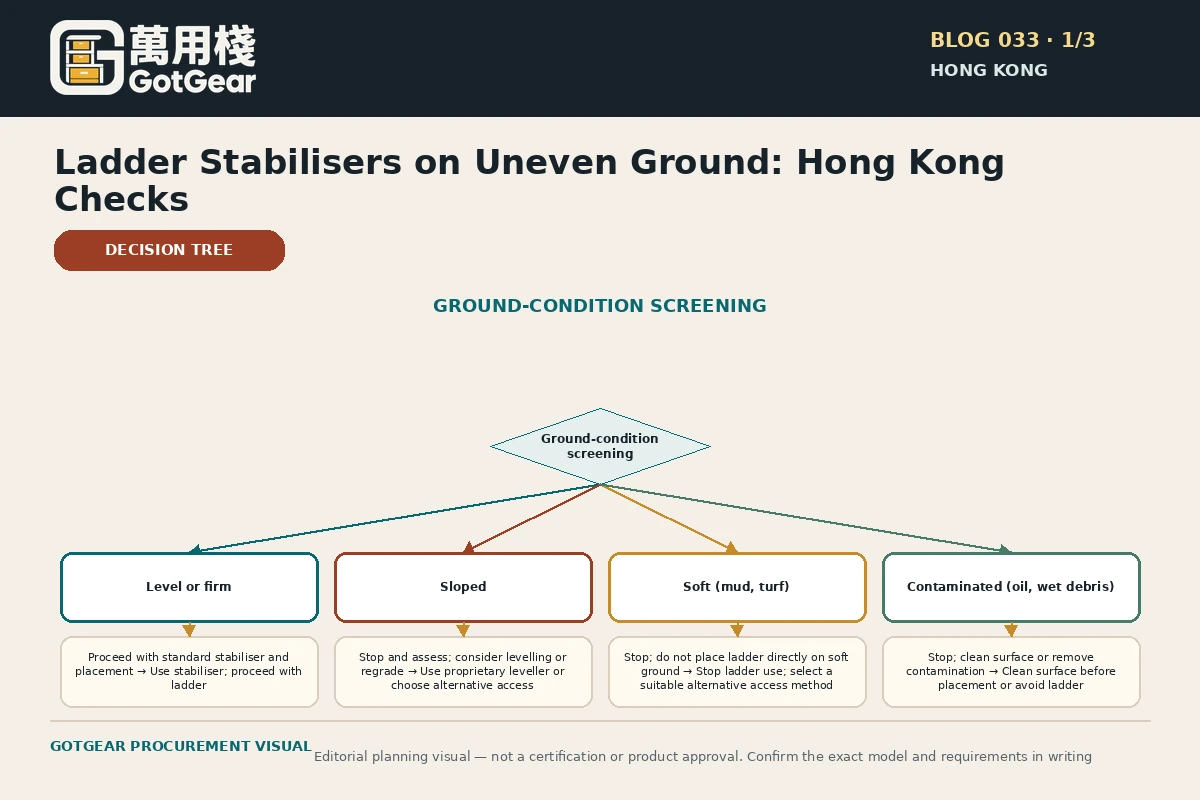
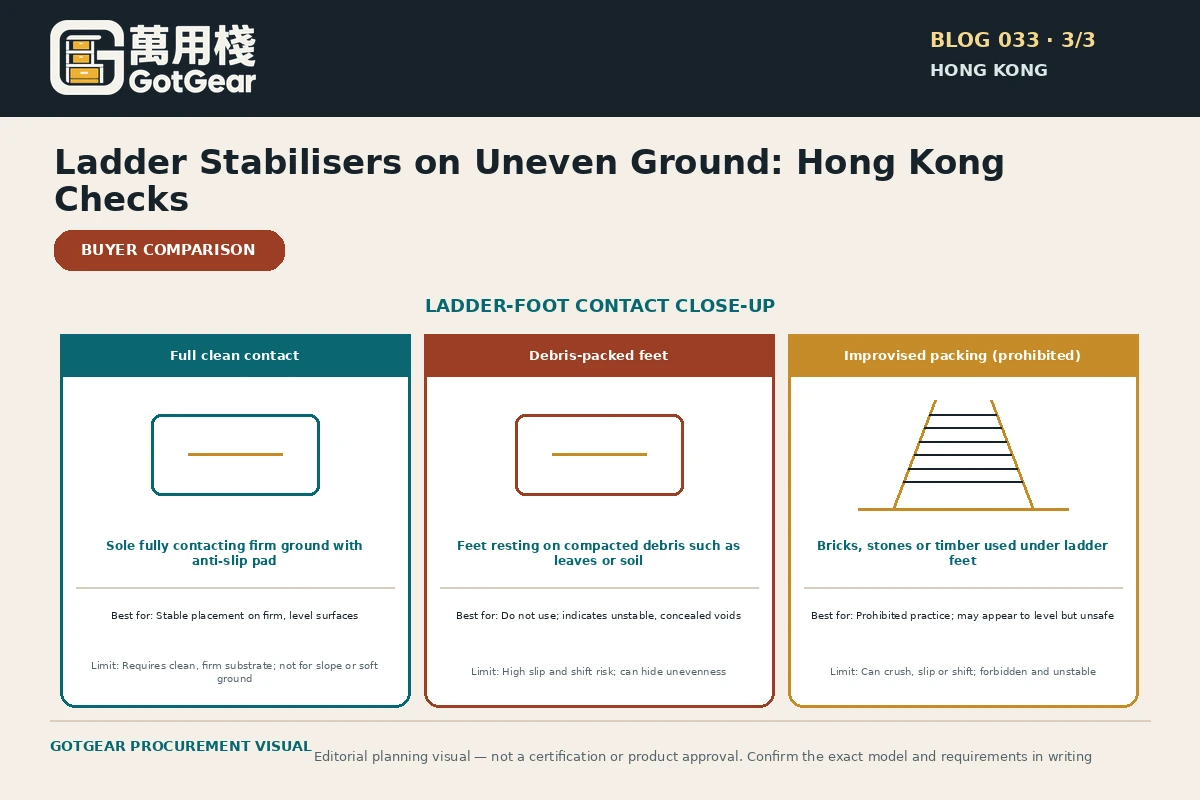
A stabiliser or levelling accessory is only acceptable when the device is explicitly compatible with that ladder and the ground can be made firm and clean; never use bricks, offcuts or ad-hoc packing. In Hong Kong, assess the task against the Labour Department’s preference for working platforms; treat stabilisers and proprietary levellers as tools for specific mismatches, not cures for soft, sloped or contaminated surfaces. If the ladder cannot be tied, supported or placed on a stable platform, choose an alternative access method.
What to remember before you decide
- Do not use improvised packing to level a ladder; it’s unreliable and unsafe.
- A stabiliser and a levelling device are different tools — confirm the exact compatibility and permitted combinations.
- Assess firmness, cleanliness and slope before approving any ladder accessory; soft or contaminated ground remains unacceptable.
- Tie both stiles first where possible; use stability devices only as the hierarchy allows and when manufacturer guidance permits.
- When in doubt, stop and select a platform or mobile tower — Hong Kong guidance prefers appropriate working platforms for marginal situations.
Understand what a stabiliser does — and what it does not
What a stabiliser is: A ladder stabiliser is an accessory that increases lateral stability and contact area at the top or base of the ladder; some models attach to the ladder stiles, others fit the feet. A levelling device is different: it lets you set unequal feet lengths so the ladder stands vertical on a slope. Use these decision checks: confirm whether the product manufacturer explicitly lists your ladder model and working angles; check load ratings, attachment method and whether the device is intended for the ladder’s intended tasks (single-person work, two-person loads, tools). A key limitation is that neither a stabiliser nor a leveller makes soft, unconsolidated, oily or heavily contaminated ground acceptable. These devices do not replace the requirement for firm, level and clean footing because the feet must still bear the load without slipping or sinking. Next actions (Hong Kong context): inspect the site for slopes, soil type, drains, cleaning needs and pedestrian or vehicular interference before accepting a device. If you are in a typical Hong Kong urban maintenance setting — rooftops, building exteriors, walkways — prioritise a temporary platform or scaffold when ground or floor integrity is in doubt. Remember the local Labour Department guidance which emphasises appropriate working platforms when ladder use is not suitable.
Practical checks at the Hong Kong site before attaching any device
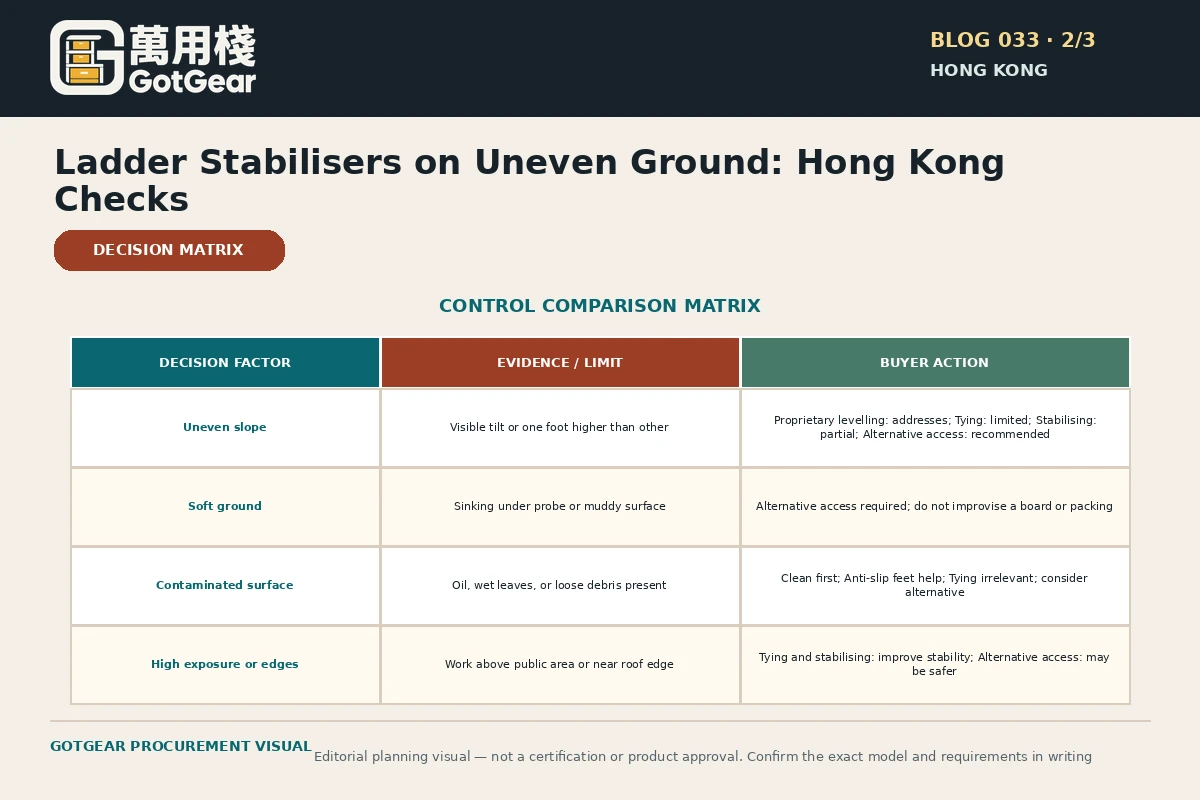
Site checklist before buying or approving a stabiliser: 1) Surface composition — concrete, tiled roof, asphalt or soft soil; 2) Cleanliness — presence of oil, moss, dust, loose aggregate; 3) Gradient — measure slope or step heights between feet; 4) Pedestrian and vehicle exposure — is the ladder in a carriageway, stairwell or shared corridor; 5) Edge and fall hazard — is the ladder near an unguarded edge? Use these decision checks: do not accept a stabiliser if the surface allows any foot penetration or if contamination prevents grip; reject level-only solutions for surfaces with repeated foot movement or vibration from plant. A key limitation is that Hong Kong sites often combine narrow spaces with mixed finishes; a levelling device that works on a roof tile may be ineffective on a nearby concrete step. Next, photograph the planned set-up, confirm the product’s stated ground compatibility with the supplier and require proof of compatibility in writing before procurement. If the supplier cannot confirm suitability for your ladder and site, escalate to an alternatives review.
“Treat stabilisers and levellers as specific tools for specific problems, not universal fixes. If you cannot make the base firm, level and clean or cannot tie the ladder, stop and pick a platform.”— GotGear Editorial Team
What should buyers compare for ladder stabiliser for uneven ground Hong Kong?
| Option or approach | Best for | Trade-offs | Checks before acceptance |
|---|---|---|---|
| Maker-approved ladder stabiliser | Ladders on generally firm, level ground needing extra lateral contact area for short-duration tasks. | Adds lateral stability but does not correct soft or contaminated surfaces; requires explicit compatibility and proper attachment. | Obtain manufacturer compatibility statement for your ladder model and inspect the stabiliser attachment points and load rating; perform a static test with a low-weight load before use. |
| Proprietary levelling device (integrated foot length adjustment) | Minor slopes or step differences on otherwise firm ground where the device manufacturer lists your ladder and slope angle. | Corrects slope but not ground firmness or contamination; mechanical failure risk if used beyond rated angles or loads. | Confirm rated slope range and ladder model compatibility in writing; test under supervision with the intended workload and re-check feet grip after a short period. |
| Securing ladder to a fixed point and using stability device | Access tasks where a secure tie-off point is available and ladder will be used for access or egress rather than prolonged work at height. | Effective for preventing movement but depends on availability and strength of anchor points; tying both stiles may not be possible in all settings. | Verify anchor strength and permanence; follow the hierarchy of securing—tie both stiles first, then use approved stability devices—document anchor capacity and method. |
| Temporary local platform or mobile tower | Prolonged tasks, heavier loads, soft/contaminated/uneven ground, or where pedestrian control is needed. | Higher mobilisation effort and footprint, requires space and may need permits, but provides a safer, stable working surface. | Confirm platform rated load and base requirements for the ground; inspect assembly instructions and records; use a competent assembler and keep assembly photos and load checks. |
| Stop and select a different access method | When testing shows the ladder base cannot be made firm and clean, or tying/anchoring cannot be achieved. | Delays the task and may increase resource requirements, but avoids unacceptable risk and aligns with Hong Kong guidance favouring safe working platforms. | Record the conditions that caused the stop decision, the alternative method selected and approvals from the site safety officer or facilities manager. |
This framework helps buyers create comparable written enquiries. Final model specifications, availability, delivery and commercial terms must be confirmed in a formal quotation.
Compare alternatives — when to use a stabiliser, leveller, securing or stop work
Four realistic approaches to uneven ground: 1) maker-approved stabiliser attached and used exactly as instructed; 2) proprietary levelling device that explicitly supports your ladder and slope; 3) properly securing the ladder (tying both stiles and using effective stability devices) or temporary localised platform; 4) aborting ladder use and selecting a different access method. Use these decision checks: match the approach to task duration, load, frequency of movement and exposure to the public. For short, light, low-risk tasks on firm surfaces a stabiliser or leveller may be appropriate when compatibility is confirmed. For prolonged access, heavier loads or soft/contaminated ground, prefer a working platform or mobile tower. A key limitation is that these approaches are not mutually exclusive; tying and a stabiliser can be combined only when manufacturer guidance allows and the securing point is suitable. Next, for each job prepare a requirements note task-specific written rationale explaining chosen method, the confirmation of compatibility with supplier documentation and the contingency trigger that requires abandoning ladder use.
Deciding to stop and change method — the responsible option in Hong Kong
Decision triggers to stop ladder use: foot sinkage under test load, unremovable contamination, inability to tie both stiles to a secure point, repeated movement in the ladder base during set-up, or public access conflicts that cannot be controlled. Use these decision checks: adopt a conservative tolerance — if one small test load produces visible settlement or loss of grip, do not proceed. A key limitation is that commercial pressure to finish tasks quickly is common in Hong Kong building maintenance, but speed should not override the Labour Department’s preference for platforms when ladder conditions are marginal. Next, when stopping, document the reasons, cordon the area, and either arrange a small temporary platform, use a mobile work tower designed for the surface, or schedule work with a compliant access contractor. Ensure the incident note and photos are retained for procurement and safety review.
Ladder stabiliser for uneven ground Hong Kong decision checklist
- Confirm the exact ladder model and serial/ID against the stabiliser or leveller manufacturer’s compatibility list.
- Inspect and photograph the ground surface for firmness, contamination (oil, moss, paint) and slope measurements.
- Check for suitable anchor points to tie both stiles; document anchor type and rated capacity before use.
- Review the intended task duration, load (tools, materials, personnel) and whether the ladder will be used for access only or for working from height.
- Request written compatibility and usage instructions from the accessory supplier; do not accept verbal assurances only.
- Run a controlled static test with a low-weight load and observe for slipping or sinking at the feet or device interface.
- Assess public and vehicular exposure; put barriers and controls in place or choose an alternative if control is not achievable.
- Ensure at least one competent person onsite who understands ladder securing hierarchy and the device limitations.
- Check local Labour Department guidance on working platforms and record why a ladder is still preferred for this specific task.
- Plan a contingency and stop criteria — criteria that immediately require abandoning ladder use and switching methods.
- Confirm rescue and emergency access plans for the chosen method and ensure communication devices are available.
- Retain documentation: photos, supplier confirmation, test results and the risk assessment rationalising the chosen method.
Practical action sequence
- Survey and photograph the intended ladder location, noting surface type, slope and nearby hazards.
- Obtain and file supplier or manufacturer confirmation of compatibility between ladder and chosen stabiliser/leveller.
- Set up exclusion zones and pedestrian/vehicle controls around the work area before placing the ladder.
- Attach stabiliser or leveller strictly per the manufacturer instructions and check fastenings and locking features.
- Tie both stiles to a secure anchor if possible; if not possible, use an approved stability device and re-test stability.
- Perform a staged static test with incremental loading while an observer watches for movement, slippage or settlement.
- If the ladder shows any instability, stop immediately, document the failure and switch to the pre-approved alternative access method.
- After work, inspect the stabiliser/leveller and ladder for wear or damage and record any incidents or near-misses for review.
Apply the checks to your Hong Kong site
In Hong Kong, always prioritise a secure working platform; a ladder stabiliser for uneven ground Hong Kong should only be fitted when the manufacturer confirms compatibility with that ladder model and the working surface can be made firm, level and free of debris. Do not use improvised packing such as bricks or timber offcuts to make up gaps. Where adjustable ladder safety feet Hong Kong are used, record the adjustment, verify contact on stable ground, and re-check during the task. When feasible, attach to an independent anchor or use recognised ladder securing methods Hong Kong rather than relying solely on base devices. If the base cannot be validated as stable and secure, stop and select a different access method. Operational takeaway: require a written site check and go/no-go sign-off before any ladder is put in service on uneven ground.
References used for this article
These sources provide regulatory, safety or planning context. They do not certify any GotGear product or replace site-specific professional advice.
- Hong Kong Labour Department — Overview of Work-at-Height Safety — Local task-risk and working-platform-first context.
- HSE — Where ladders should be used — Firm, level, clean footing and proprietary levelling-device guidance.
- HSE — Securing ladders and ladders used for access — Securing hierarchy for tied ladders, stability devices, wedging and footing.
- Occupational Safety and Health Council — Safety Hints for Using Ladders — Local reminder on firm, level ground, fastening and avoiding passageways.
Questions about ladder stabiliser for uneven ground Hong Kong
Can I level a ladder with bricks, blocks or timber packing on uneven ground?
No. Both overseas guidance and local safety councils advise against improvised packing. Bricks, blocks and timber can crush, shift or become unstable under load and cannot reasonably be tested for safety in situ. Use a proprietary levelling device specifically rated for your ladder model, or choose another access method. In Hong Kong facilities management, improvised packing is treated as an unacceptable practice because it fails the firm, level and clean footing expectations and offers no predictable performance.
Where should ladders be used and when should I prefer a platform?
Guidance indicates ladders are appropriate only for short-duration, low-risk tasks on firm, level and clean surfaces with adequate space and control of other hazards. For prolonged tasks, heavy loads or where ground or flooring is soft or contaminated, a working platform, mobile tower or scaffold is preferred. In Hong Kong the Labour Department emphasises selecting suitable working platforms when ladder conditions are marginal; assess task length, load and environment before approving ladder use.
What is the correct order for securing a ladder?
The generally accepted hierarchy starts with tying both stiles to a secure point to prevent displacement. If tying is not possible, follow with an effective stability device or suitable mechanical support. Wedging the base is an option in some situations, and footing by a second person is the last resort. Always follow manufacturer guidance and confirm any combination of securing methods is permitted for the ladder and accessory in question.
If the ground is sloped but firm, can a levelling device always be used?
Not always. A proprietary levelling device can be appropriate for minor slopes when the manufacturer explicitly supports that ladder model and the slope angle falls within the device’s rated range. However, the ground must still be firm and free of contamination. If there is doubt about firmness, or if the slope is steep, choose a platform or other engineered access solution rather than relying solely on a leveller.
How do I confirm compatibility between a ladder and a stabiliser or leveller?
Ask the supplier for written confirmation that the accessory is compatible with your ladder model and for any restrictions on angle, load or feet types. Request product documents showing rated loads, tested ground conditions and instructions for attachment. Do not accept verbal assurances alone. Validate compatibility on-site with a supervised static test prior to live work and retain the documentation as part of your procurement and safety records.
What should I do if the ladder base moves or sinks during testing?
Stop immediately, cordon the area, record photographic evidence and do not proceed. The correct response is to switch to an alternative access method such as a temporary platform or mobile tower. Document the reason for stopping, the test results, and the chosen alternative. This ensures compliance with safety expectations and provides a record for future procurement and site planning decisions.
Compare available product models and specifications
These product cards are matched to this buying topic. Select a specification and quantity to send the product details to WhatsApp.
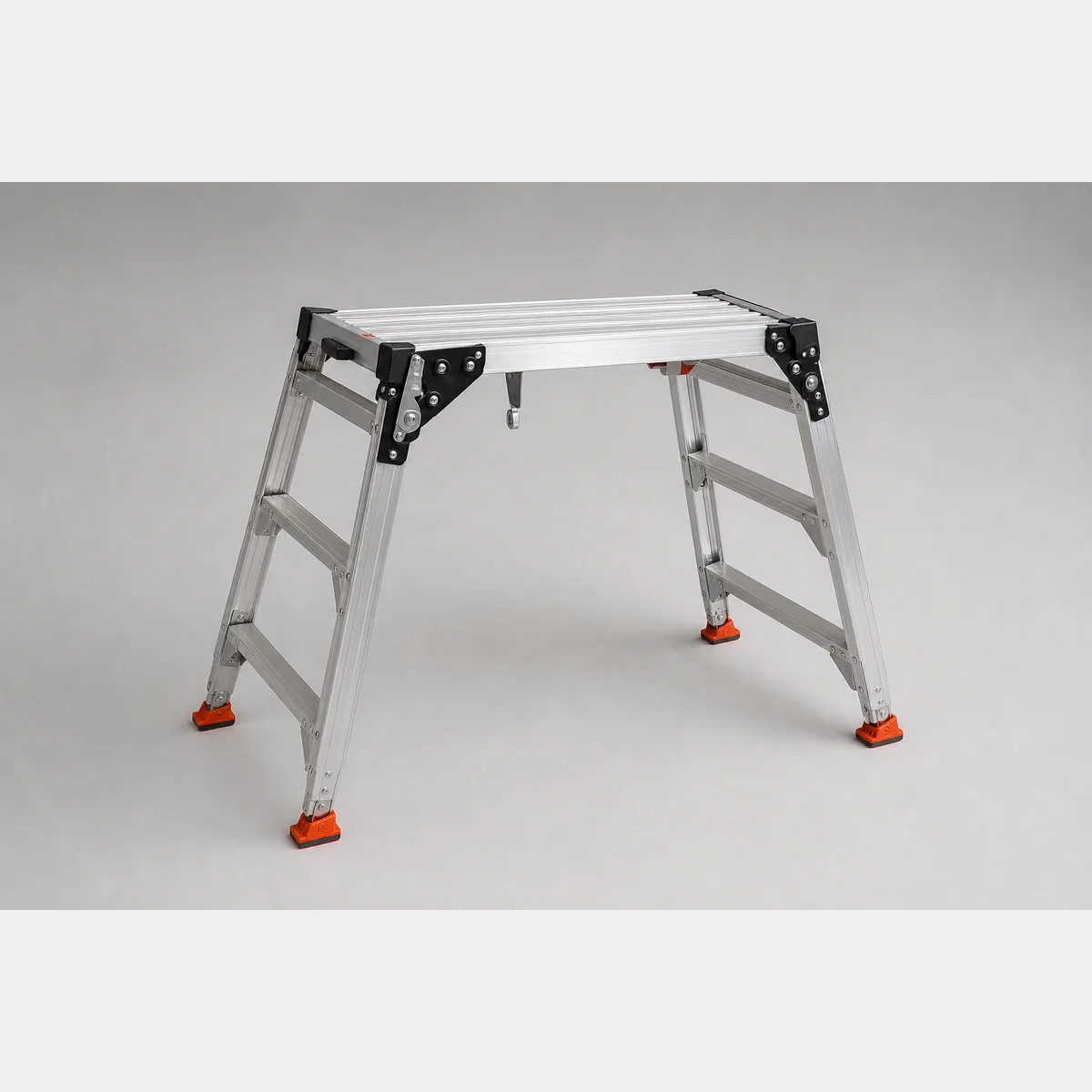 Aluminium Ladders & Access EquipmentProduct reference image
Kung Fu Stool Aluminium Ladder (Telescopic Feet)
Kung Fu Stool Aluminium Ladder (Telescopic Feet), Dimensions / specification range: W498~521xD983~1044xH533~696 mm / W514~535xD1363~1450xH674~830 mm. Formal quotation available upon request based on use, specifications and quantity.
- Dimensions / Specification range
- W498~521xD983~1044xH533~696 mm / W514~535xD1363~1450xH674~830 mm
 Aluminium Ladders & Access EquipmentProduct reference image
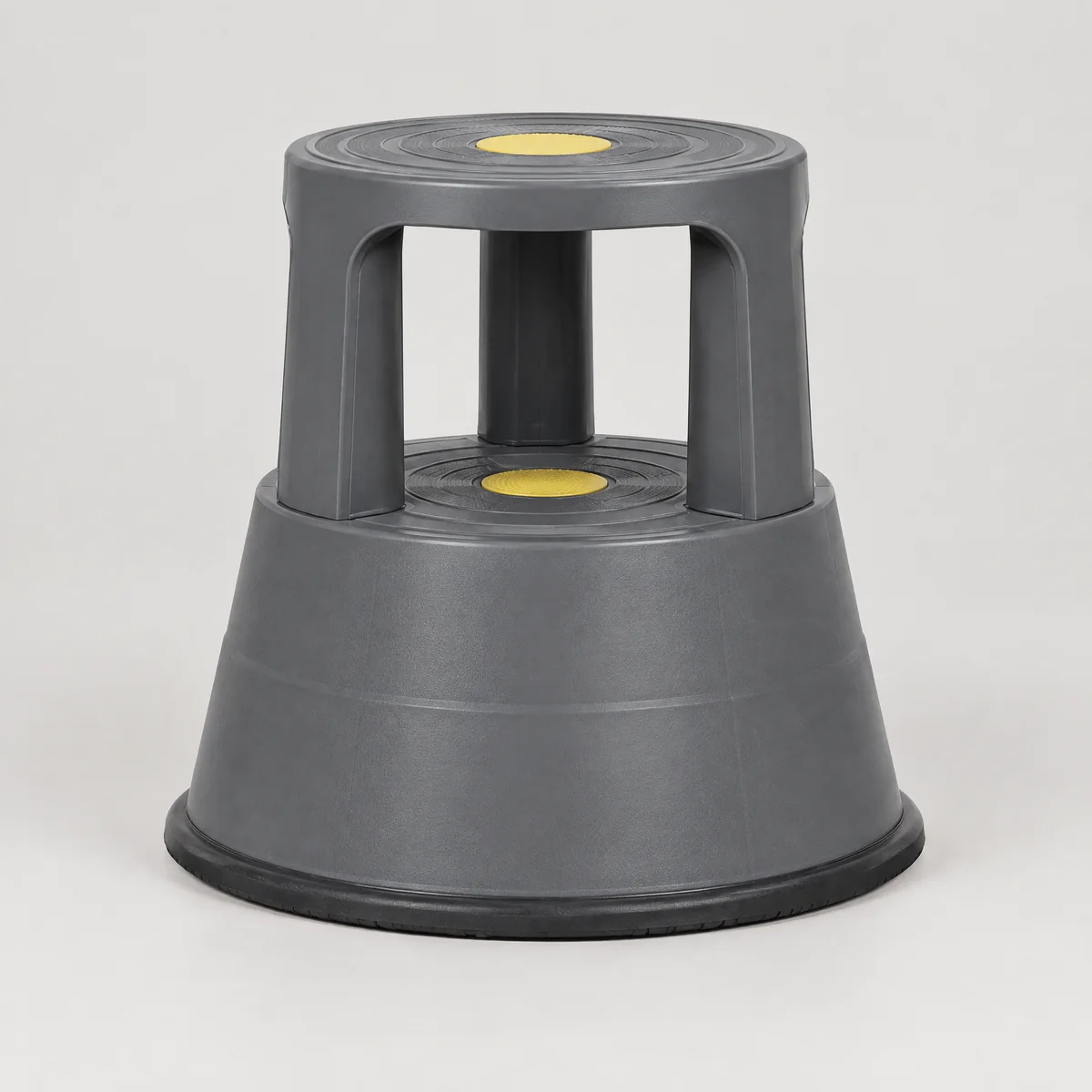
2-Level Round Step
2-Level round step. Colour: grey-white; Load capacity records differ: 100 kg in product information and 120 kg in selectable variant records; confirm the exact rating in writing. Formal quotation available upon request based on use, specifications and quantity.
- Colour
- grey-white
- Load capacity
- 100 kg in product information / 120 kg in variant records; confirm exact rating in writing
- Source-record note
- The JC2508-B/JC2509-B model identifier requires written confirmation because source product text and the selectable record conflict.
 Aluminium Ladders & Access EquipmentProduct reference image
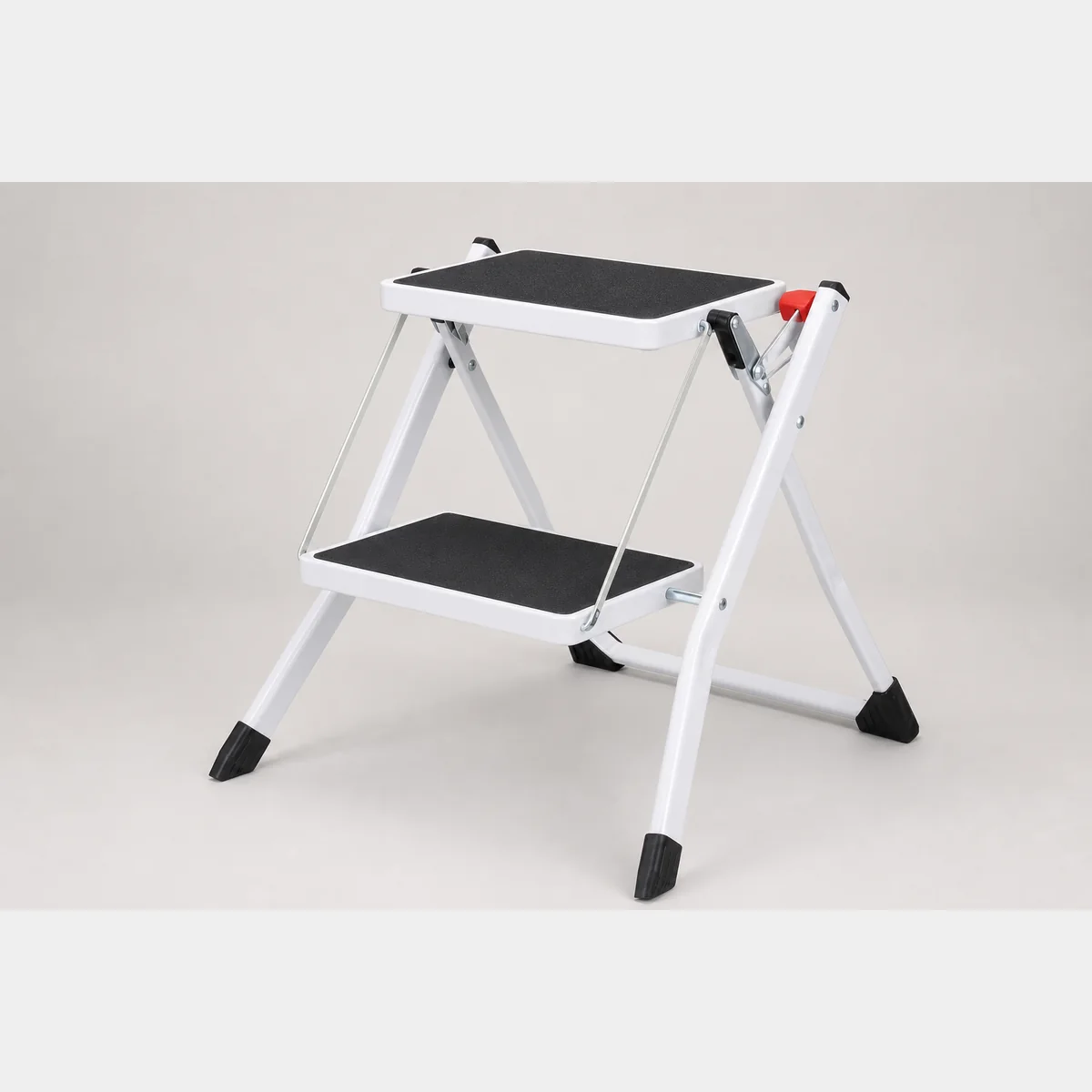
2-step ladder
2-step ladder. Dimensions/specification: L49xW48.5xH44.5 cm. Formal quotation available on enquiry with intended use, specifications and quantity.
- Dimensions/Specifications
- L49xW48.5xH44.5 cm
 Aluminium Ladders & Access EquipmentProduct reference image
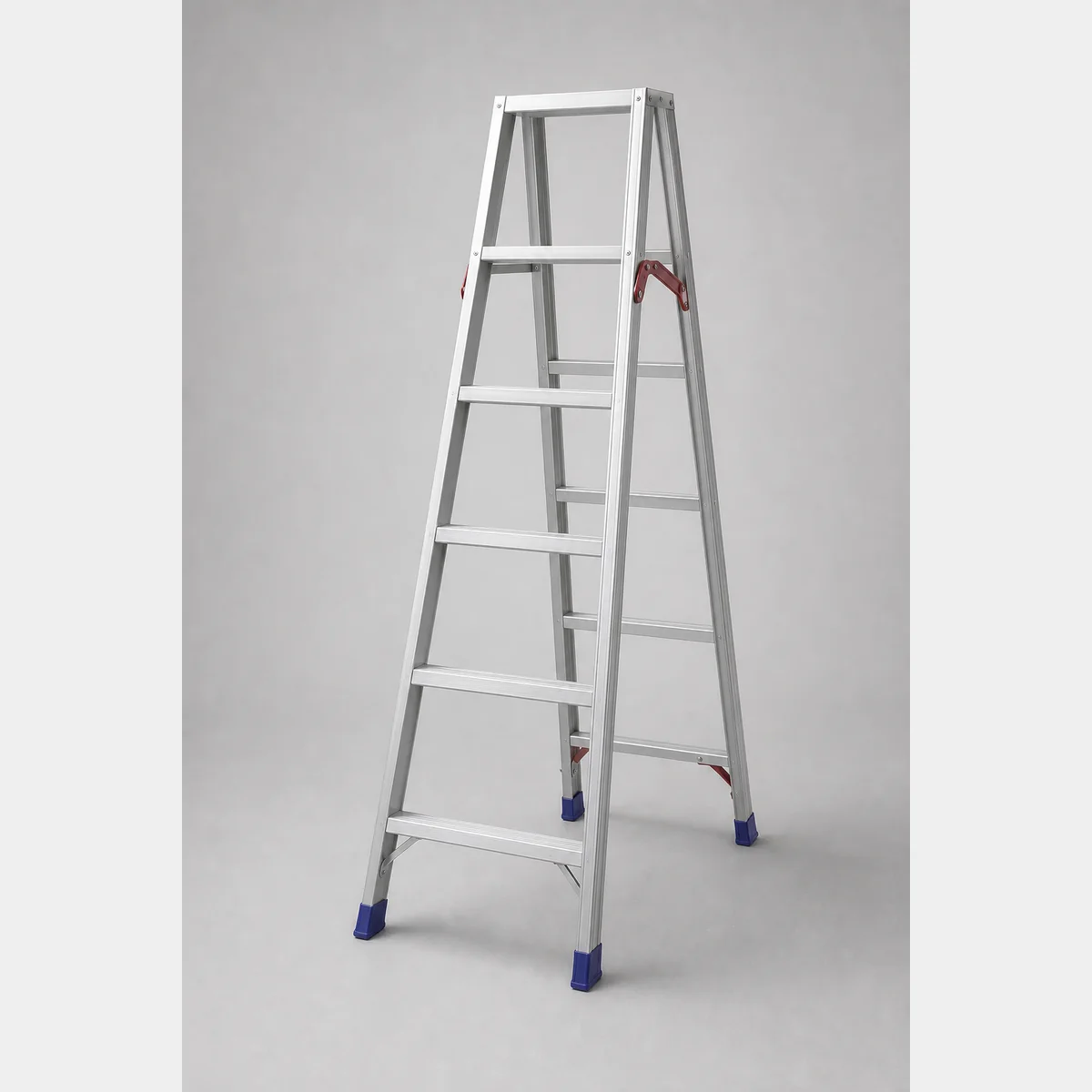
2-way double-sided A-frame aluminium ladder
2-way double-sided A-frame aluminium ladder. Size/Model lines: NXG150A2X4 / NXG150A2X5. A formal quotation is available on request by use, specification and quantity.
- Size/Model line
- NXG150A2X4 / NXG150A2X5
 Aluminium Ladders & Access EquipmentProduct reference image
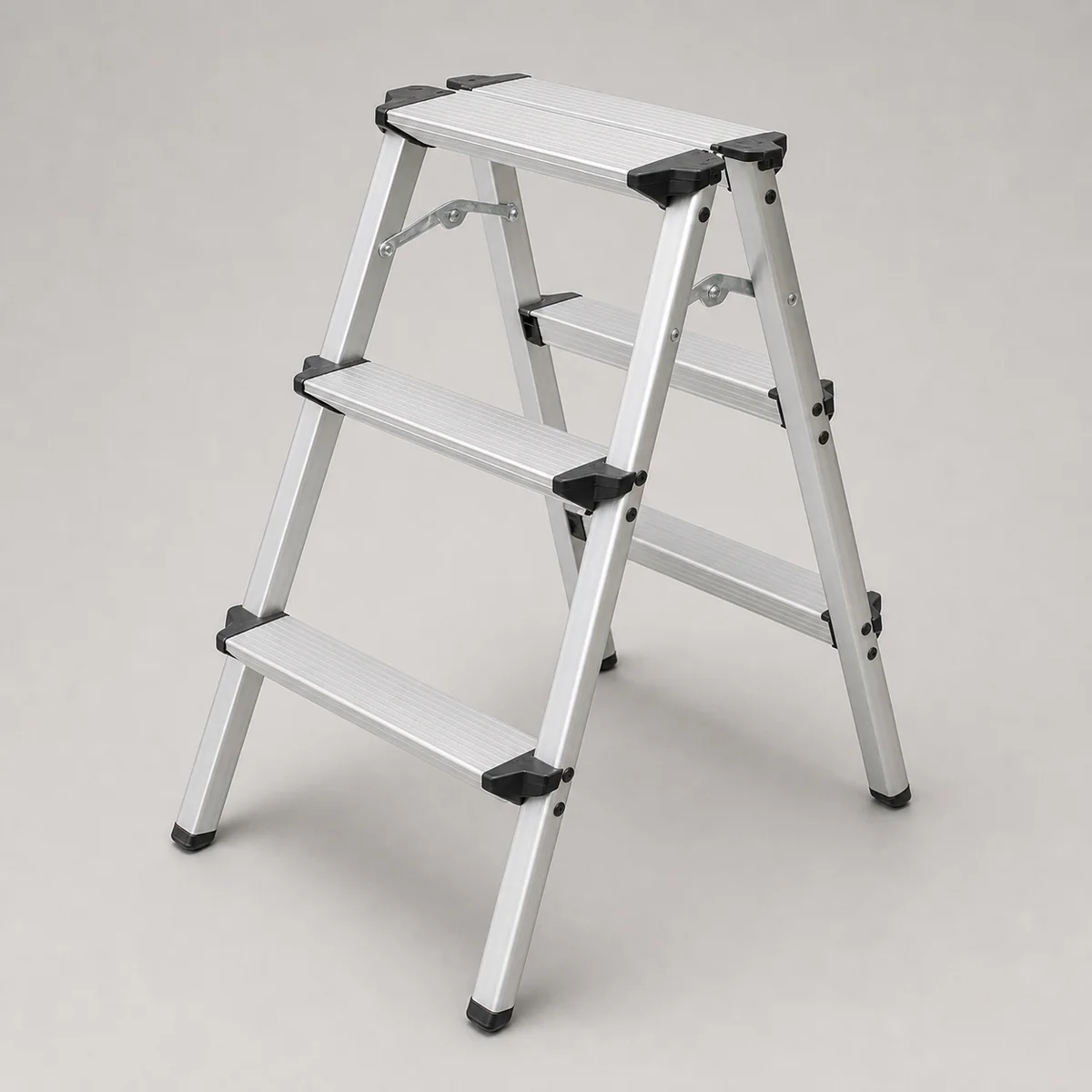
3-level A-frame aluminium ladder
3-level A-frame aluminium ladder. Material: aluminium; Working height: 80 CM; Load capacity: 100KG. Please contact us for a formal quotation based on application, specifications and quantity.
- Material
- Aluminium
- Working height
- 80 CM
- Load capacity
- 100KG
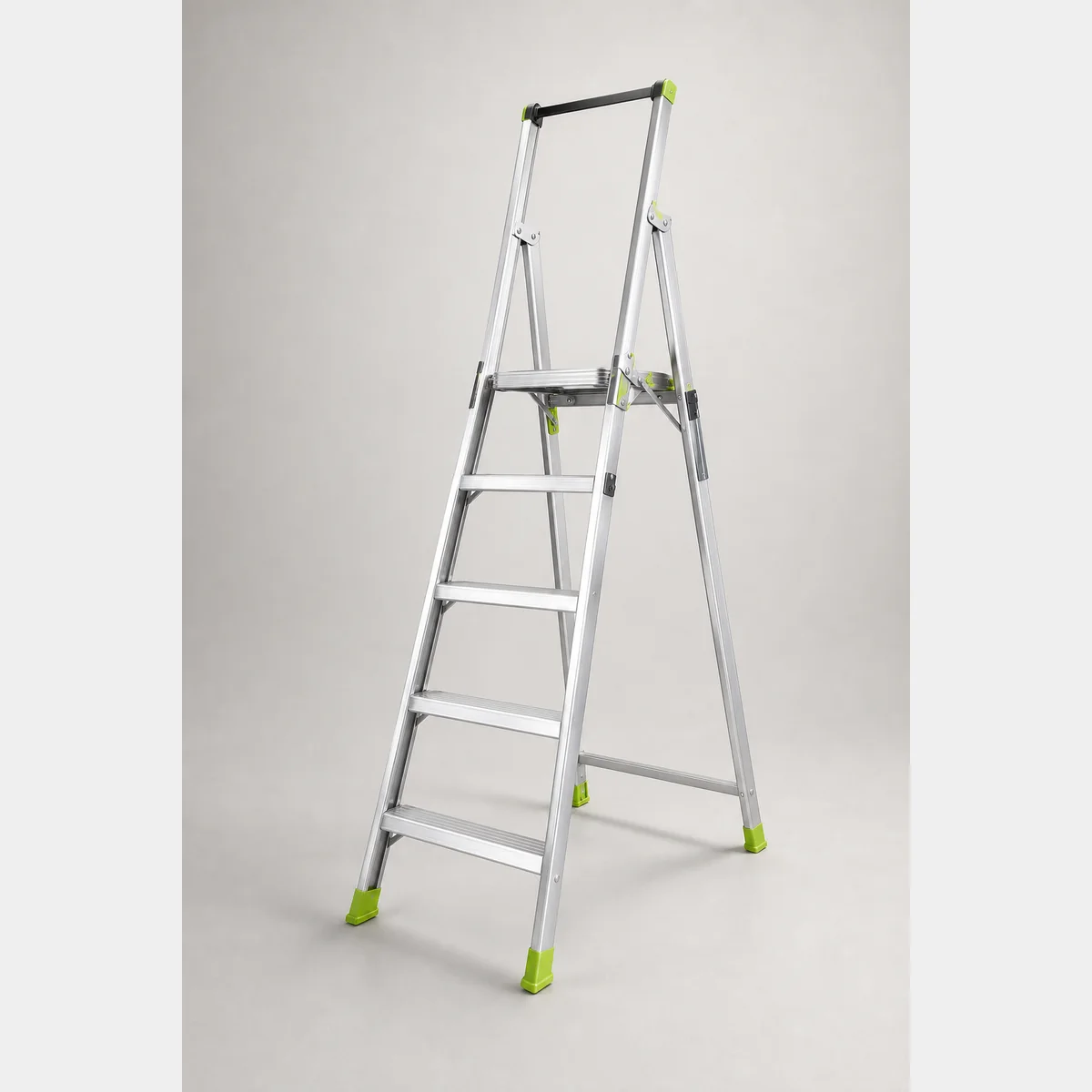 Aluminium Ladders & Access EquipmentProduct reference image
Aluminium Ladder with Handrail
Aluminium ladder with handrail. Dimensions/Specs: W473xD660xH1107 mm / W530xD845xH1387 mm; Use height: 487 mm / 767 mm; Load capacity: 150KG. Formal quotation available based on use, specifications and quantity.
- Dimensions/Specs
- W473xD660xH1107 mm / W530xD845xH1387 mm
- Use height
- 487 mm / 767 mm
- Load capacity
- 150KG
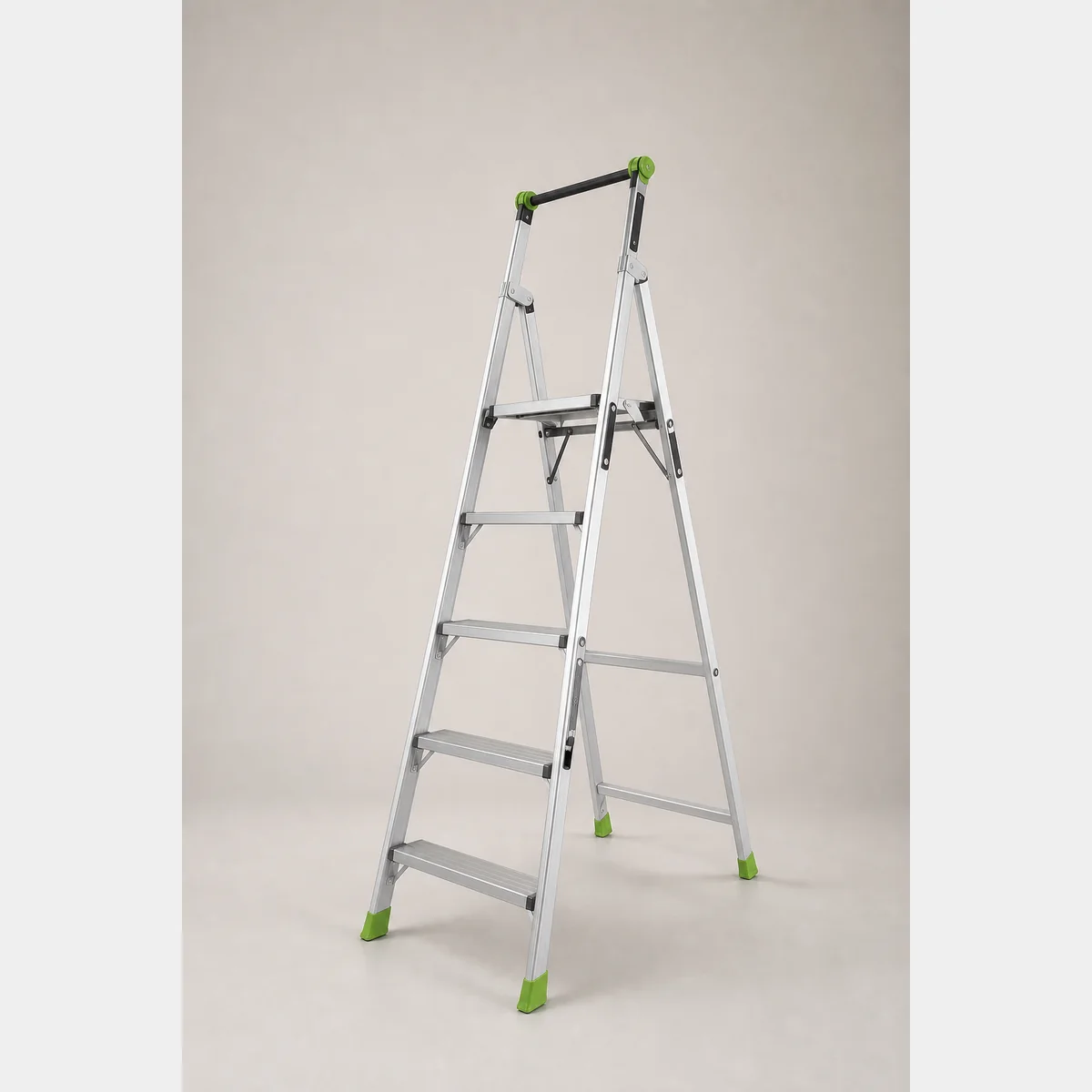 Aluminium Ladders & Access EquipmentProduct reference image
Aluminium Ladder with Handrail
Aluminium Ladder with Handrail. Enquire with the intended use, specifications and quantity for written confirmation.
- Dimensions / Spec line
- W424xD666xTH1221 mm / W448xD819xTH1436 mm
- Working height
- 611 MM / 827 MM
- Minimum order quantity
- 1PC
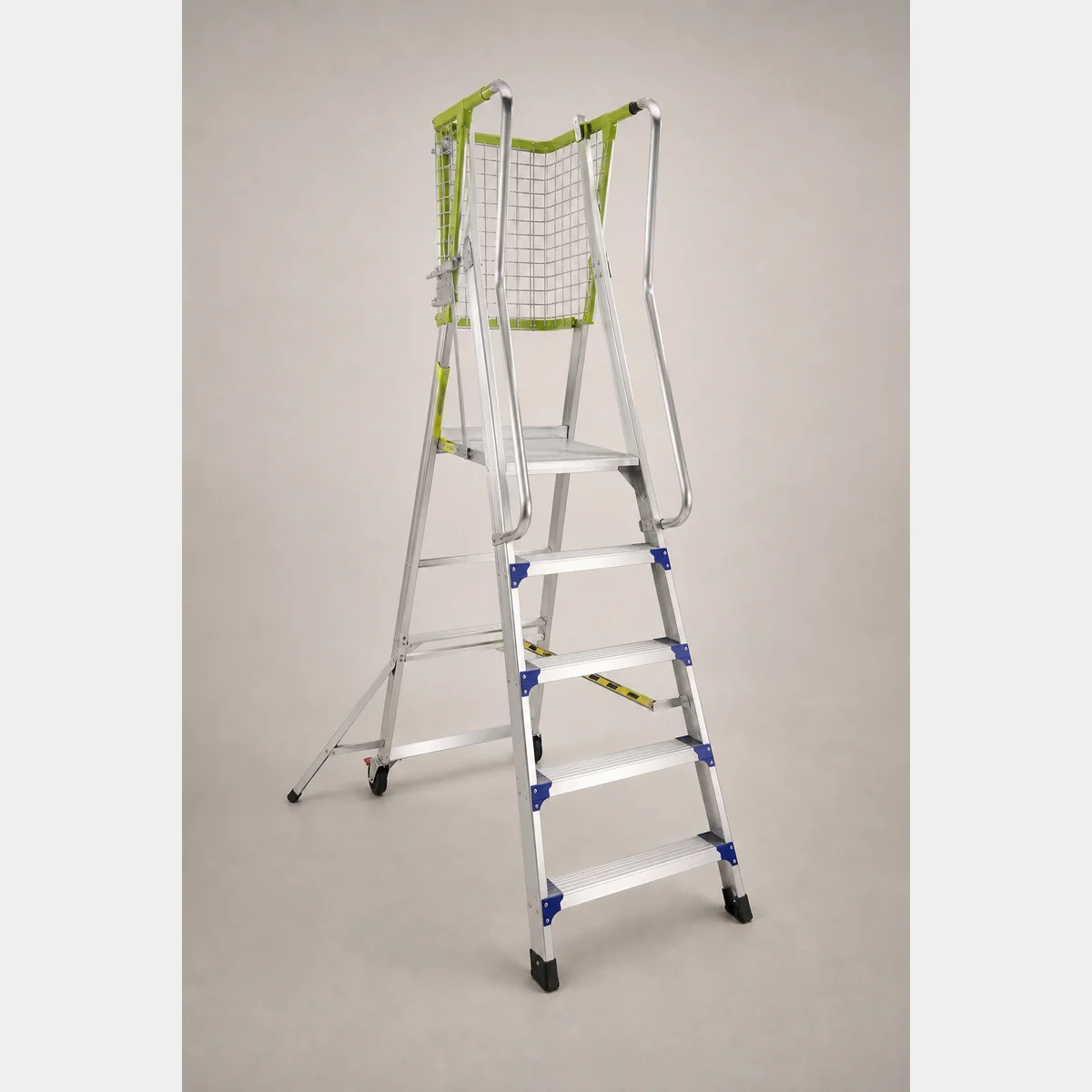 Aluminium Ladders & Access EquipmentProduct reference image
Aluminium platform ladder with mesh enclosure (Diagonal Brace)
Aluminium platform ladder with mesh enclosure (Diagonal Brace), working heights: 860 mm / 1150 mm. Formal quotation available upon request based on use, specifications and quantity.
- Working height
- 860 mm / 1150 mm
Continue with closely related procurement topics
These pages share equipment, operating or decision-stage signals with this guide.
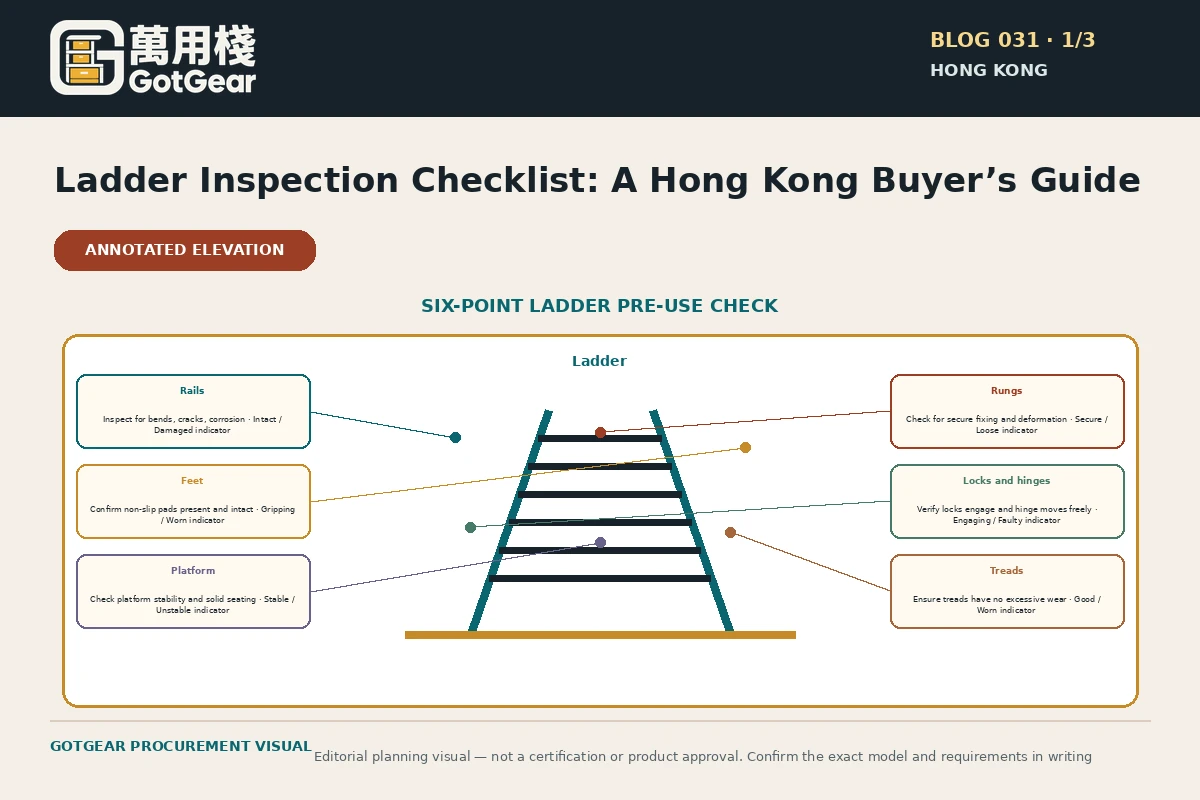
Ladder inspection checklist Hong Kong
GotGear explains ladder inspection checklist Hong Kong for Hong Kong buyers. See how ladder pre-use check Hong Kong supports ladder defect tag Hong Kong, with practical checks, evidence boundaries and written requirements.
Read the guide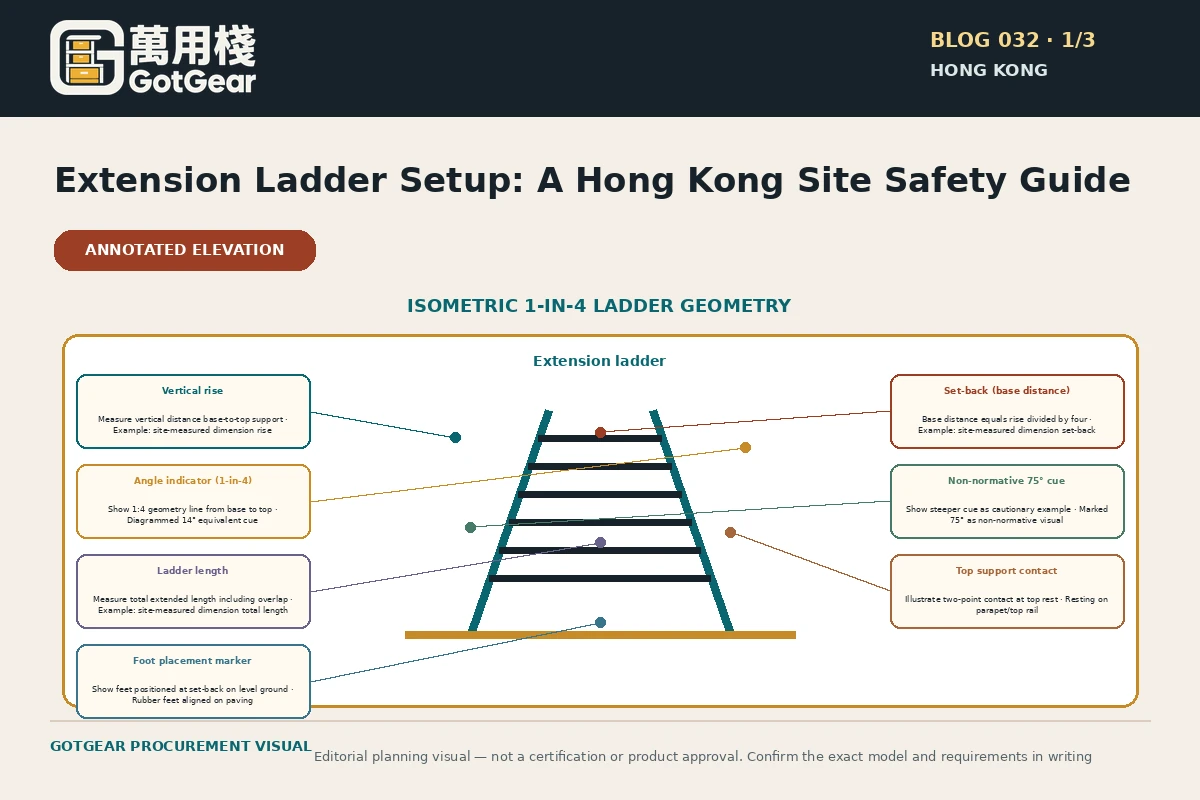
Extension ladder setup Hong Kong
GotGear explains extension ladder setup Hong Kong for Hong Kong buyers. See how ladder 4 to 1 rule Hong Kong supports extension ladder landing access Hong Kong, with practical checks, evidence boundaries and written requirements.
Read the guide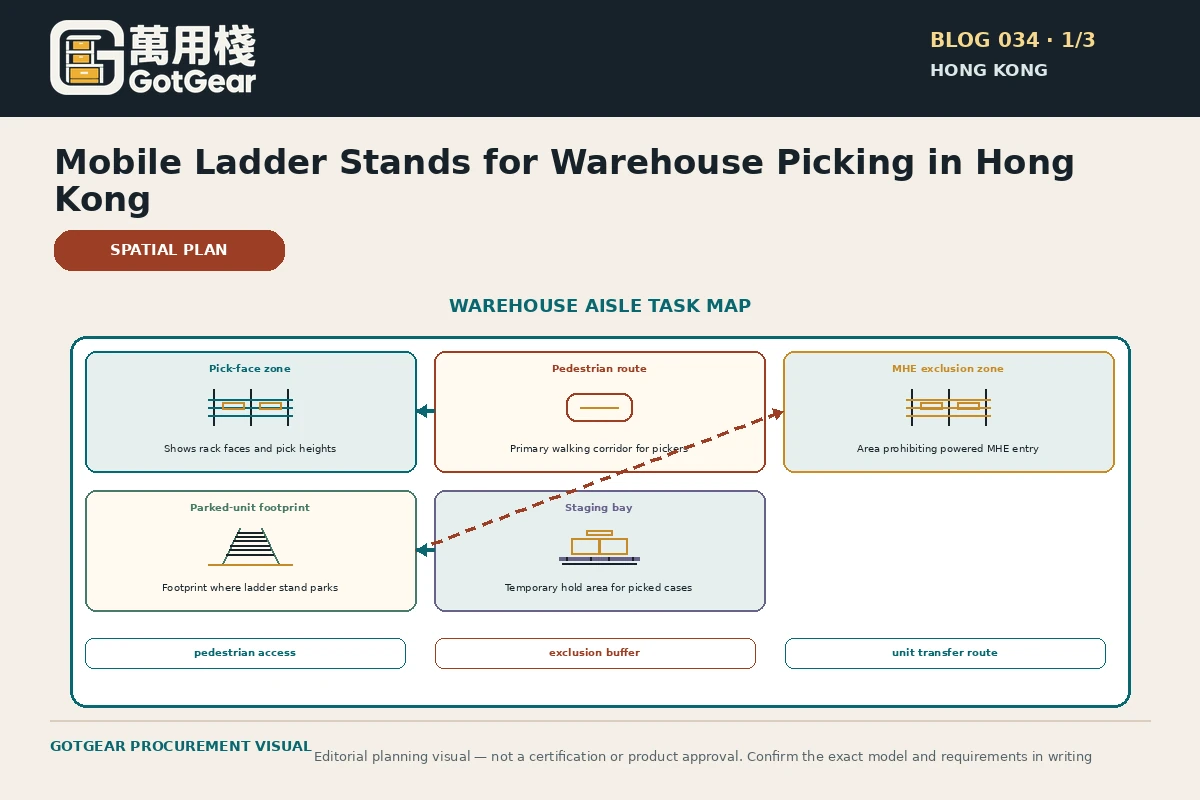
Mobile ladder stand for warehouse picking Hong Kong
GotGear explains mobile ladder stand for warehouse picking Hong Kong for Hong Kong buyers. See how warehouse order picking ladder Hong Kong supports rolling ladder platform Hong Kong, with practical checks, evidence boundaries and written requirements.
Read the guide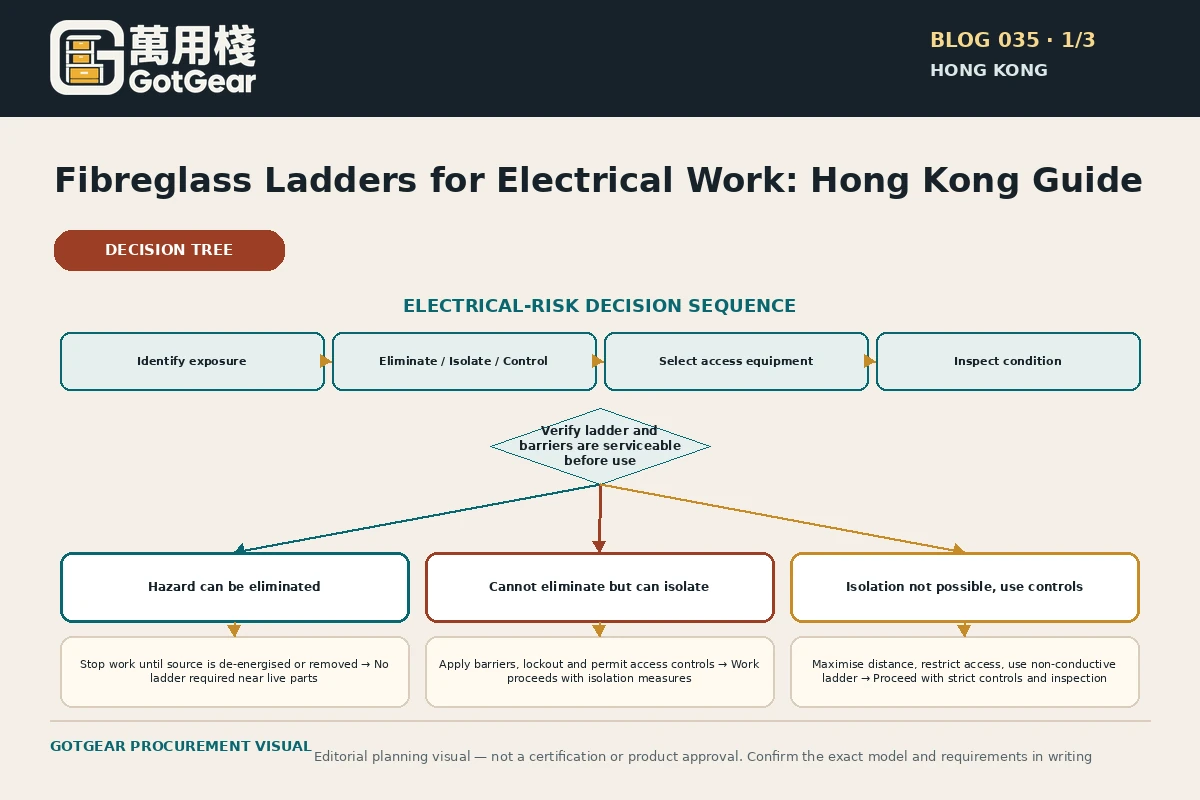
Fibreglass ladder for electrical work Hong Kong
GotGear explains fibreglass ladder for electrical work Hong Kong for Hong Kong buyers. See how non-conductive ladder Hong Kong supports ladder near electrical installations Hong Kong, with practical checks, evidence boundaries and written requirements.
Read the guideRelated topic indexOpen more English procurement pages13 topics
Browse additional equipment families, applications and procurement questions relevant to these operating requirements.