
Library book trolley Hong Kong — Keep the intended books stable and accessible while maintaining control in public and staff areas. Confirm capacity, overall dimensions, wheel and brake details and manufacturer guidance, then assess noise, route clearance and parking at the site.
Library book trolley Hong Kong — Quantify book sizes, loads and collection tasks
Start with the collections and tasks you actually move. Note the differences between returns sorting, reshelving rounds, inter-floor transfers and archive retrieval, and quantify frequency and peak loads. When procuring a library book trolley Hong Kong, teams should measure representative book heights, spine thicknesses and weights across paperbacks, hardbacks and folio items, plus binders and periodicals. Record the proportion of oversize items and any media cases that require edge protection. Map typical sequence lengths for a round so shelf capacity is sized to avoid unstable stacks.
Translate the survey into specification fields. Request usable shelf width and depth (not just external), the number of tiers, the shelf pitch/clearance between tiers, any shelf inclination, lip/edge style, divider options and handle layout. Ask for the manufacturer’s dynamic and per-shelf load ratings, distribution guidance and stability notes in writing. Where oversize items are common, state the maximum book height to be cleared and whether spines should face the operator or the aisle. Include requirements for signage rails, barcode holders and bumper protection. If your operation needs bilingual labels, state the preferred placement. Any example dimensions or capacities used in internal scoping must be confirmed by the chosen supplier’s formal quotation and technical drawings, which will prevail.
Library book trolley Hong Kong — Measure stacks, lifts, ramps and public-area routes
Walk the full route from the returns point to the stacks, including staff-only shortcuts and public corridors. Measure door widths and heights; aisle clearances at shelf ends; turning spaces at junctions; lift-car internal dimensions and door openings; and the tightest ramp or threshold. Book the goods lift with building management during the survey to confirm time windows and any escort or registration requirements. Photograph tight spots and note flooring transitions such as tile to carpet, mats at lobbies, and raised plates near fire doors.
Corners determine controllability. Document the trolley turning radius in Hong Kong. Record what teams can practically achieve at 90-degree bends without bumping end panels. Check gradients and handrail conflicts on ramps and bridge links, and confirm whether trolleys are prohibited on escalators. Record the narrowest queueing gap outside service counters during peak hours. Note slip risks where condensation or rainwater collect and whether weather mats can be laid. For quoting, provide a simple route sketch with all critical dimensions, still photos and, if allowed by management, a short video of the worst corner. Any example clearances discussed are starting points and must be validated against the supplier’s stated overall dimensions and wheelbase.
What should buyers compare for library book trolley Hong Kong?
| Criterion | Straightforward requirement | More complex requirement | Evidence to provide |
|---|---|---|---|
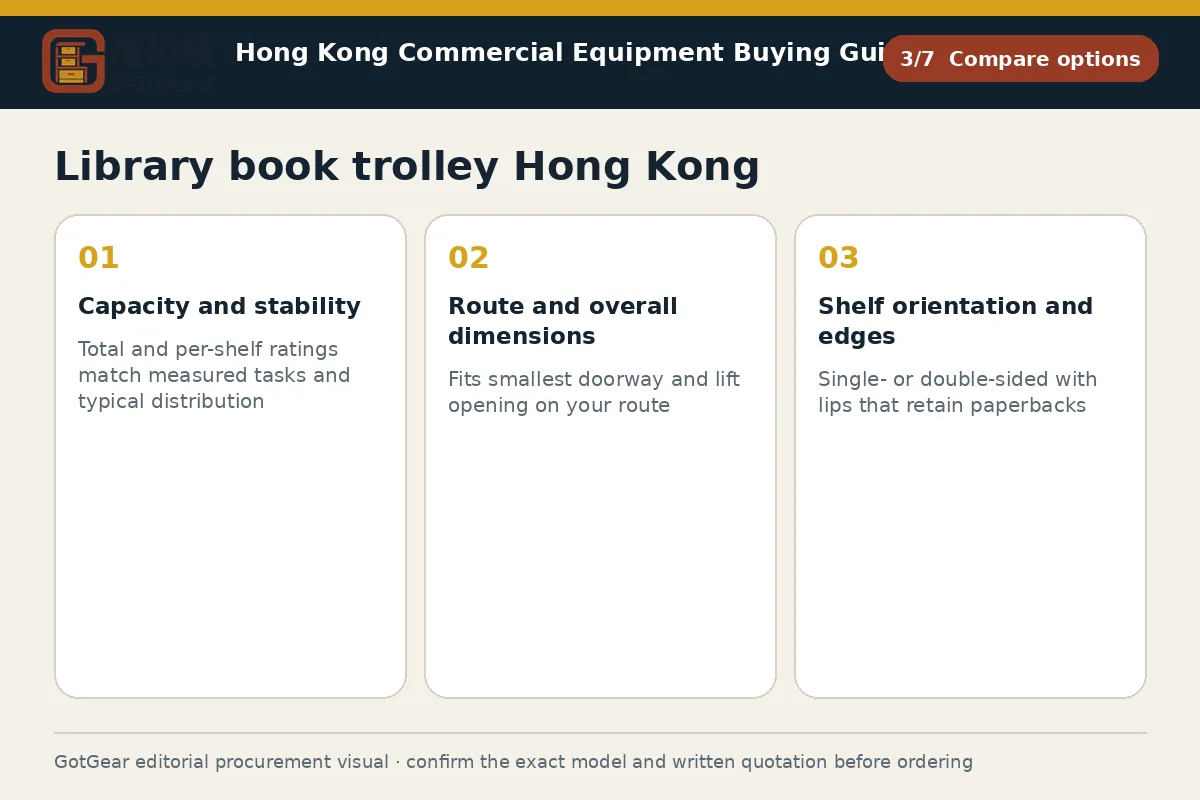
| Capacity and stability | Total and per-shelf ratings match measured tasks and typical distribution | Handles oversize folios and uneven stacking without tipping in turns | Provide book-size range, sample weights and how loads are placed on each tier |
| Route and overall dimensions | Fits smallest doorway and lift opening on your route | Negotiates tight turns and ramps without scraping or loss of control | Submit a route sketch with critical widths/heights, photos and any slope notes |
| Shelf orientation and edges | Single- or double-sided with lips that retain paperbacks | Adjustable dividers, soft edges or mesh sides for mixed collections | State access preference (operator/aisle), divider spacing and labelling needs |
| Wheels and brakes | Low-maintenance casters with reliable foot brakes | Low-noise treads, precision bearings and directional locks if required | List floor materials, thresholds, cleaning agents and preferred brake type |
| Noise and parking | Basic bumpers and defined parking spot off main routes | Quiet-operation features and marked bays coordinated with building rules | Share quiet periods, signage language, bay sizes and management policies |
This framework helps buyers create comparable written enquiries. Final model specifications, availability, delivery and commercial terms must be confirmed in a formal quotation.
Library book trolley Hong Kong — Compare shelf orientation, edges and access
Decide how books will be presented and retrieved from the trolley. Single-sided sloping shelves keep spines visible to the operator and are helpful for tight aisles; double-sided shelves suit batch sorting or multi-aisle rounds but require more width and greater care at turns. Confirm ergonomic reach: state the maximum top-shelf height operators should lift to, and whether the lowest shelf needs toe clearance to reduce bending. Specify handle style and a height range so push forces remain comfortable across your staff profile.
Edges and containment protect stock and people. Define the lip or retainer style required to stop paperbacks sliding on inclines, and state whether soft edges or mesh sides are preferred to reduce snagging. Request details on adjustable dividers, end-panels, and any strap or bar options for transit between buildings. Ask for drawings showing usable shelf openings and the method for adjusting tiers. If a mobile storage cart Hong Kong installation already serves archives, align shelf labelling and access conventions to avoid confusion. Require finish and material information suitable for frequent cleaning in humid conditions, and ask for the manufacturer’s stability and maintenance guidance with the quotation.
Library book trolley Hong Kong — Assess manoeuvring, noise and parking needs
Manoeuvrability depends on wheels, bearings and brake design. State floor types and transitions, and request wheel diameter, tread material, hardness, bearing type, swivel configuration and brake specification in the quotation. Discuss caster wheel selection in Hong Kong. Consider conditions such as tile-to-carpet moves, level changes and summer humidity. Clarify whether you need two fixed and two swivel casters for straight tracking, or four swivels with a directional lock for tight pivoting. Ask whether the brake is a total-lock (wheel and swivel) or wheel-only, and where foot levers are placed.
Noise and parking affect public comfort and safety. Inquire about low-noise treads, precision bearings, damped bump stops and side guards to reduce rattle near reading areas. If your venue sets quiet periods, ask suppliers for any indicative noise-reduction features, and understand that such claims are site-dependent and should be validated in use. Plan where trolleys will sit when not in motion and coordinate trolley parking safety in Hong Kong with security and cleaning teams. Mark parking bays so they do not obstruct fire egress and display bilingual “in use/out of service” tags. On receipt, verify free-rolling wheels, intact edges, brake holding power, fastener tightness, finish quality and the presence of manuals and capacity markings before signing acceptance.
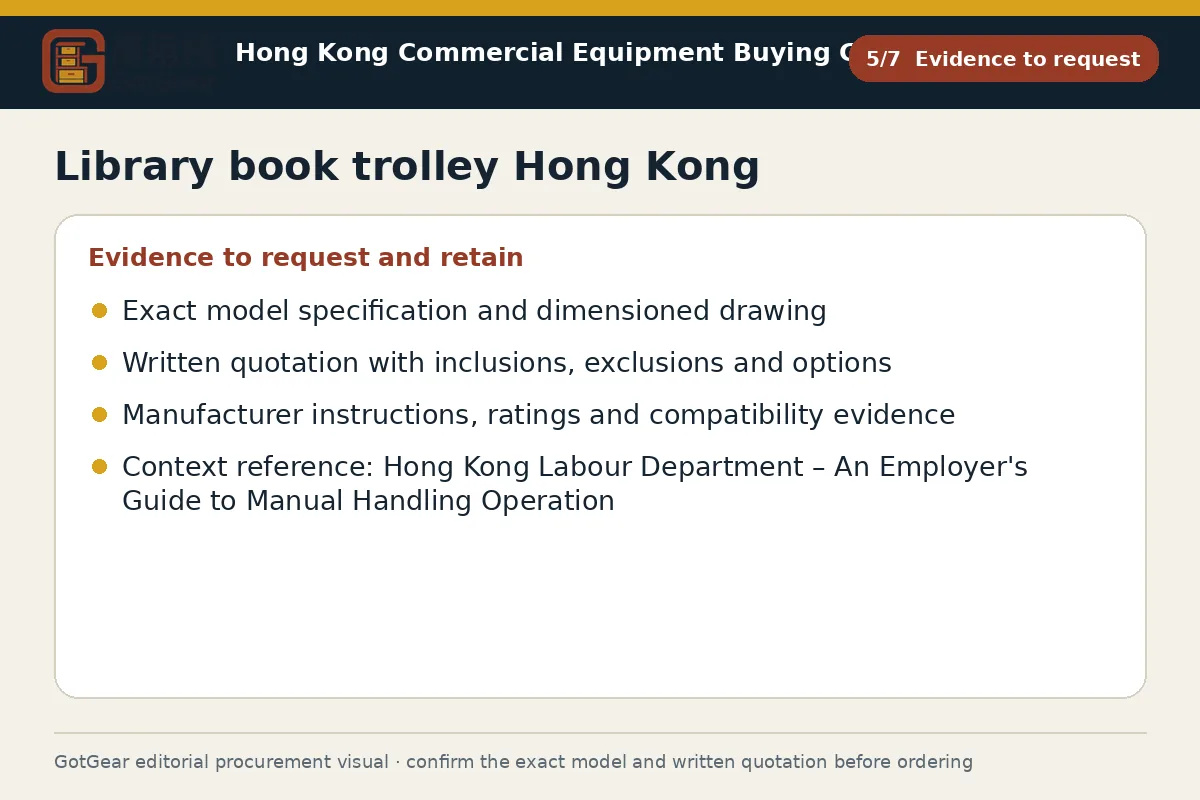
Library book trolley Hong Kong decision checklist
Create a clear enquiry: define tasks (returns, reshelving, inter-floor moves), measure representative book sizes and weights, and set usable shelf and tier requirements. Survey the route from handover to stacks, recording tightest doors, turns, lifts and ramps with photos. Choose shelf orientation, lip style and divider options to stabilise typical loads. State wheel configuration, tread material, bearing type and brake design, and highlight any low-noise need. Identify parking areas and cleaning practices, noting humidity. Request written per-shelf and total load ratings, stability guidance, drawings with usable dimensions, care instructions and bilingual labelling positions. Compare quotations line-by-line against the same evidence pack; the supplier’s model specification and signed quotation should prevail. On delivery, inspect rolling, braking, edges, finish and documentation before acceptance.
- Operating use, quantity and expected frequency
- Dimensions, capacity, material and accessory requirements
- Delivery address, floor, goods lift and loading window
- Required documents, acceptance checks and after-sales arrangements
Key points for library book trolley Hong Kong
Hong Kong buildings often mix public space with back-of-house routes, so confirm goods-lift sizes, booking rules and escort requirements with the management office before ordering. Community libraries inside malls or civic complexes can impose narrow delivery windows and stricter noise expectations near reading rooms and tenants. High humidity and frequent cleaning favour corrosion-resistant finishes and sealed bearings; ask the manufacturer for care guidance. Many routes involve tight 90-degree turns and ramps between wings, so map clearances precisely. Always align practices with venue policies and the supplier’s formal documentation rather than assumptions.
Questions about library book trolley Hong Kong
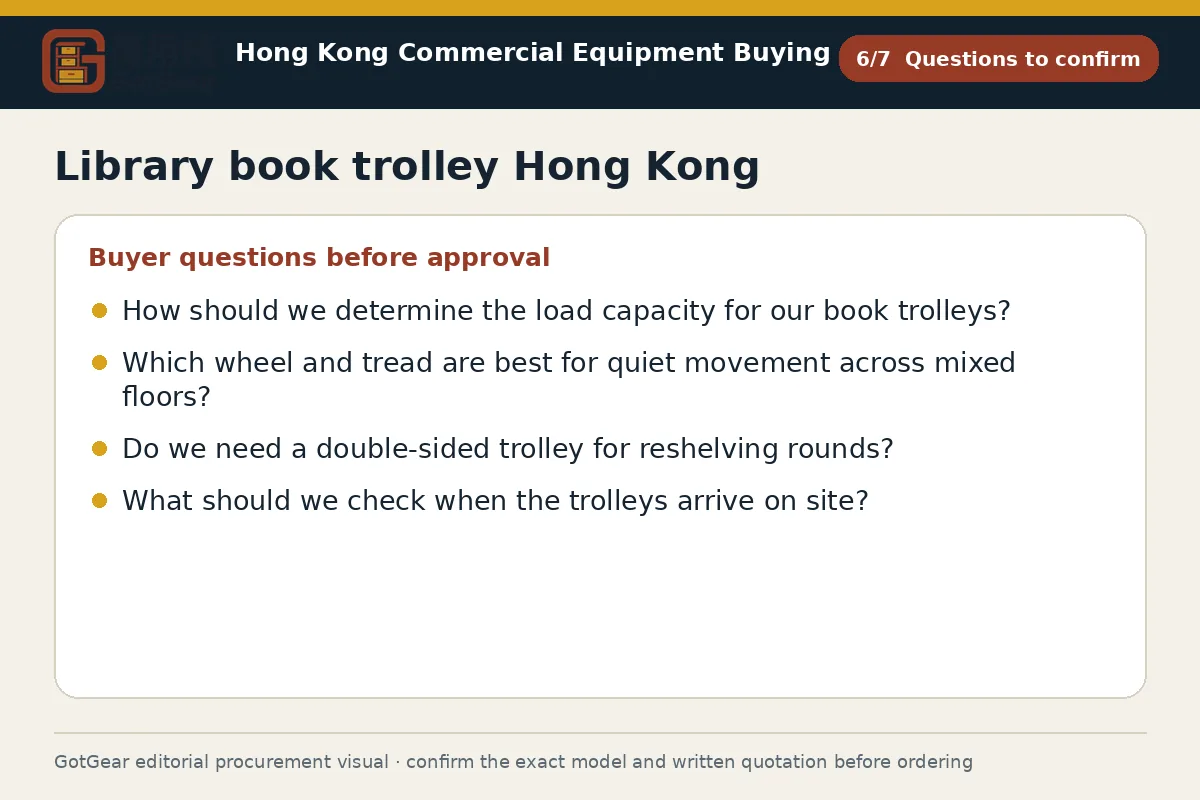
How should we determine the load capacity for our book trolleys?
Start with measured tasks: weigh typical and peak stacks and decide how many tiers you will load at once. Ask for written dynamic and per-shelf ratings plus load-distribution guidance from the manufacturer. Treat any internal figures as example starting points only and confirm the final capacity and stability requirements against the model specification and formal quotation.
Which wheel and tread are best for quiet movement across mixed floors?
Thermoplastic rubber or polyurethane treads with quality bearings generally reduce rumble on hard floors and ease transitions to carpet. Specify your floor types, thresholds and cleaning chemicals so the supplier can advise. Request details of wheel diameter, hardness and brake type in writing, and trial a sample where possible, as performance is site-dependent.
Do we need a double-sided trolley for reshelving rounds?
Double-sided units increase capacity and allow sorting for multiple aisles but demand more width and careful cornering. Single-sided designs suit narrower routes and keep spines facing the operator. Base the choice on measured aisle widths, turn spaces and workflow, then confirm overall dimensions, stability and handle placement in the supplier’s drawings and quotation.
What should we check when the trolleys arrive on site?
Verify overall dimensions match the quotation and that the trolley clears doors and lifts as planned. Check wheels roll freely, brakes hold, shelves are secure, edges are intact and finishes are undamaged. Confirm capacity markings and manuals are present in the required languages. Record issues with photos and contact the supplier before signing acceptance.
Continue with closely related procurement topics
These pages share equipment, operating or decision-stage signals with this guide.
Gas cylinder trolley Hong Kong
GotGear's checklist for a gas cylinder trolley Hong Kong outlines key considerations such as cylinder size, filled mass, valve guards, correct loading, safe gradients, and checks with the trolley manual and site rules.
Read the guide
Panel trolley Hong Kong
GotGear offers a practical guide to panel trolley Hong Kong that helps facilities record dimensions, mass, surface finishes, support angles, contact materials, retention methods and route clearances.
Read the guide
Computer trolley Hong Kong
GotGear’s procurement checklist for computer trolley Hong Kong covers supported devices, dimensions, load limits, adjustment range, power and cable needs, ventilation, security and route access.
Read the guide
Equipment trolley Hong Kong
Use this request for quotation checklist from GotGear for equipment trolley Hong Kong to confirm dimensions, total mass, load distribution, wheel and brake suitability, access routes, controls, and site fit.
Read the guide