
Mailroom trolley Hong Kong — Support the organisation’s actual rounds without overloading shelves or obstructing the user’s view. Confirm dimensions, capacity, access and braking details, then assess manoeuvring, security and parking within the building.
Mailroom trolley Hong Kong — Map intake, sorting, delivery and collection tasks
Begin by mapping the full journey of letters and parcels: intake from reception or courier counter, interim sorting, floor-by-floor drops, and end-of-day collections. Record peak periods, building-management lift-booking rules, and any handovers at security desks. Note whether staff must exchange mailbags, capture signatures, or collect returns, stationery and recycling on the same round. For teams specifying a mailroom trolley Hong Kong, operations benefit from a simple route schematic showing stops, dwell times and constraints.
Translate the route into load profiles. Estimate envelope bundles, small parcels, laptop boxes and awkward tubes per round, then identify which items need shelves, bags, bins or removable totes. State handling rules for fragile or confidential items and the labelling scheme for departments and tenants. In your enquiry pack, request drawings with overall dimensions, wheel set, brake type, shelf/bin layout, and included accessories such as bag hoops, label holders and document pouches. Ask suppliers to confirm turning clearances and to propose a companion parcel sorting trolley that Hong Kong teams can assign to bulkier items when mixed loads risk obscuring the operator's view. Make clear that any example figures you provide are starting points to be verified, and that the model specification and the written quotation will prevail.
Mailroom trolley Hong Kong — Define security, identification and access needs
Define what must be protected, identified and controlled. If deliveries cross public lobbies or student corridors, consider lockable doors, sealed totes or privacy panels; where routes are staff‑only, open shelving with clear line‑of‑sight may be faster. State the organisation’s confidentiality, safeguarding and incident‑reporting rules, and whether tamper‑evident tags, audit logs or chain‑of‑custody notes are required. Specify bilingual placards, colour coding by floor or department, and asset numbers that match your inventory system.
Access and control affect the build. In the specification, request lock type and keying plan (keyed alike or to differ), provision for tamper tags, label pockets, barcode/QR holders, and a document pouch for manifests. For routes with slopes or busy lift landings, ask for total‑stop brakes or directional locks, hand‑guard clearance, corner bumpers and noise‑reducing wheels. Where sensitive contents are planned, ask the manufacturer for lock datasheets and material details, and align with your building manager or institutional approver on who may hold keys and where the trolley can be parked. Confirm in writing that proposed measures are compatible with site policies and that the quotation states all inclusions.
What should buyers compare for mailroom trolley Hong Kong?
| Criterion | Straightforward requirement | More complex requirement | Evidence to provide |
|---|---|---|---|
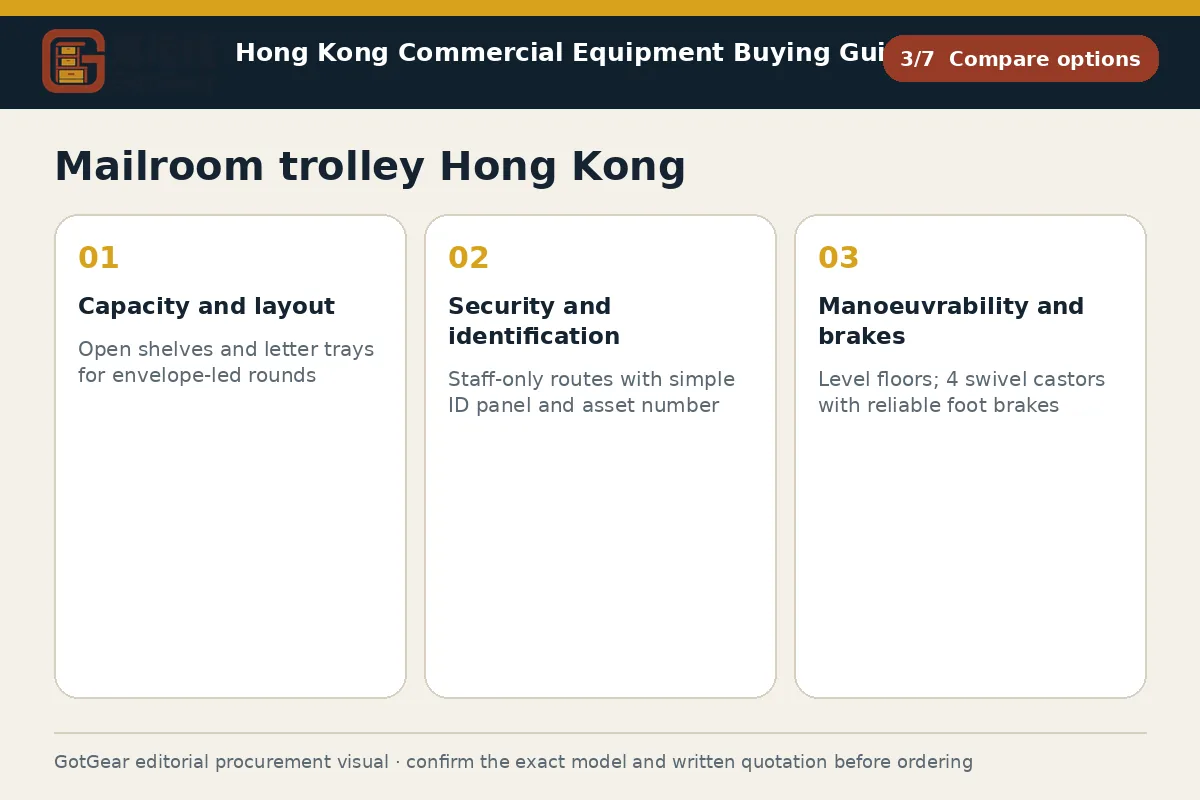
| Capacity and layout | Open shelves and letter trays for envelope‑led rounds | Mixed letters and parcels with modular bins, dividers and a returns tote | Daily volume by type per round; largest parcel dimensions and approximate weights |
| Security and identification | Staff‑only routes with simple ID panel and asset number | Public‑area transits needing lockable bays, tamper tags and bilingual labels | Policy excerpt, keying plan, confirmed language requirements, and asset ID format |
| Manoeuvrability and brakes | Level floors; 4 swivel castors with reliable foot brakes | Ramps/lifts; directional locks, total‑stop brake and corner bumpers | Floor finishes, ramp locations, turning spaces, noise limits to observe |
| Route fit (dimensions) | Generous doors and lifts accept standard footprint | Tight doors and shallow lift cars require narrow chassis and handle design | Measured clear openings, lift car depth, corridor pinch‑points and turning radii |
| Materials and hygiene | Dry offices; powder‑coated steel and open wire shelves | Humid docks/F&B; stainless, sealed bearings, liners and drainage options | Cleaning agents used, humidity exposure points, wipe‑down requirements |
This framework helps buyers create comparable written enquiries. Final model specifications, availability, delivery and commercial terms must be confirmed in a formal quotation.
Mailroom trolley Hong Kong — Size compartments for letters, parcels and returns
Compartment design should follow your actual mail mix. Separate upright letter storage from bulk parcel space to prevent crushing. Request adjustable dividers for envelopes, removable letter trays for rapid sorting, and a deeper bay for padded packs and small boxes. If you collect returns, include a lidded bin or tote that is easy to lift out in the mailroom without blocking aisles. Consider splash‑resistant covers for outdoor links or exposed loading docks, and label holders for department codes.
Ask suppliers to state per‑shelf and overall load ratings, shelf lips or retainers, divider increments, internal dimensions of trays and totes, and whether totes are compatible with your existing mobile storage cart Hong Kong — i.e. the units your facilities already operate. Note requirements for wipe‑clean liners if food or lab supplies share the route. In quotation comparisons, check what is included: number of trays, bins, dividers, label holders, document clipboards and covers. On receipt, inspect welds and fasteners, finish quality, absence of sharp edges, smooth castor rotation, positive brake engagement and that all specified accessories, serial labels and documentation are present. Assembly and maintenance instructions should be provided in English and Chinese where required by your organisation.
Mailroom trolley Hong Kong — Measure lifts, doors, routes and parking areas
Verify the trolley will pass every pinch‑point before you order. Measure the clear opening of doors, lift car width and depth, landing turning spaces, corridor widths at corners, and floor transitions such as thresholds, mats and expansion joints. Record ramp locations, gradients and any tight service corridors common in older Hong Kong buildings. Confirm goods‑lift booking windows, queuing space at loading bays, and any noise restrictions near management offices.
Translate the survey into specification fields: maximum overall width, length and height; castor arrangement (swivel/fixed mix); wheel diameter and tread material for tiles, terrazzo and concrete; bearing type for humid areas; brake type; handle height; corner bumpers; and edge protection. Ask for scaled drawings to compare against site measurements and request the written quotation to confirm the exact wheel set, brake hardware and footprint. Plan safe parking at destinations and in the mailroom; where space is constrained, request wall buffers or floor markings to support trolley parking safety in Hong Kong, following local practices. If routes are complex or shared with visitors, a brief trolley route assessment for Hong Kong sites that building teams can review with management will reduce rework.
Mailroom trolley Hong Kong decision checklist
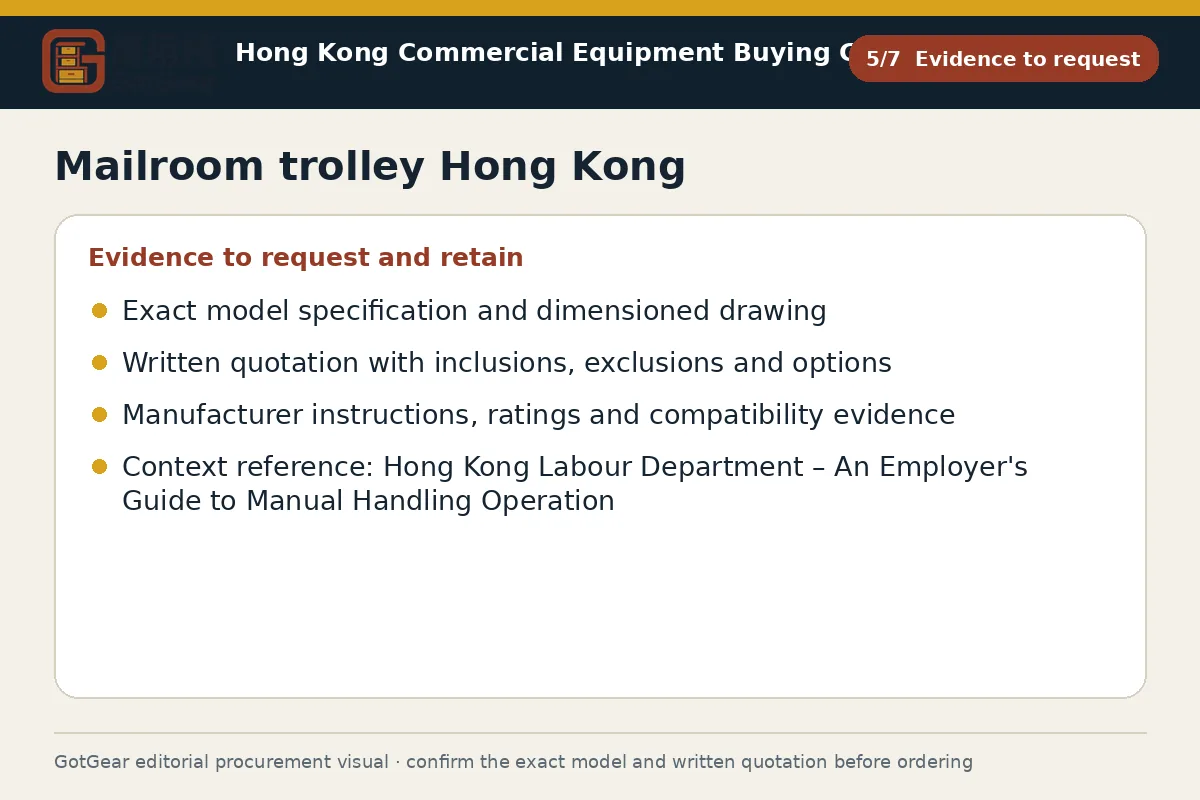
Confirm the daily rounds, including peaks, stops and returns, then translate that into shelf, tote and bin needs with clear labelling. Measure every door, lift and turn, and set a maximum footprint. Decide on lockable or open storage, identification method and brake requirements based on routes and policies. Request drawings, per‑shelf and total load ratings, wheel and brake specifications, materials and finish details, and included accessories. Compare quotations line by line for dimensions, hardware, counts of trays and totes, delivery terms and any assembly. Plan parking and lift bookings with building management. Define receipt checks and required bilingual documents. The model specification and the supplier’s written quotation should prevail.
- Operating use, quantity and expected frequency
- Dimensions, capacity, material and accessory requirements
- Delivery address, floor, goods lift and loading window
- Required documents, acceptance checks and after-sales arrangements
Key points for mailroom trolley Hong Kong
Hong Kong mail flows often navigate narrow service corridors, compact lift cars and booking rules set by building management. Plan around limited loading windows, shared lobbies in mixed‑use towers and occasional public‑event controls in malls or campuses. Humid conditions favour corrosion‑resistant materials and sealed bearings, especially near coastal districts and open docks. Many organisations expect bilingual documentation and labels. Always confirm site‑specific dimensions, access permissions and operating constraints with the venue or building manager; these local details shape safe, efficient internal deliveries and should be reflected in the written quotation and model specification.
Questions about mailroom trolley Hong Kong
Which wheel and castor setup works best for mixed office, mall and dock surfaces?
Choose non‑marking elastomer or rubber treads for tiles and terrazzo, with sealed bearings for humid areas and smooth thresholds. Where ramps or long corridors feature, add directional locks for stability and a reliable total‑stop brake. Finalise the wheel diameter, tread and castor arrangement after a route survey and confirmation from the supplier, referencing your measured floor finishes and slopes.
Do we need lockable compartments for internal deliveries?
Use lockable doors or sealed totes if routes cross public areas, student spaces or handle confidential items. For staff‑only corridors with low risk, open shelving may be faster. Align the choice with your organisation’s information‑handling policy, insurer requirements and building‑management expectations, and ask the manufacturer to confirm compatible lock options and keying plans in the quotation.
What frame and finish perform best in Hong Kong’s humidity?
Powder‑coated steel suits dry offices; stainless steel and sealed bearings offer better resilience in humid docks or semi‑open links. If cleaning involves disinfectants, request wipe‑clean liners and confirm chemical resistance. Where exposure is higher, ask for material grades and manufacturer corrosion information; any example recommendations are starting points that must be validated for your site.
How should we compare two competing trolley quotations fairly?
Request scaled drawings, overall dimensions, per‑shelf and total load ratings, wheel and brake specifications, lock type, and a clear list of trays, totes, dividers and accessories. Ensure delivery and assembly terms are stated. Check that materials, finishes, bumpers and labels match your brief. The supplier’s model specification and written quotation should be the basis for approval and later receipt checks.
Continue with closely related procurement topics
These pages share equipment, operating or decision-stage signals with this guide.
Drum trolley Hong Kong
This quotation checklist helps facilities and EHS teams plan for drum trolley Hong Kong. It guides you on drum size, filled mass, orientation, pickup method, retention and route conditions, and is provided by GotGear.
Read the guide
Gas cylinder trolley Hong Kong
GotGear's checklist for a gas cylinder trolley Hong Kong outlines key considerations such as cylinder size, filled mass, valve guards, correct loading, safe gradients, and checks with the trolley manual and site rules.
Read the guide
Panel trolley Hong Kong
GotGear offers a practical guide to panel trolley Hong Kong that helps facilities record dimensions, mass, surface finishes, support angles, contact materials, retention methods and route clearances.
Read the guide
Glass trolley Hong Kong
GotGear guide to glass trolley Hong Kong explains how to specify equipment and plan sites by comparing rated capacity, support geometry, contact materials and restraints, pane size, loading method and route clearances.
Read the guideRelated topic indexOpen more English procurement pages1 topics
Browse additional equipment families, applications and procurement questions relevant to a wider buying brief.