
Parcel sorting trolley Hong Kong — Use clearly identified positions, stable loads and a layout that staff can replenish or clear without crossing active routes. Test the arrangement with representative parcels and verify equipment limits before finalising the process.
Parcel sorting trolley Hong Kong — Measure parcel mix, peaks and sorting destinations
Start with hard numbers on your inbound and outbound mix. Record typical and peak-item sizes (length, width, height) and weights by destination group, plus any fragile, liquid or lithium-battery flags. Note barcode symbologies and where labels usually sit so scanning faces can be oriented on-shelf. Time the intake-to-sort and sort-to-dispatch intervals during quiet and busy periods to identify where staging needs to grow. Count the distinct destinations you sort to (carriers, routes, floors, counters) and map their relative priority. Also capture the tightest turning point, doorway and goods-lift dimensions along the intended path and any ramps, mats or thresholds.
Translate these observations into specification fields. State the usable shelf area and the clear height between tiers; dividers or bin frames required; shelf lips to contain small packets; quantity and format of label holders; and any document pouches. Define rated capacity per shelf and per trolley, wheel diameter and material, swivel/total-lock brakes, handle height and finish (galvanised, stainless or powder-coated) that tolerates humidity. Where an electronics flow is common, ask about anti-static options if your adviser deems them necessary. Send the route sketch, measured constraints, and a list of destinations with typical parcel dimensions so quotations can confirm fit, stability and scan visibility in writing.
Parcel sorting trolley Hong Kong — Separate exceptions, returns and completed consignments
Prevent the main sorter becoming a catch-all by designating separate, clearly marked locations for exceptions, returns and consignments already closed for dispatch. Define exception subtypes relevant to your operation (damaged, address queries, dangerous goods queries, payment holds) and where they pause for investigation. Returns often need quarantine and repacking, so plan a zone with tamper-evident tie points, a document sleeve and bilingual signage. For completed consignments awaiting a carrier, position bays with labels hidden from public view to reduce privacy risk while remaining easy to scan for handover.
Build these requirements into the enquiry. Ask for options such as lockable lids or doors on one tier, removable tote cradles, colour-coded panels for fast visual sorting, and clipboards or swing-tag rails for exception notes. Specify total-stop brakes so a parked unit cannot creep on slight gradients, and request advice if wheel chocks are recommended for your floor. Document checks may include your organisation’s SOP, client or insurer guidance on custody or privacy, and a manufacturer statement of load rating and safe-use instructions. On receipt, inspect that any doors close and lock smoothly, dividers sit square, label holders are secure, and the key set and paperwork match the quotation.
What should buyers compare for parcel sorting trolley Hong Kong?
| Criterion | Straightforward requirement | More complex requirement | Evidence to provide |
|---|---|---|---|
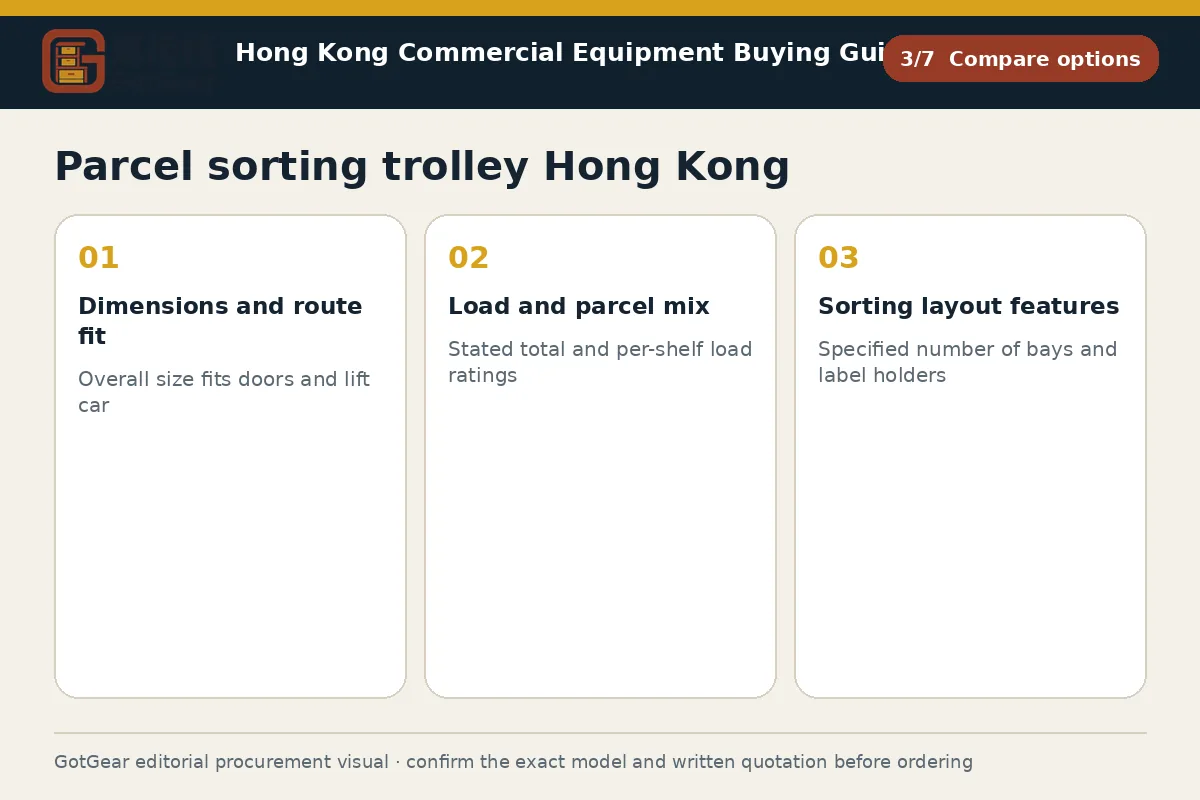
| Dimensions and route fit | Overall size fits doors and lift car | Turning radius, shelf heights and hand clearance match the route | Door and lift measurements, tightest-path sketch, target turning radius (example to confirm) |
| Load and parcel mix | Stated total and per-shelf load ratings | Mixed-size containment with lips/dividers and stability under peak loads | Dataset of sizes/weights by destination; example heaviest item to confirm |
| Sorting layout features | Specified number of bays and label holders | Lockable/exception bins and privacy-oriented labelling | Destination list, privacy/custody notes, label format and language needs |
| Mobility and safety | Non-marking wheels and total-lock brakes | Ramps/threshold handling and any towing compatibility | Floor type, gradients, threshold heights (example to confirm), towing intent |
| Documentation and support | Dimensioned drawing, manual and warranty terms | Manufacturer test statement and maintenance schedule; bilingual decals | Request letters or data sheets; sample labels; approval-chain contacts |
This framework helps buyers create comparable written enquiries. Final model specifications, availability, delivery and commercial terms must be confirmed in a formal quotation.
Parcel sorting trolley Hong Kong — Design a visible, scan-friendly staging sequence
Staging must make the next scan obvious. Arrange destinations in a left-to-right or back-to-front sequence that mirrors your dispatch manifest, with barcode faces outward and at a consistent height. Use anti-glare label holders sized to your paperwork (for example, A6 or A5 as a starting point to be confirmed), and fit dividers so items do not migrate when the trolley moves. Open mesh or cut-outs on side panels improve visibility while restraining loads. Trial your scanners' read range and angles with representative packaging, particularly glossy satchels and shrink wrap, and adjust shelf pitch if reflections cause misreads.
In the enquiry, request the exact dimensions and quantity of label rails, options for an additional top rail, and the finish colour that improves contrast for camera-based scanning. Confirm handle height and reach for your workforce, and consider corner bumpers to protect walls and lift cars. If device holsters or small-printer shelves are needed, ask for mounting details and load limits. When integrating with a packing trolley Hong Kong, and where teams operate upstream, align tote sizes and label formats so hand-offs are seamless. On delivery, acceptance-test by running a timed, scan-heavy sort with mixed parcels, checking that labels stay readable and that shelves remain level under load.
Parcel sorting trolley Hong Kong — Review movement, replenishment and dispatch hand-offs
Walk the full intake-to-dispatch loop and define who moves, replenishes and clears what, and when. Set a simple cadence: intake stages to pre-sort; pre-sort feeds destination bays; closed consignments advance to a dispatch-facing tier; and a carrier hand-off confirms clearance. Place parking zones so they do not block aisles, and agree how many units are allowed in each area. Coordinate with loading windows so that full bays are positioned near the dock before pickup. Where multiple teams share space, publish a bilingual route map and rules consistent with trolley traffic management Hong Kong, with guidance from your site or building manager.
Turn that into specification and trial steps. State the expected turning radius, acceptable noise level, and wheel/caster details; as an example starting point to be confirmed, request quotations for non-marking wheels of 125–160 mm diameter with total-lock brakes. If towing by a tug is contemplated, ask the manufacturer whether the frame and casters are tow-rated and request their maintenance schedule and parts list; seek a competent adviser’s input before any powered movement. Confirm dock, corridor and lift bookings with the management office for delivery day. On receipt, check free-rolling movement, brake holding on your smoothest and most polished floors, tight fasteners, and that routing labels and accessories match the written quotation and drawing.
Parcel sorting trolley Hong Kong decision checklist
Confirm the parcel mix with real measurements, destination counts and peak-hour observations. Sketch the intake-to-dispatch route, marking the tightest turn, lift and doorway sizes, ramps and shared pinch points. Translate this into a written specification: usable shelf area and clearance, number of sort bays and dividers, label-holder formats, load ratings per shelf and total, wheel type and brake style, handle height, finish and any lockable sections. Ask for dimensioned drawings, photos of an equivalent build and statements of rated capacity and care. Request itemised quotations listing accessories, delivery conditions and lead-time assumptions. Plan acceptance: run a scan-heavy test with representative parcels, check stability and brakes, and log discrepancies in writing. Model specifications and the formal written quotation prevail.
- Operating use, quantity and expected frequency
- Dimensions, capacity, material and accessory requirements
- Delivery address, floor, goods lift and loading window
- Required documents, acceptance checks and after-sales arrangements
Key points for parcel sorting trolley Hong Kong
Hong Kong sites often work within tight goods-lift cars, narrow doorways and short booking slots controlled by the management office. Plan paths, parking zones and delivery timing around these constraints, and confirm access instructions in writing. Humid conditions can encourage corrosion and wheel noise, so specify finishes and bearings accordingly. If trolleys pass near public areas or events, ensure destinations and labels are not visible to passers-by and that marshals can maintain clear lanes. This summary reflects typical local operating constraints only and is not legal advice.
Questions about parcel sorting trolley Hong Kong
What should we include in a first enquiry to size the trolley correctly?
Provide measured door and lift dimensions, the tightest turning point, floor type, slopes and thresholds. Add parcel size and weight ranges by destination, barcode locations, the number of sort bays desired, and any privacy or lockable sections. Include photos of the route and a simple sketch. Written specifications and the supplier’s drawing should confirm final fit and ratings.
How many sorting bays do most teams use per trolley?
It depends on destinations and parcel mix. As an example starting point to be confirmed in your written brief, many operations explore 6–12 clearly labelled bays plus a small exceptions area. Test with real parcels and adjust for peak volumes, aisle space and staffing. The supplier’s model specifications and your formal quotation should prevail.
Which wheels and brakes work best on typical Hong Kong floors?
Non-marking rubber or polyurethane wheels with total-lock (swivel and roll) brakes suit many smooth concrete and vinyl floors. Where thresholds, gratings or mild ramps exist, consider larger diameters and sealed bearings; as an example starting point to be confirmed, 125 mm and above often helps. For polished lobbies, specify quiet compound wheels and trial braking at your site.
Do we need covers or lockable sections for returns and completed consignments?
Use them where privacy, custody or weather exposure is a concern, or where trolleys may pause in public or shared corridors. Building management, clients or insurers may set conditions, so request their guidance in writing. Ask the manufacturer for load ratings and safe-use instructions for any doors or lids, and confirm details in the formal quotation.
Continue with closely related procurement topics
These pages share equipment, operating or decision-stage signals with this guide.
Trolley inspection checklist Hong Kong
GotGear’s trolley inspection checklist Hong Kong and trolley preventive maintenance Hong Kong explain how to inspect wheels and brakes, log defects and schedule servicing under maker guidance.
Read the guide
Trolley load securing Hong Kong
GotGear provides guidance on trolley load securing Hong Kong, explaining how to check the centre of gravity, identify restraint points and compare straps, rails and clamps. It also covers trolley load stability Hong Kong.
Read the guide
Trolley anti-slip deck Hong Kong
GotGear explains how to assess a trolley anti-slip deck Hong Kong by reviewing load retention, material, contamination and contact risks. It also outlines considerations for trolley bumper protection Hong Kong.
Read the guide
Trolley traffic management Hong Kong
GotGear explains trolley traffic management Hong Kong, trolley route assessment Hong Kong and trolley parking safety Hong Kong for mapped pedestrian, vehicle and parking controls.
Read the guideRelated topic indexOpen more English procurement pages2 topics
Browse additional equipment families, applications and procurement questions relevant to a wider buying brief.