
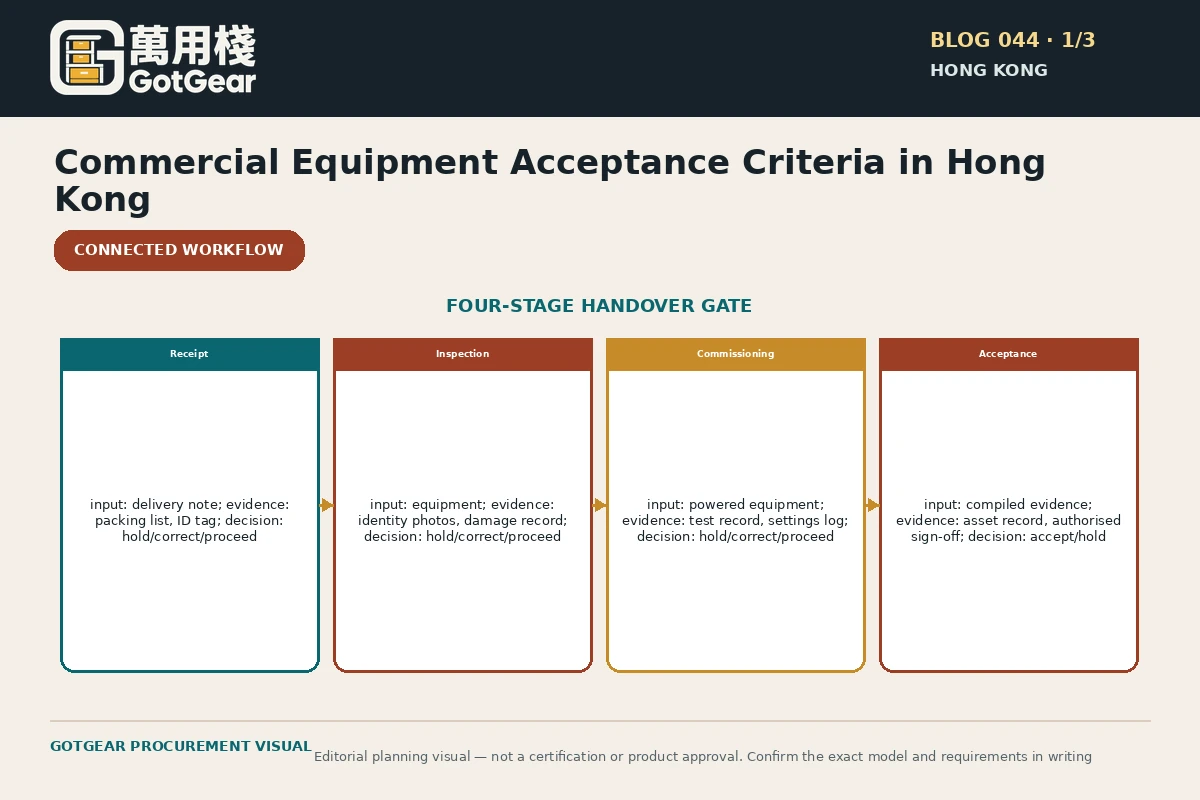
Define acceptance criteria before handover and link them to specification requirements: identify the item and version, confirm condition and installation, perform proportionate functional tests, collect relevant documents and record exceptions. Require named, authorised acceptance sign-off and retain test records in the asset register. Scale checks by risk and complexity — visual and paperwork checks for basic goods, installation and performance verification for installed equipment, and formal commissioning records for safety‑relevant or complex systems. Treat ArchSD test-record discipline as an evidence principle, not a universal method.
What to remember before you decide
- Agree acceptance criteria before handover and include them in procurement documents to create a clear evidence trail.
- Distinguish receipt, inspection, commissioning and acceptance and apply each stage according to risk and complexity.
- Use one concise evidence table to map the required fields by equipment class and attach it to purchase orders.
- Capture essential asset register fields at acceptance and use extended fields for complex equipment to support lifecycle planning.
- Treat ArchSD test‑record discipline as a useful evidence model for complex installs, but adapt it to commercial scope.
- Require named acceptance authorities, corrective‑action owners and explicit maintenance triggers to close the loop.
Receipt, inspection, commissioning and acceptance — clear distinctions
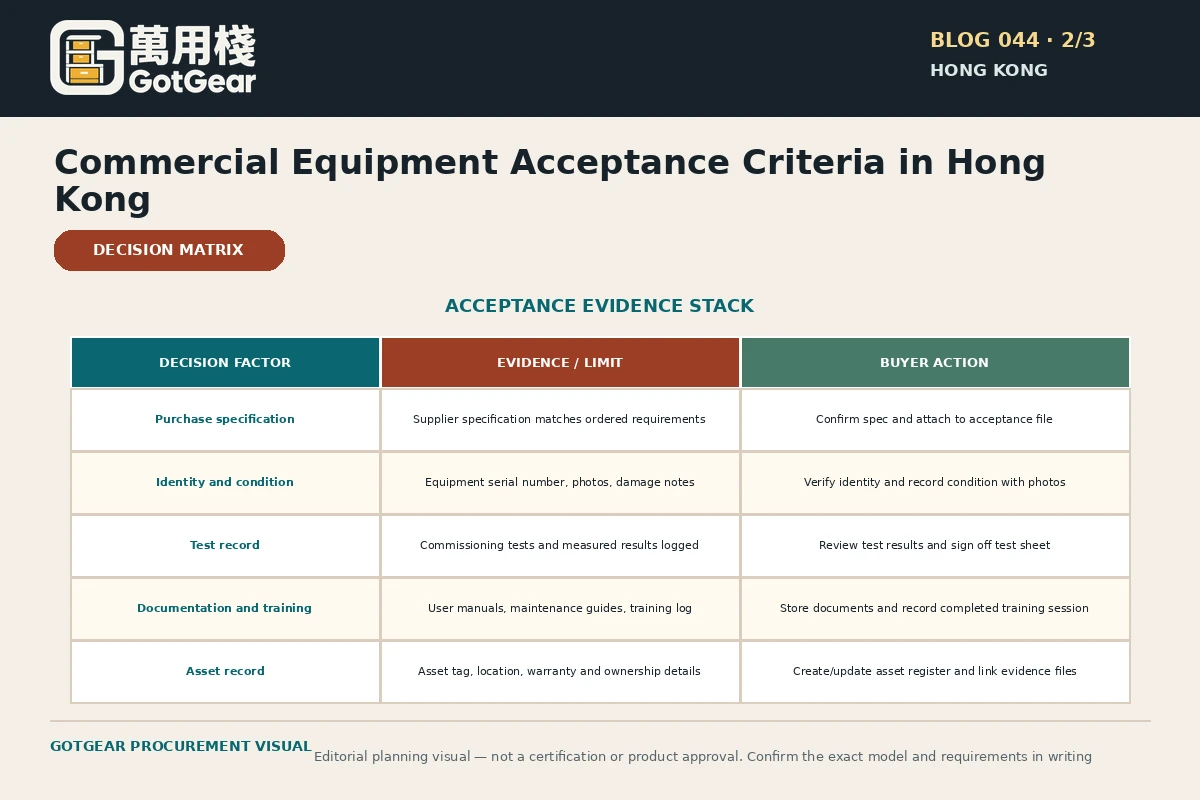
Practical context: In Hong Kong projects the supplier, contractor and client often expect different closure steps. Make clear in contracts and delivery protocols that you use four distinct stages: arrival (receipt), attribute check (inspection), designated performance verification (commissioning) and documented acceptance decision. These are separate responsibilities: receipt is logistics and custody, inspection verifies identity and visible condition, commissioning confirms correct installation and performance under defined conditions, and acceptance is the authorised declaration that the asset meets specified criteria. Use these decision checks: For each purchase, decide which stages apply and who is responsible. Basic consumables and non‑installed furniture usually require only receipt and inspection; plug‑in appliances and stand‑alone equipment require inspection and a basic functional check; permanently installed or safety‑relevant plant requires full commissioning records and witnessed tests. Base decisions on the purchase specification, health and safety risk, potential impact of failure, warranty or maintenance obligations and whether the item will appear in the asset register. One practical evidence table: use a single, concise table to pick the required fields by equipment class. Adapt this table into procurement documents and the acceptance form so suppliers know in advance. Table — evidence fields by equipment class Delivered item | Installed equipment | Complex / safety‑relevant equipment Identity | Model, serial, part number; invoice | Model, serial, asset tag; location | Model, serial, asset tag, drawing reference, serialised components Condition | Visual damage, packaging, accessories | Installation integrity, cable routing, anchorage | Safety interfaces, protective devices, redundancy checks Documents | Invoice, packing list, basic manual | Installation instruction, wiring diagram, certificate of conformity | Manufacturer certificates, commissioning reports, test certificates Installation | N/A or minimal | Installed per spec, connectors correct | Installation witness report, as‑fitted drawings Functional check | Power on, basic function | Operational check to spec, control response | Performance tests, calibration, safety trip tests User handover | Basic user sheet | User quick guide, known limitations | Formal training record, operations protocol Asset record fields | Description, supplier, PO, date | Location, maintenance due, warranty | Asset lifecycle data, serials, commissioning date, maintenance regime Limitations and Next, Use the table as a procurement annex rather than a checklist that tries to cover every technical test. Specifying a required certificate or test does not remove the need for competent personnel to witness or perform specialised testing. Next, add the selected evidence fields to the tender documents, include acceptance criteria in the purchase order, and ensure procurement and operations agree the named acceptance authority.
When to apply ArchSD testing discipline
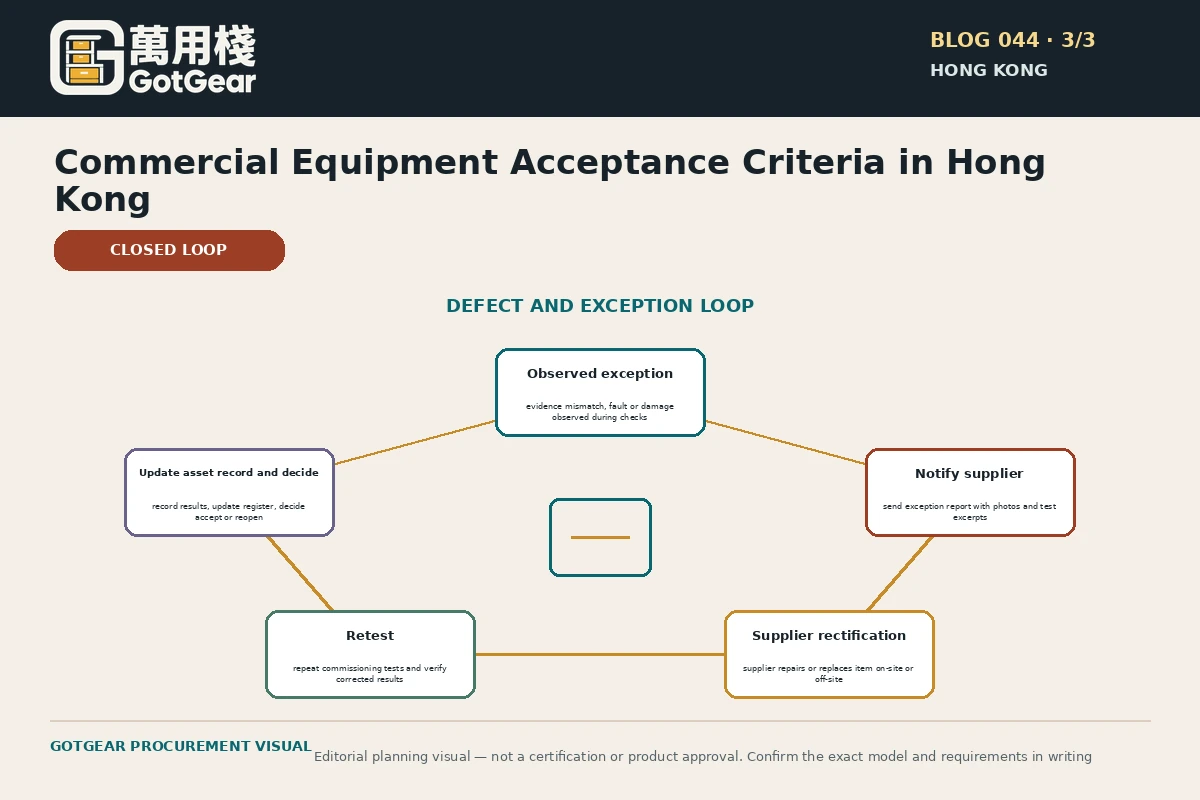
In Hong Kong, The Architectural Services Department (ArchSD) testing and commissioning procedure provides a disciplined approach to test records and witnessed checks for government building HVAC installations. It is a useful analogy for evidence expectations because it requires written procedures, test sheets and defined responsibilities. However, the ArchSD document applies to a specific HVAC scope in government building projects; do not assume its procedures are mandatory for commercial procurements. Use these decision checks: Use ArchSD principles — defined tests, documented results, witness records, and corrective action logs — when the equipment is complex, safety‑relevant, or expensive enough that failure would cause significant disruption. For routine items, adopt a reduced set: defined checks, a retained receipt/inspection record, and a named acceptance authority. For vendor‑provided commissioning, require a commissioning plan and evidence of competent personnel. A key limitation is that ArchSD prescribes detailed mechanical and HVAC tests that may be unnecessary for smaller items. Adopting the full ArchSD scope increases administrative effort; scale the approach to match risk and value. ArchSD does not change statutory responsibilities or replace the need for competent contractors and manufacturers’ calibration or certification. Next, For larger installs, request the supplier’s commissioning programme in advance, assign an in‑house witness or third‑party commissioning engineer, and pre‑agree reporting templates modelled on ArchSD test sheets. For smaller items, require a completion checklist that feeds the asset register.
“Acceptance is a documented decision matched to risk: specify what evidence you need up front, who is authorised to accept it, and where the records live so they deliver value across the asset lifecycle.”— GotGear Editorial Team
What should buyers compare for commercial equipment acceptance criteria Hong Kong?
| Option or approach | Best for | Trade-offs | Checks before acceptance |
|---|---|---|---|
| Minimal receipt and visual inspection | Low‑value consumables and non‑installed furnishings with low operational risk. | Fast and low overhead, but provides no assurance of functional performance or long‑term reliability. | Require invoice, packing list and photo record; capture basic register fields and note warranty; schedule first maintenance entry for expanded verification if needed. |
| Supplier functional check with client witness | Plug‑in equipment and stand‑alone appliances where functional verification is straightforward. | Balances supplier responsibility with client oversight; relies on supplier competence and truthful reporting. | Agree test script in advance, require supplier test sheet signed by client witness, and retain results in the asset register. |
| Formal commissioning with witnessed tests and certificates | Installed systems, control systems and items affecting health and safety. | Higher resource requirements and schedule impact but provides stronger evidence and contractual closure. | Require a pre‑approved commissioning plan, witnessed tests documented on standard forms, and manufacturer calibration certificates where applicable. |
| Independent third‑party verification | High‑risk critical plant, specialist lab equipment, and where regulatory or insurance requirements demand independence. | Most robust validation, but adds procurement and scheduling complexity and resource requirements. | Specify accreditation or competency, require an independent report uploaded to the asset register, and close acceptance only on satisfactory independent findings. |
| Two‑stage acceptance (conditional sign‑off + final closure) | Large projects with phased commissioning or where some corrective works are forecast at handover. | Allows operational use sooner with tracked exceptions, but relies on effective corrective‑action management. | Use a conditional acceptance form listing outstanding items, owners, deadlines and maintenance triggers; final acceptance follows verified closure. |
This framework helps buyers create comparable written enquiries. Final model specifications, availability, delivery and commercial terms must be confirmed in a formal quotation.
What to capture in the commercial equipment asset register
Practical context: Asset registers are often created after acceptance, but data quality depends on the evidence gathered at handover. In Hong Kong operations teams must capture enough detail to support maintenance, warranty claims and lifecycle planning without overburdening reception teams. ISO 55001 frames asset information as part of lifecycle performance and decision‑making: an asset register alone does not confer compliance but it supports risk‑based maintenance and expenditure planning. Use these decision checks: Insist on the following core fields at acceptance so records are actionable: unique identifier, supplier and purchase order reference, model and serial numbers (or firmware version), exact location and responsible team, installation date and commissioning status, warranty start and end, maintenance trigger and interval, criticality rating, retained documents (manuals, test reports, certificates) and named acceptance authority. For complex assets add as‑fitted drawings, calibration certificates, control logic versions and spares list. A key limitation is that A large register with excessive fields slows entry and raises error risk. Avoid mandatory fields that cannot be reasonably supplied for low‑value items. Plan a two‑tier register: essential fields required at acceptance; extended fields to be populated during first maintenance or within a defined post‑installation window. Next, Configure your asset‑management system to enforce required fields at acceptance, create upload templates that mirror the acceptance checklist, and plan periodic audits to reconcile physical assets against the register. Include acceptance records in the warranty onboarding process so maintenance teams receive test reports and corrective action logs.
Scaling tests and competence: who does what
Practical context: Hong Kong facilities teams often rely on suppliers for tests while needing independent verification for critical systems. Decide where vendor evidence is sufficient and where independent witnessing or third‑party testing is necessary. Procurement terms should specify required competence levels, accreditation if applicable, and the right to reject or require re‑test. Use these decision checks: Require supplier self‑certification and manufacturer documentation for basic goods. For installed or safety‑relevant equipment require witnessed commissioning by the supplier with your staff or a third party present, or require an independent commissioning certificate from a competent engineer. Consider the failure mode and the potential business impact when deciding whether to require independent verification. A key limitation is that Acceptance sign‑off does not guarantee long‑term reliability. Visual checks prove condition at handover but not performance over time. Complex performance validation often requires specialist instruments and competent testers; do not rely solely on generic staff for technical tests. Also, insist on agreed corrective‑action owners and timelines — incomplete corrective items should be tracked and acceptance conditional on mitigation plans. Next, Define competence requirements in procurement (e.g. manufacturer‑trained technician, recognised commissioning engineer), specify witness requirements, include corrective‑action tracking with named owners, and ensure acceptance sign‑off records the scope of any deviations and the maintenance trigger that will close them.
Commercial equipment acceptance criteria Hong Kong decision checklist
- Have acceptance criteria been documented in the purchase order and tender (what is checked, how, who, and acceptable limits)?
- Has the equipment been classified by risk and complexity to determine the required evidence level (visual only, functional check, commissioning, third‑party)?
- Are identity fields captured: model, serial number, firmware/version, and supplier PO reference?
- Is installation and site location clearly recorded with an as‑fitted reference where applicable?
- Have required documents been listed and received: manuals, wiring diagrams, certificates and commissioning reports?
- Is a named, authorised acceptance signatory identified and recorded for this asset class?
- Are corrective actions and exceptions captured with named owners and target completion dates before final acceptance?
- Has the asset register template been prepared with mandatory core fields and optional extended fields?
- Is witness or independent testing required, and if so, are competence and accreditation specified in procurement documents?
- Have warranty start dates and maintenance triggers been recorded to support future claims?
- Is training for users included where operation or safety depends on competent use, and is attendance recorded?
- Do records include who performed tests, the test method, instrument calibrations and retained evidence for future audits?
Practical action sequence
- Classify the asset at purchase approval: basic, installed, or complex/safety‑relevant.
- Insert the agreed acceptance fields into the purchase order and tender documentation.
- Request supplier commissioning plan and required documentation before delivery for complex items.
- Prepare witness arrangements and competence requirements; schedule tests and inform suppliers.
- Use the standard acceptance form to record identity, condition, documents and test results on handover.
- Upload acceptance records and documents into the asset register with a unique identifier.
- Log any exceptions with named owners and deadlines and issue conditional acceptance if necessary.
- Trigger maintenance onboarding: schedule first service, set alarms for warranty expiry and maintenance intervals.
- Audit completed acceptances periodically to reconcile physical assets against the register.
- Review and update procurement templates based on lessons learned from commissioning and defects.
Apply the checks to your Hong Kong site
Hong Kong teams should embed clear acceptance criteria in procurement and operations documents so suppliers know the evidence expected at delivery. When defining commercial equipment acceptance criteria Hong Kong, require site measurements, up‑to‑date documents and a documented validation route that links identity, condition, installation, functional testing, documentation, training and asset‑record fields. Use ArchSD’s test‑record discipline as a design pattern for complex installations, explicitly as an analogy because its remit covers government HVAC work. Apply ISO 55001 principles so the commercial equipment asset register Hong Kong supports lifecycle decisions rather than being a static log. Treat overseas maintenance guidance (for example HSE material) as helpful context for competence and planned maintenance, not as local legal obligation. Those handover records should feed the commercial equipment commissioning checklist Hong Kong and the asset register. Operational takeaway: require a delivery pack template that mandates signed fields for identity, condition, installation verification, test records, training logs and an asset‑register entry before acceptance.
References used for this article
These sources provide regulatory, safety or planning context. They do not certify any GotGear product or replace site-specific professional advice.
- Architectural Services Department Testing and Commissioning Procedure — Government-building procedure on testing, commissioning, records and certificates for stated HVAC installations; use only for adaptable evidence principles because its disclaimer limits general applicability.
- ISO 55001:2024 Asset Management — Current requirements standard for asset-management systems, framing lifecycle performance, risk and expenditure; an individual asset register does not itself establish compliance.
- Hong Kong Government Guide to Procurement — Tender evaluation is against stated conditions and specifications and may address maintenance, parts, warranty and written commitments, supporting specification-to-acceptance traceability.
- HSE Maintenance of Work Equipment — General guidance on manufacturer instructions, planning, competence and relevant maintenance records; not Hong Kong law.
Questions about commercial equipment acceptance criteria Hong Kong
What is the difference between receipt, inspection, commissioning and acceptance?
Receipt is the logistics act: goods arrive and custody transfers. Inspection verifies identity and visible condition against the delivery note and purchase order. Commissioning is the technical process that confirms correct installation, configuration and performance against defined criteria — it may include functional tests, calibration and safety checks. Acceptance is the authorised decision, recorded by a named person, that the equipment meets the agreed criteria and may be entered into service. Treat them as sequential but separate tasks with distinct evidence requirements.
How should we use the ArchSD testing and commissioning procedure in commercial work?
ArchSD offers disciplined test record principles (pre‑defined tests, witness statements, corrective‑action logs) used in government HVAC projects. Use those principles as a template when you need rigorous evidence for complex or safety‑relevant installations, but do not treat ArchSD HVAC procedures as mandatory for commercial procurements. Scale the approach to fit the equipment class, and adapt templates and test sheets rather than adopting the full ArchSD scope wholesale.
Which fields must the acceptance checklist capture for the asset register?
At a minimum capture: unique identifier, supplier and PO reference, model and serial number or firmware version, exact site location, installation date, commissioning status, warranty start and end, maintenance trigger and interval, criticality rating, retained documents list and the named acceptance authority. For complex assets add as‑fitted drawings, calibration certificates, control logic revisions and spares lists. Use essential and extended field tiers so low‑value items do not block acceptance.
Can a visual inspection at delivery prove equipment is fit for purpose?
No. Visual checks confirm identity and visible condition but cannot confirm performance, calibration or long‑term reliability. Use visual inspection as part of a broader evidence set. For plug‑in or simple appliances supplement with a basic functional check; for installed or critical systems require commissioning tests, calibration or independent verification as appropriate to the risk.
Who should sign acceptance and what authority do they need?
Acceptance should be signed by a named, authorised person from operations, facilities or asset management who has the delegated authority to accept items against the contract and trigger warranty and maintenance responsibilities. For critical or high‑value assets, specify a higher authorisation level or require joint sign‑off with procurement or technical specialists. Procurement documents should list the acceptance authority and any levels of conditional acceptance.
What happens if the equipment fails tests after acceptance?
Acceptance can be unconditional, conditional or rejected. If an accepted item fails subsequent tests, treat it under the corrective‑action and warranty process defined in procurement documents: log the defect, notify the supplier, require remedial action or replacement, and record the action and closure in the asset record. Where final acceptance was conditional on corrective actions, do not change the asset’s acceptance status to final until the items are verified closed.
Compare available product models and specifications
These product cards are matched to this buying topic. Select a specification and quantity to send the product details to WhatsApp.
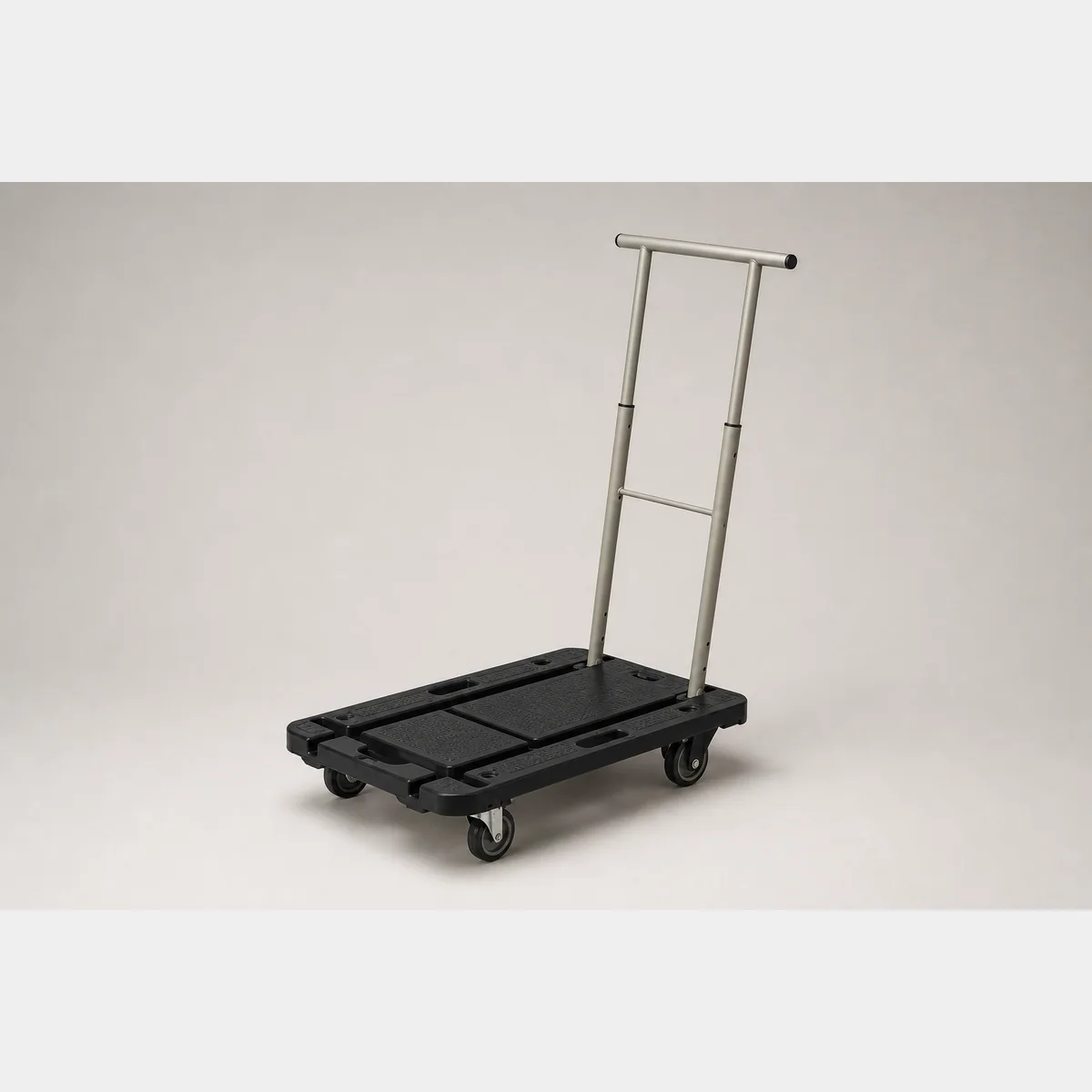 Material Handling & LogisticsProduct reference image
2-in-1 Hand Trolley
2-in-1 hand trolley, Dimensions/Specification: L600xW390xH820 mm; Formal quotation available based on application, specifications and quantity.
- Dimensions/Specification
- L600xW390xH820 mm
 Material Handling & LogisticsProduct reference image
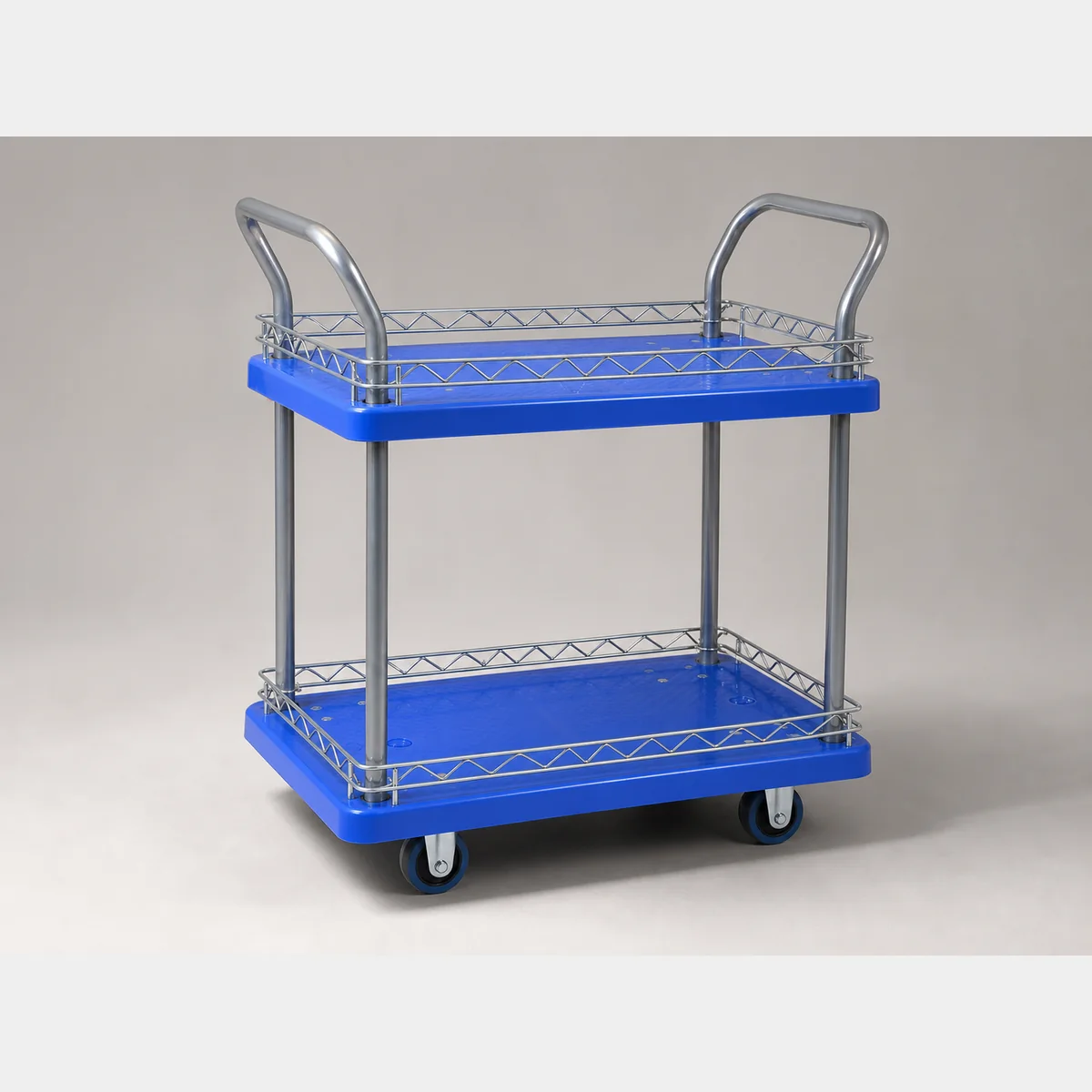
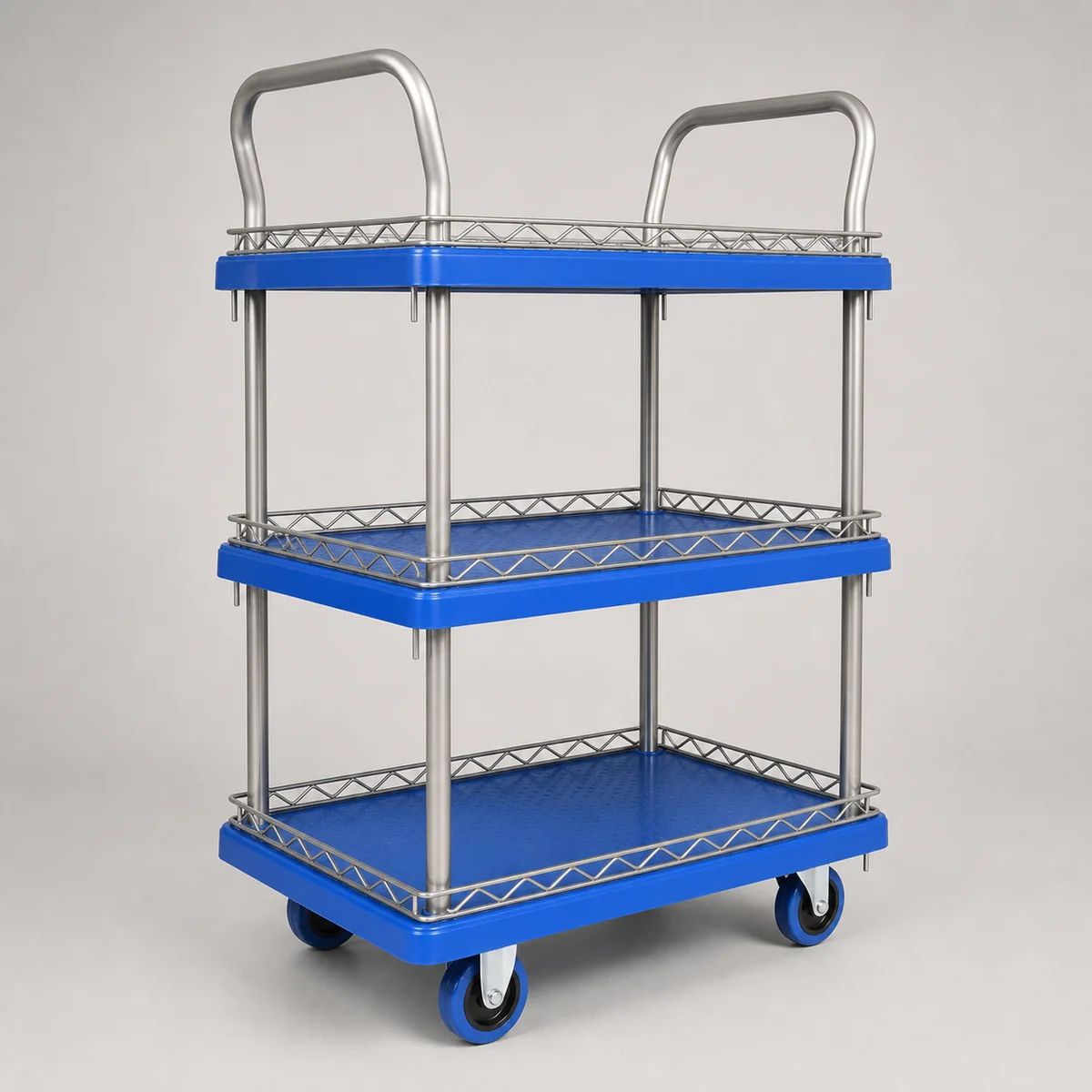
2-tier silent plastic trolley (with side guard rails)
2-tier silent plastic trolley (with side guard rails). (A) Dimensions: L730 X W480 X H950 MM; Net weight: 14.5kg *castor: 100 MM / 17.5kg *castor: 130 mm; Load capacity 150kg *shelf clearance: H550 MM. Formal quotation available based on application, specifications and quantity.
- (A) Dimensions
- L730 X W480 X H950 MM
- Net weight
- 14.5kg *castor: 100 MM / 17.5kg *castor: 130 mm
- Load capacity 150kg *shelf clearance
- H550 MM
 Material Handling & LogisticsProduct reference image
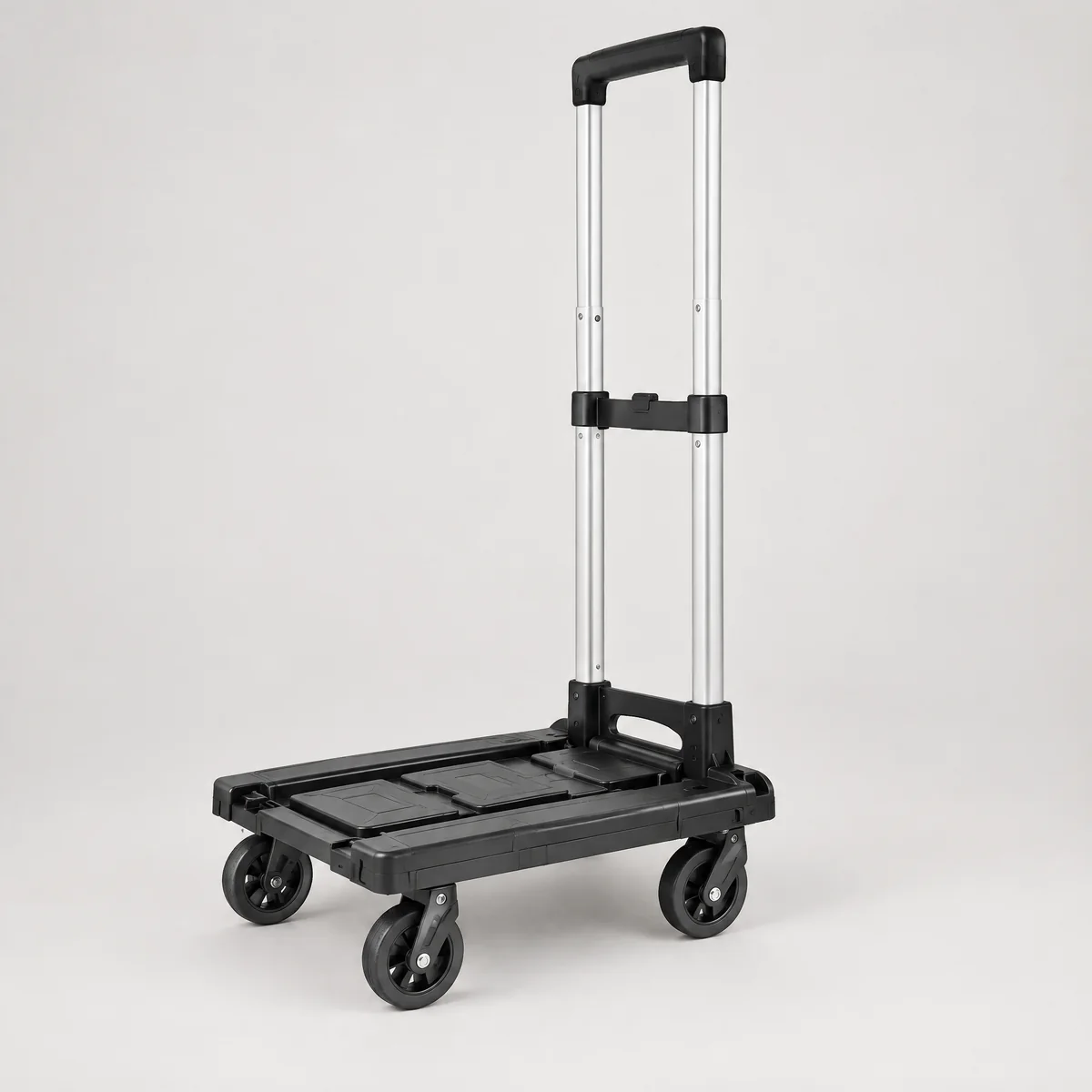
2.5-inch wheel hand cart
2.5-inch wheel hand cart, A: L48xW31xH78.5 cm; B: L50xW31xH88.5 cm; C: L55xW36xH97.5 cm. Please request a formal quotation with intended use, specifications and quantity.
- A
- L48xW31xH78.5 cm
- B
- L50xW31xH88.5 cm
- C
- L55xW36xH97.5 cm
 Material Handling & LogisticsProduct reference image
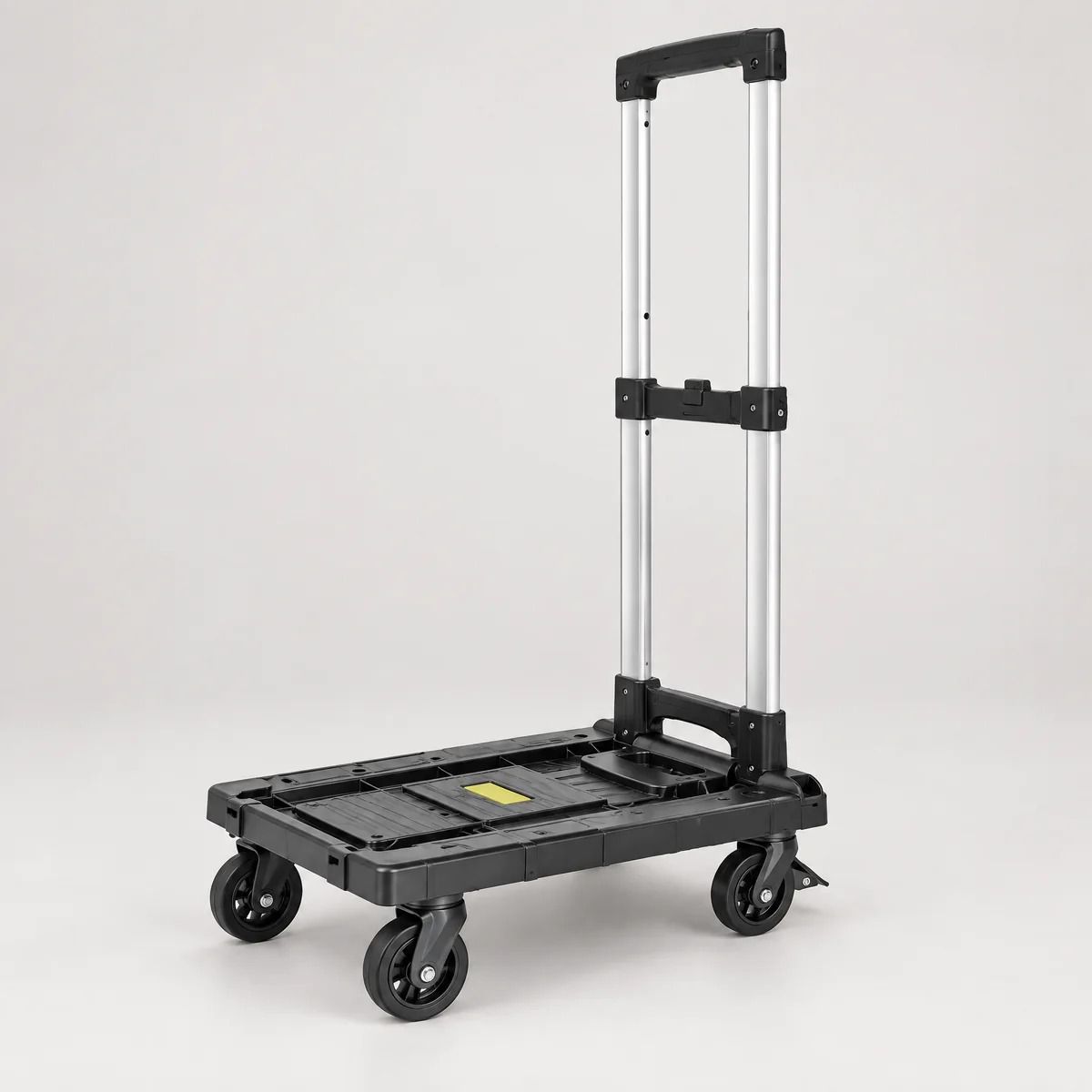
3-inch Wheel Hand Truck (SKU: JRA049)
3-inch wheel hand truck, A: L48xW31xH78.5 cm; B: L50xW31xH88.5 cm; C: L55xW36xH97.5 cm. For a formal quotation, please enquire with intended use, specifications and quantity.
- A
- L48xW31xH78.5 cm
- B
- L50xW31xH88.5 cm
- C
- L55xW36xH97.5 cm
 Shelving & StorageProduct reference image
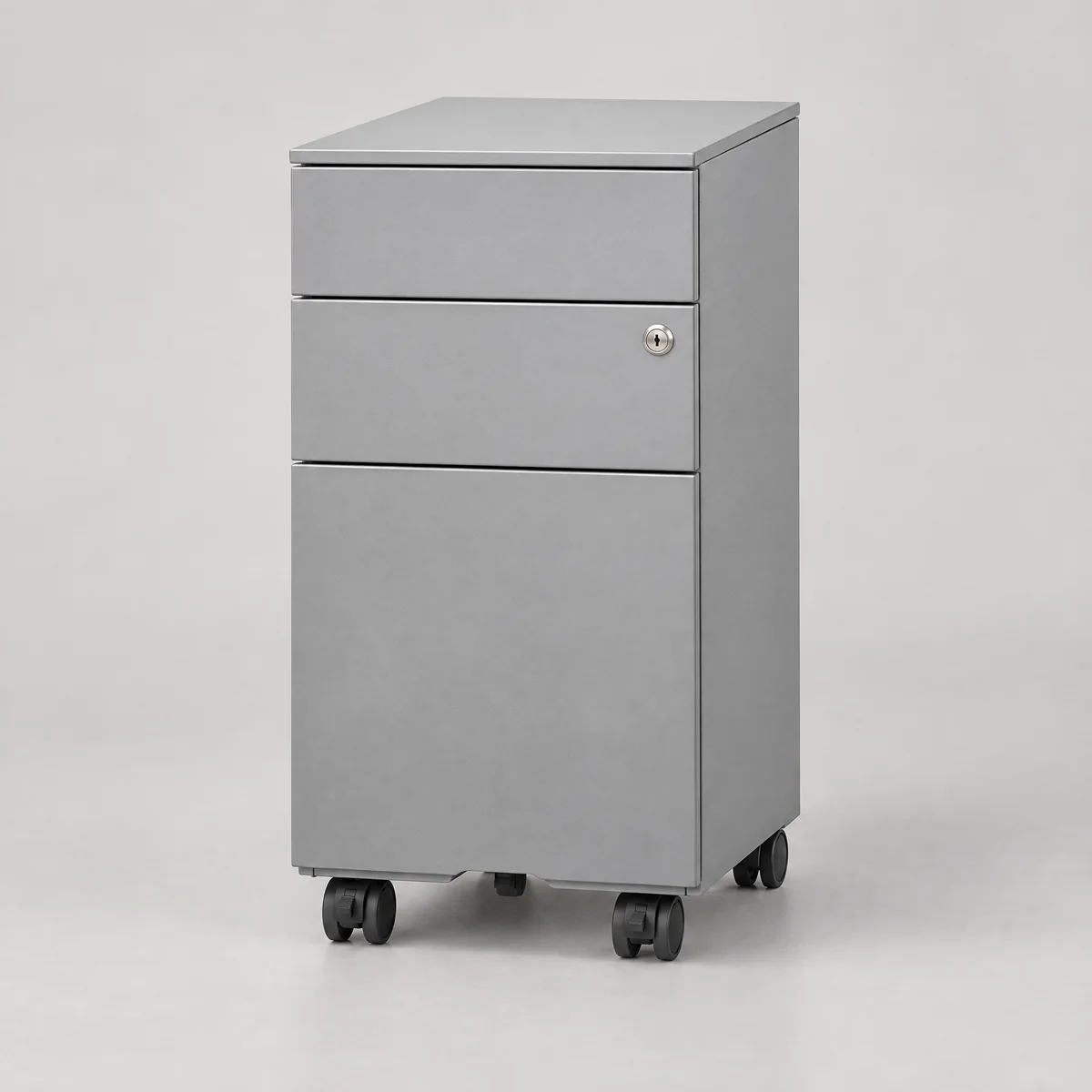
3-tier filing cabinet
3-tier filing cabinet; Size: Length 300xDepth520 × Height 600 mm. Formal quotation available based on use, specifications and quantity.
- Size
- Length 300xDepth520 × Height 600 mm
 Material Handling & LogisticsProduct reference image
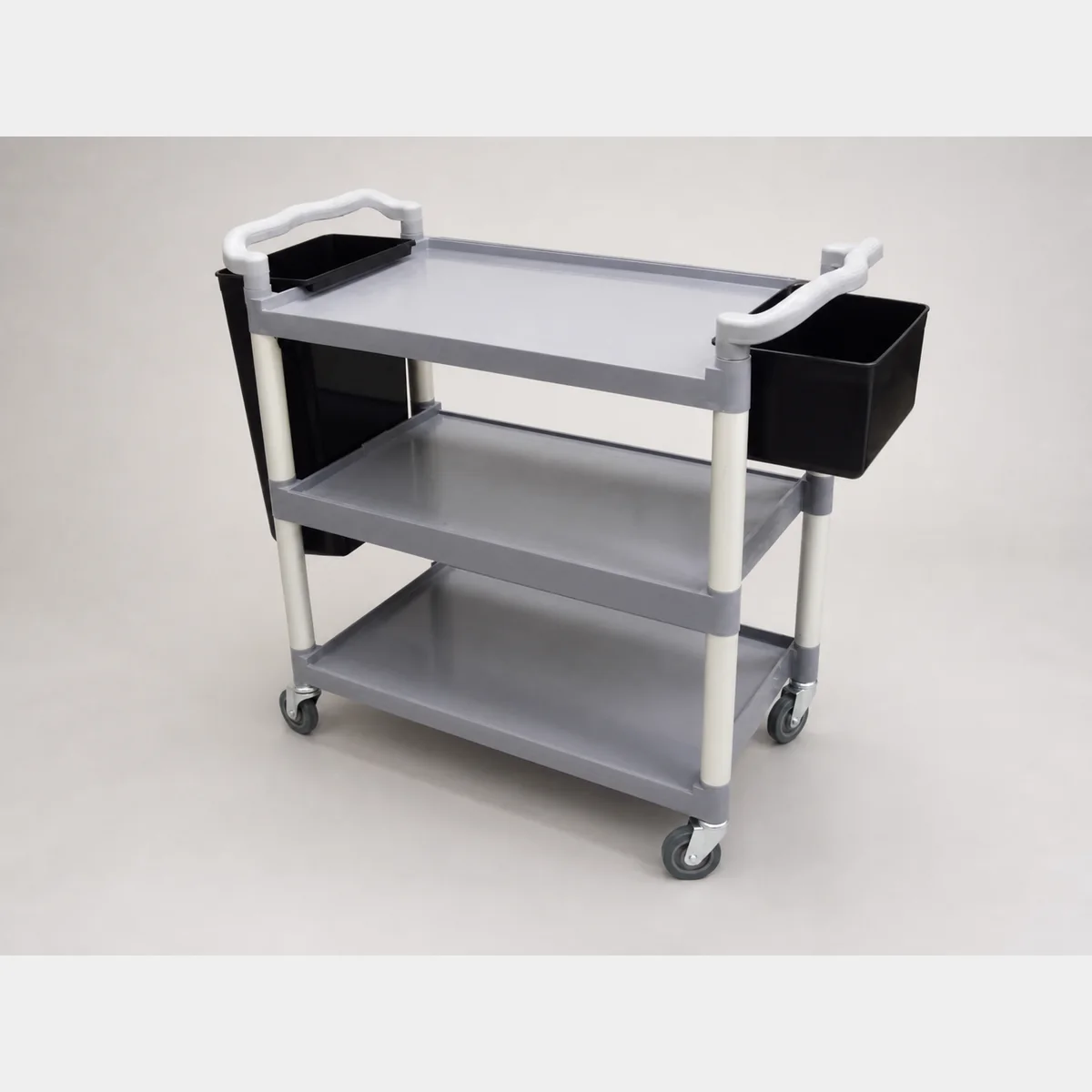
3-Tier Plastic Railed Trolley (S8923-AF)
3-tier plastic railed trolley. Model association requires written confirmation: source records list L730xW480xH950 mm and S8923-BF at L880xW590xH1000 mm.
- Recorded sizes
- L730xW480xH950 mm / S8923-BF: L880xW590xH1000 mm
 Material Handling & LogisticsProduct reference image
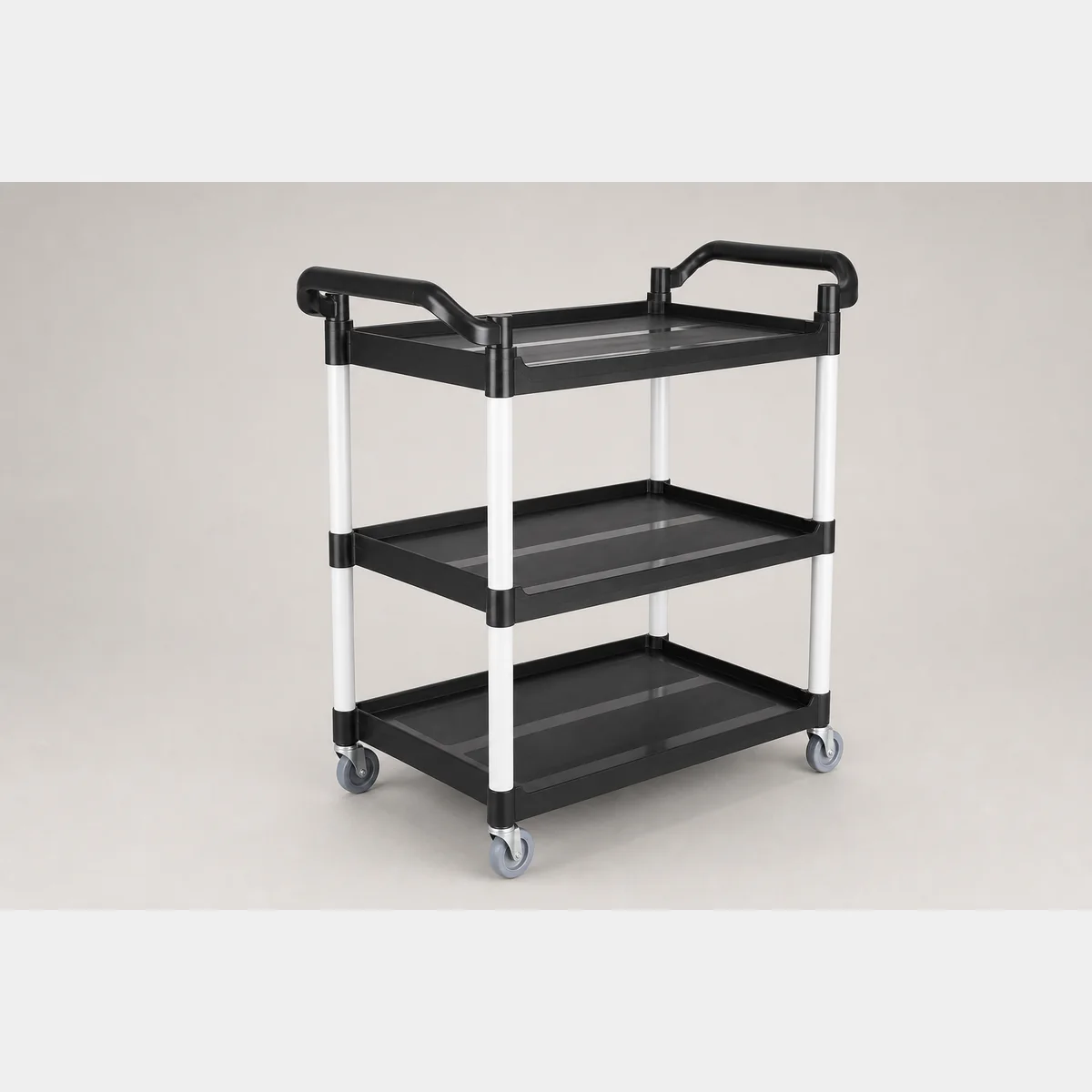
3-tier plastic trolley
3-tier plastic trolley. (Large) Overall dimensions: L103 X W51 X H96 CM; each shelf size: L83 cm x W51 cm / L62 cm x W41 cm; (Small) Overall dimensions: L80 X W41 X H96 CM. Formal quotation available based on usage, specifications and quantity.
- (Large) Overall dimensions
- L103 X W51 X H96 CM
- Each shelf size
- L83 cm x W51 cm / L62 cm x W41 cm
- (Small) Overall dimensions
- L80 X W41 X H96 CM
 Material Handling & LogisticsProduct reference image
3-Tier Plastic Trolley
3-tier plastic trolley. JRA020-C width requires written confirmation because source records conflict between 49 cm and 50 cm.
- JRA020-A
- L80xW42xH93.5 cm
- JRA020-B
- L87xW43.5xH96.5 cm
- JRA020-C
- JRA020-C width requires written confirmation because source records conflict between 49 cm and 50 cm.
Continue with closely related procurement topics
These pages share equipment, operating or decision-stage signals with this guide.
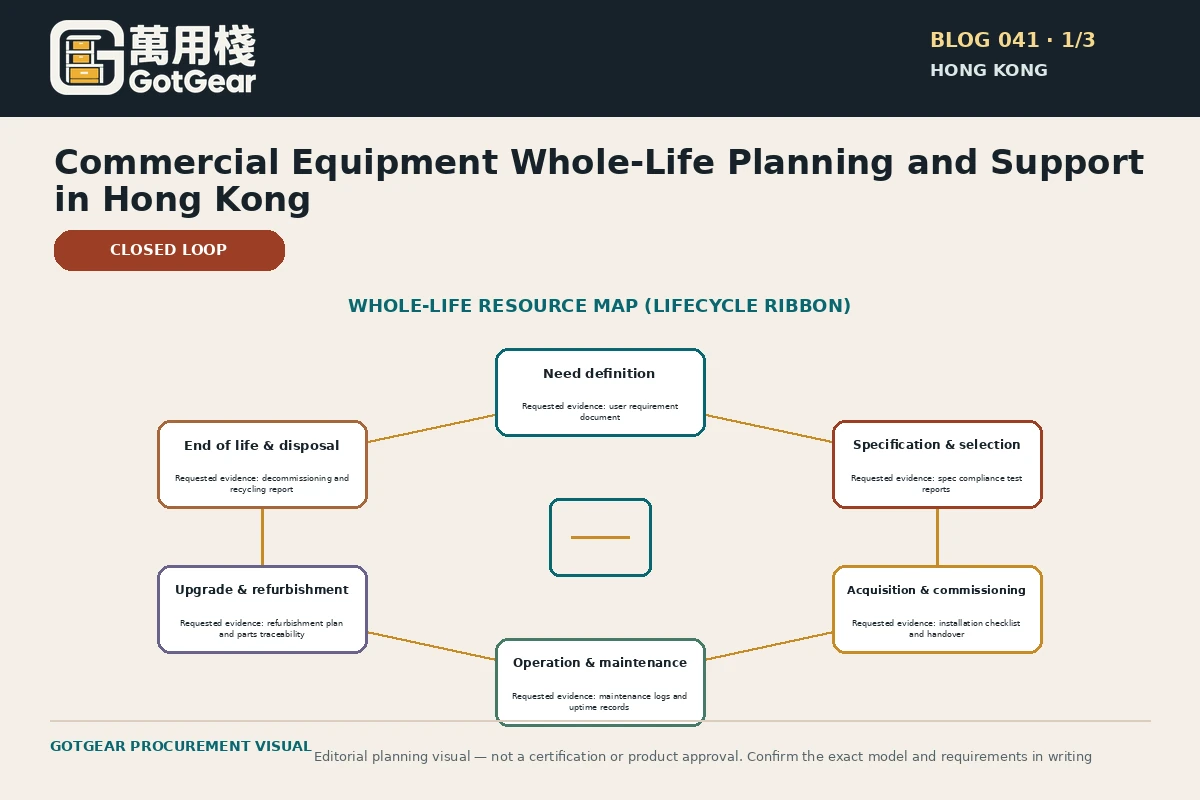
Commercial equipment whole life planning Hong Kong
GotGear explains commercial equipment whole life planning Hong Kong for Hong Kong buyers. See how commercial equipment lifecycle planning Hong Kong supports commercial equipment after-sales support Hong Kong, with practical checks, evidence boundaries and written requirements.
Read the guide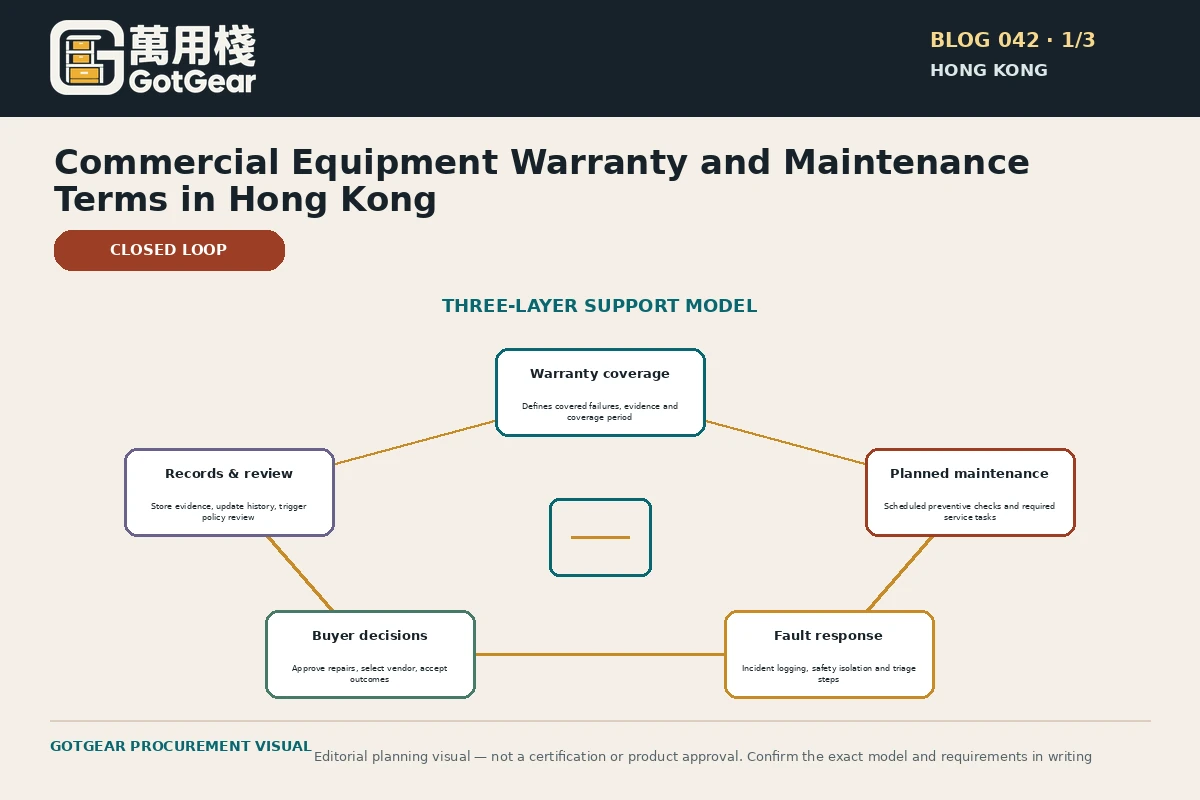
Commercial equipment warranty and maintenance terms Hong Kong
GotGear explains commercial equipment warranty and maintenance terms Hong Kong for Hong Kong buyers. See how commercial equipment warranty checklist Hong Kong supports commercial equipment preventive maintenance plan Hong Kong, with practical checks, evidence boundaries and written requirements.
Read the guide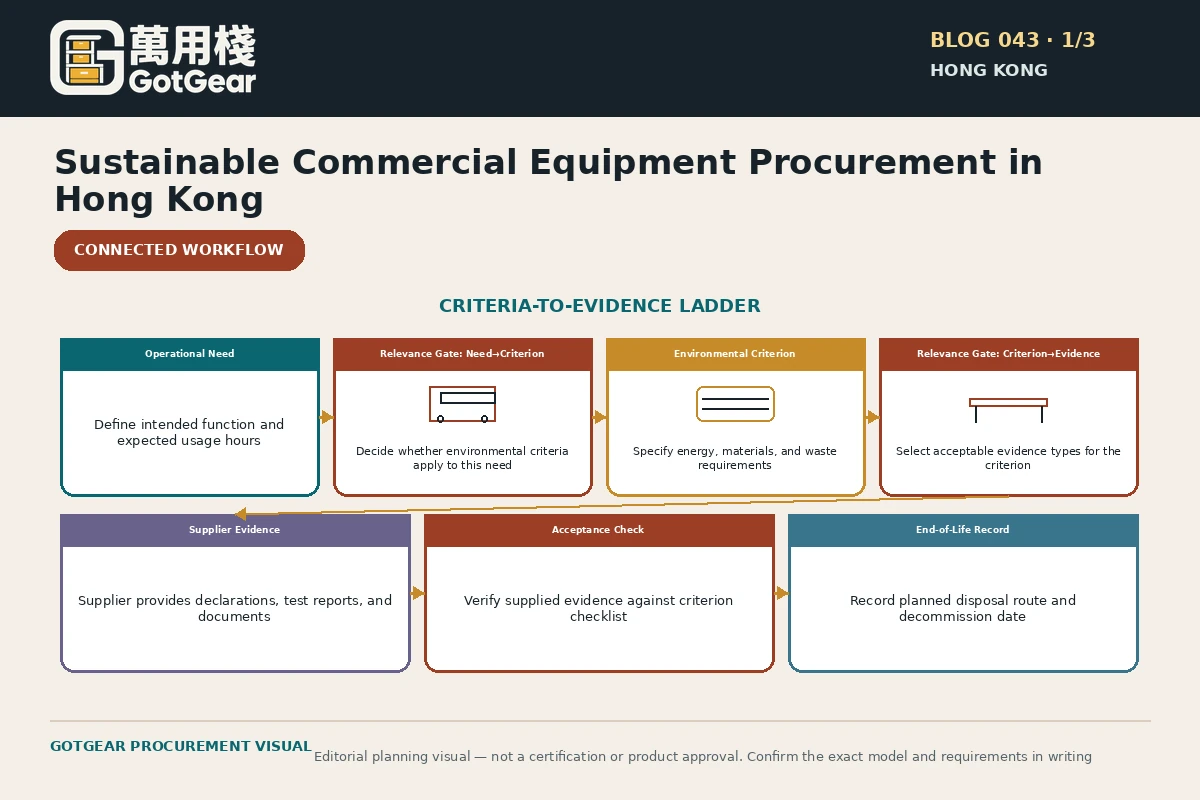
Sustainable commercial equipment procurement Hong Kong
GotGear explains sustainable commercial equipment procurement Hong Kong for Hong Kong buyers. See how green equipment specification Hong Kong supports commercial equipment end-of-life planning Hong Kong, with practical checks, evidence boundaries and written requirements.
Read the guide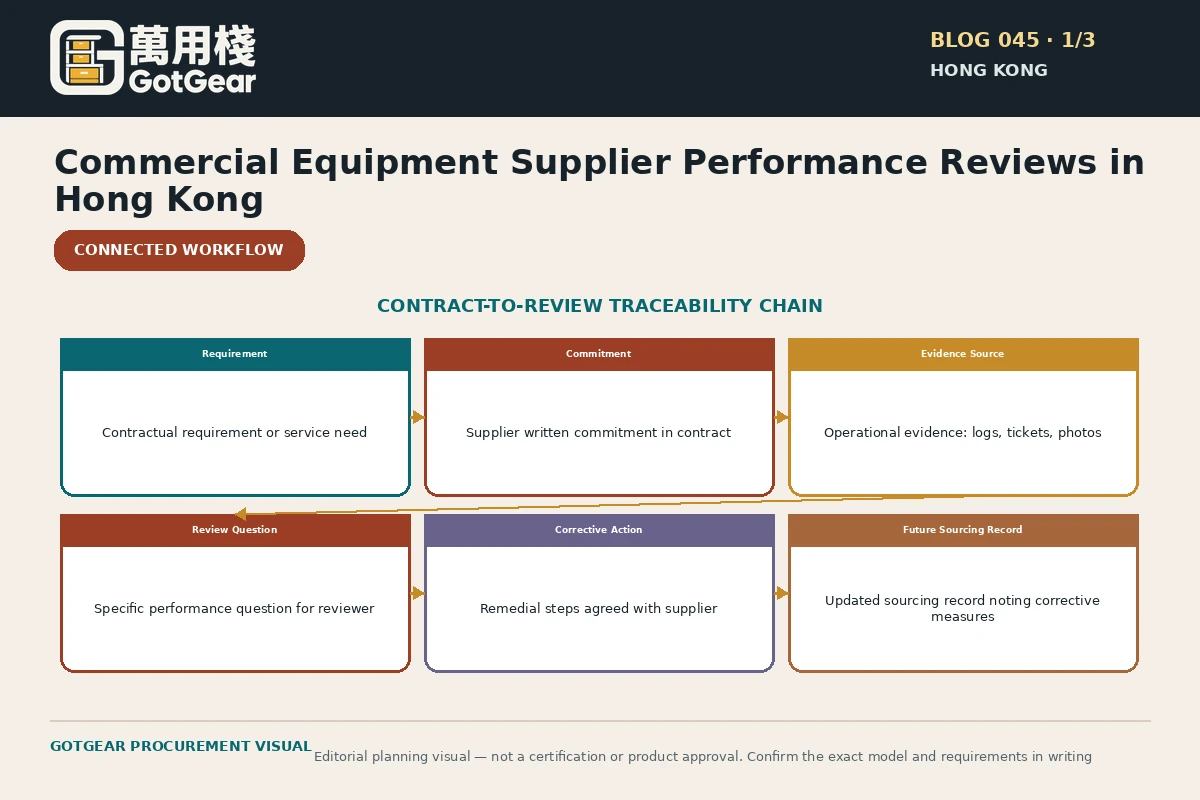
Commercial equipment supplier performance review Hong Kong
GotGear explains commercial equipment supplier performance review Hong Kong for Hong Kong buyers. See how commercial equipment service level agreement Hong Kong supports commercial equipment maintenance response time Hong Kong, with practical checks, evidence boundaries and written requirements.
Read the guideRelated topic indexOpen more English procurement pages14 topics
Browse additional equipment families, applications and procurement questions relevant to these operating requirements.